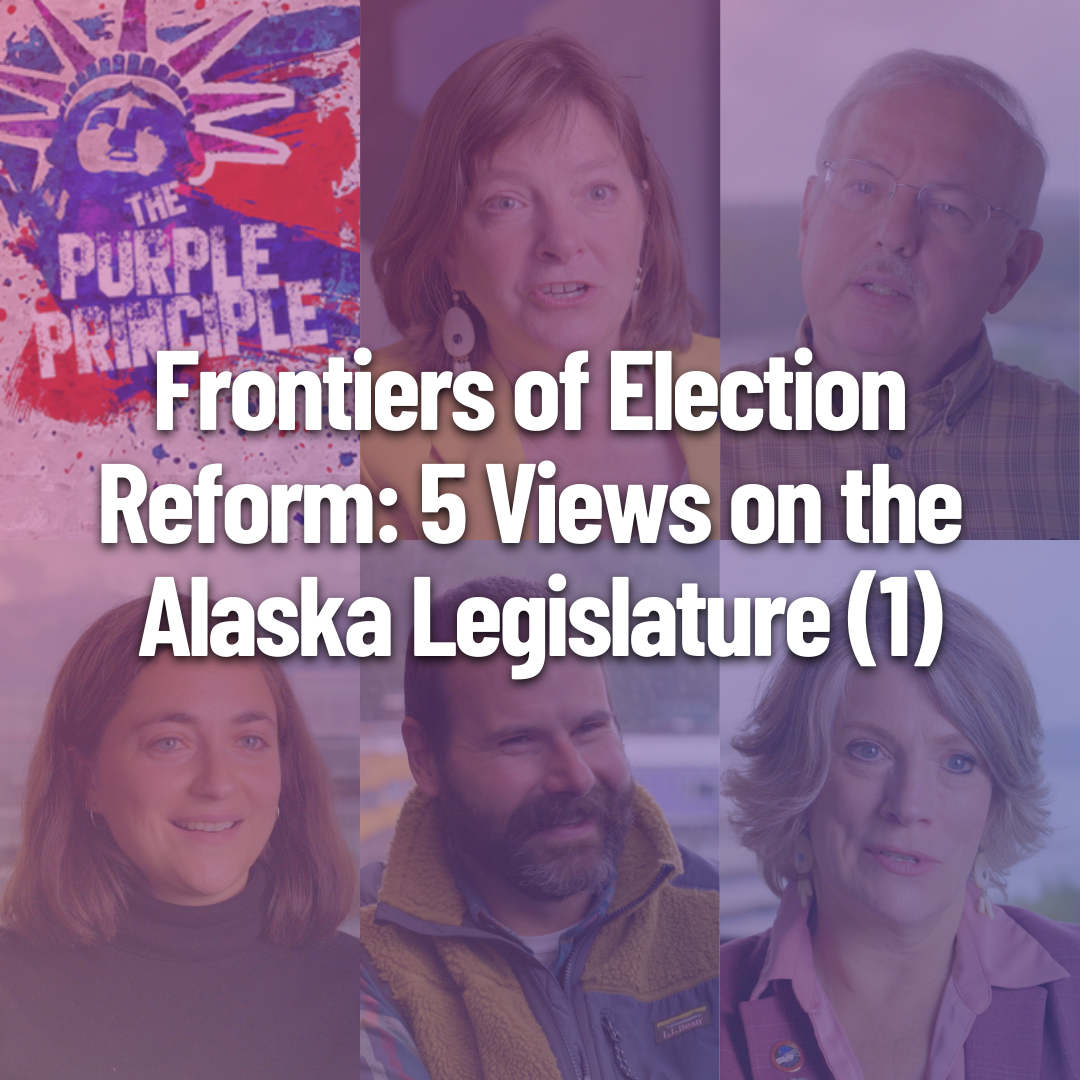
“The notion of getting rid of a closed primary system in Alaska appealed to me instantly,” says former Alaska House Speaker Bryce Edgmon who has represented Bristol Bay and parts of the Aleutian Islands for nearly two decades. “It overrode right there almost on the spot any trepidation I might have about having to rank candidates or anything else that would eventually become part of the ballot measure that narrowly passed in Alaska.”
Rep. Edgmon is referring to Alaska’s first-in-nation passage of a final or top four voting system with a unified open primary plus ranked choice general election. In this episode we examine the dynamics of the first state legislature in the country to have been elected by this system in 2022, even as a ballot measure to repeal the system has been put before Alaska voters in 2024.
We also discuss the dynamics of the Alaska legislature with Anchorage Daily News Reporter, Iris Samuels, and University of Alaska Southeast Political Science Professor, Dr. Glenn Wright.
“Alaska is fairly unique in that even before this election reform, we’ve had bipartisan and tri-partisan coalitions in the House and Senate,” says Samuels, who covers the Juneau State House. “But it has reinforced that phenomenon and made it possible for elected officials to envision doing that and not experience repercussions from within their party and from voters.”
“If you talk to incumbent politicians,” explains Dr. Wright, “ they will tell you that they’re less concerned about the primary challenge now– that before the reform that was in the back of their mind. And they were thinking not about what do voters in my district want but what do party primary voters in my district want.”
AFL-CIO President Joelle Hall has also observed what might be a similar deepening of Alaska’s cross-partisan tendencies in the two years since passage of the top four reform.
“One of the ways that we are really different is that we have always come to a bipartisan coalition at the end of every decade,” observes Hall, a legislative lobbyist for nearly three decades. “Redistricting happens. Then slowly the two parties claw back to roughly even. So it’s accelerated what is already a normal path in Alaska where we gravitate towards these coalitions.
But our final guest on this first of two Alaska episodes, Rep. Alyse Galvin of Anchorage, cautions that these post reform dynamics have not yet translated into legislative action. That’s partially because senior house leadership has blocked several bipartisan legislative efforts, while others were vetoed at the executive level.
“if we don’t allow this to play out a bit more, I’d say one more cycle, maybe two,” says Galvin, previously a two time candidate for the US House, ”then we’re really missing a big chance to get things done that will give Alaskans hope.”
Tune in for five different perspectives on the first legislature in the country elected by final or top four voting as citizens in four other US states (NV, ID, CO & MT) consider passing the Alaskan model for less divisive elections toward more collaborative governance.
The Purple Principle is a Fluent Knowledge production. Original music by Ryan Adair Rooney.
watch now: Best Of Episode Highlights
See/hear from all five of our expert guests in this “Best Of Podcast Video.”
We will be posting new content each week to The Purple Principle YouTube channel, such as shorts, highlights, and previews for our podcast episodes. Short form videos also now available on our TikTok.
Opening
Bryce Edgmon (Guest): My first two years of speaker was 2017 and 2018, I went to national speakers conferences and got to learn what’s happening in their states
Robert Pease (Host): Bryce Edgmon was the first Alaska native to serve as speaker of the house. He’s represented the 37th district including parts of the Aleutian Islands in the Alaska State House for nearly two decades.
Bryce Edgmon: And just to see the shock and the disbelief of the 50 states Are you kidding me? Say that again. You actually have a coalition and I said, yeah, it’s largely dominated by Democrats, but we, we’ve got four or five Republicans and we’re functioning quite well.
Robert Pease: The frontier state of Alaska is also on the frontlines of electoral reform. As regular listeners to this show will know, Alaska was the first state to pass final or top four voting back in 2020. That was a historic breakthrough. Then in 2022 Alaska was the first and so far only state to hold an election under this system which has since become the North Star for other states seeking pragmatism in state government and the US Congress through election reform.
Robert Pease: But how has Alaska fared so far under this new voting system where legislators no longer fear being taken out in a low turnout party run primary from a far left or right candidate, and where general election candidates must find a broader base of support.
Robert Pease: We’ll hear from Bryce Edgmon on these questions and also from fellow house member Alyse Galvin…
Alyse Galvin (Guest): We’re independent thinking. And we up until fairly recently, and as in the last decade or so, we haven’t paid any attention to national politics.
Robert Pease: We’ll also hear from Iris Samuels, the Anchorage Daily News reporter who covers the Alaska legislature.
Iris Samuels (Guest): It’s much more personal here.
Iris Samuels: And I think that that lends itself to people voting not according to party affiliation, but according to an ability to remember a conversation that they had with a particular candidate…
Robert Pease: We’ll also get some vital context from Dr. Glenn Wright, a political scientist at the University of Alaska Southeast in the state capital of Juneau.
Glenn Wright (Guest): I think of Alaska is a place that had really sensible state level politics for a really long time.
Glenn Wright: And it’s worrisome to see some of the kind of circus that emerges when you see this sort of divergence and maybe relative extremism amongst the political parties.
Robert Pease: And some inside insight from Joelle Hall President of the AFL CIO in Alaska on the complexities of supporting and lobbying legislators in a ranked choice environment.
Joelle Hall (Guest): So you have to play four dimensional chess on every single race, every single time. It’s infinitely more challenging.
Robert Pease: I’m Robert Pease and this is The Purple Principle, a podcast on the perils of polarization, looking at the nation’s least partisan state where 60% of voters are registered non-partisan or unaffiliated and where bi or tri partisan coalitions with Democratic, Republican and Independent legislators often form and function. But hyper partisanship respects no boundaries. And our tribal national politics has been creeping into Alaskan media diets and very likely bending some of the 49th state’s indy minded viewpoints.
Robert Pease: Can this top four voting system with an open unified primary and ranked choice general election help Alaska stay pragmatic and collaborative? What can we learn from this first term of a state legislature elected by a top four election system in 2022 and facing re-election through the same system in 2024?
Robert Pease: Let’s start our discussion off with Bryce Edgmon, former speaker and current independent member of the Alaska house. Our Executive Producer, Carol Wingard, caught up with Rep. Edgmon in Anchorage recently. He was on short layover between flights in a state that relies more on planes than cars but is famous for a much more traditional form of transport.
Axe : Welcome to the Iditarod
Interview One: Bryce Edgmon
Bryce Edgmon: So my name is Bryce Edgmon. I’ve been in the legislature since 2007, which should I get reelected this fall would put me at the 20 year mark once the two year term ends. So I’ve been a legislator for, I think it’s four or five gubernatorial administrations on both sides of the political spectrum. I’ve served in Republican caucuses. I’ve been speaking of the house for two terms. I’ve been in a coalition for three terms, so I’ve kind of had my toe in the water in just about every sort of atmosphere one could imagine in the Alaska legislature.
Bryce Edgmon: When I first ran in 2006 was the year that Sarah Palin ran for governor, and Sarah Palin has ties to my hometown of Dillingham.
Bryce Edgmon: And to jump to the punchline, I ended up having to go through a coin toss because my opponent and I were neck and neck. Both of us had 724 votes, I think it might’ve been, but that was because the closed Republican primary system that was in place in 2006, people had to and had a number of people in Dillingham say, oh, we just had to vote for Sarah and couldn’t vote for you because we knew you were going to make it to the general and be okay. But as it turned out, I almost didn’t make it to the general. And so I feel like I’ve been personally impacted by rank choice voting.
Bryce Edgmon: And that’s what happened amidst every journalist in the state, every TV camera, 300 people, just packed room environment here in Anchorage. And the other candidate who was a 22 year veteran who I ended up beating picked heads, and the coin came up tails. And it’s just that simple. And I like to tell people, I still don’t know whether I’ve won or lost yet, but I’m working on it.
Carol Wingard (Executive Producer): That’s a great story. It sounds like a pretty unique, probably like a lot of facets of Alaskan politics.
Bryce Edgemon: Yes. Yes. And I would not wish it upon anybody. It was, there’s a lot of tension involved and put a lot of money and effort into a campaign. And for me to unseat somebody who’d been around for so long, I worked super hard going to some communities as many as six times. And when you’re at rural Alaska, you have to fly to a community. So to have lost it by the skin of my teeth was not very appealing.
Carol Wingard: Tell us about the district. You represent District 37, is that right?
Bryce Edgmon: Yeah. So the district I represent, if you could imagine where the Aleutian Islands intersects or connects with the mainland of Alaska. Just to give you a visual, that part of southwest Alaska, I represent the Bristol Bay region, which is the largest sockeye salmon fishery in the world, all the way down the chain to an Alaska Dutch harbor with the deadliest catch saga, well-known in that area and the largest Pollock fishery in the world. So very diverse district centered around commercial fishing and not connected by the road to any of the urban parts of Alaska. And for me to go from one community to the next, I have to get into a small airplane.
Carol Wingard: Yeah. Now, when did you first hear about open primaries ranked choice voting…
Bryce Edgmon: I think it was 2019 when I first heard about it, maybe it was 2018, but the notion of getting rid of a closed primary system in Alaska appealed to me instantly and overrode right there almost on the spot any trepidation I might add about having to rank candidates or anything else that would eventually become part of the ballot measure that narrowly passed in Alaska. But the moment I heard about it, the moment, I was almost committed to seeing it through and doing what I could do to make sure that we could do away with sort of this choke hold in Alaska politics called a closed primary system.
Carol Wingard: Any noticeable changes in how the legislature operates or is it almost too soon to say? Because I think one of the points about this system is not necessarily affecting who is elected but influencing how people behave after they are elected.
Bryce Edgmon: Well, I would respond to your question about how this has impacted the legislature by stepping back a little bit and characterizing the demographics. In Alaska, we’re a state where we have some areas of the state that are losing population. And we have a couple areas in the road system or primarily one of ’em that are growing exponentially in terms of population growth. That’s the Matsu Valley. So the Matsu Valley and Kenai in some places at Fairbanks are seeing a lot of population growth. But with it, we’re getting people moving into Alaska. I can only sort of hypothesize this romantic notion of moving out in the wilderness and living in an independent lifestyle, but also voting Republican and voting is sort of an extreme fashion, if you will, a lot of those voters. So in the nearly 20 years that I’ve been Alaska legislature, we’ve seen the number of representatives from the Matsu Valley increase through the two or three different cycles of redistricting.
Bryce Edgmon: But with ranked choice voting, We’re starting to see, at least in my view, a little bit of softening of some of those more conservative legislators coming out of like the Matsu Valley because they have to be in competition possibly with other Republican legislators in the general election, have to rely on moderate, perhaps center left, even Democrats to get across the finish line. So I think the jury’s still out in terms of across the board impact, but there are signs that it’s having an impact in terms of moderating two or three seats across the state, which is enough in a state that has traditionally been ruby red, if you will. Thanks largely to a closed Republican primary system that’s now becoming purplish in some areas. And I think it’s made the legislative process so much stronger, so much healthier and more conducive to what the general public in the state really wants.
Carol Wingard: Is there something about Alaska that leads you to form coalitions?
Bryce Edgemon: Yeah, and I think the full circle goes back to rank choice voting and all this because Alaska truly is an independent state where you will get someone supporting to legalize marijuana on one hand, but at the same time voting for an conservative member of the legislature or a statewide office or what have you. That’s just the nature of the state and I think ranked choice voting if we’re the canary in the coal mine, if you could say that. I couldn’t think of a better state to really be sort of at the vanguard of what I hope is a pretty common practice around the country in the future.
Bryce Edgmon: But that going back to being a speaker before and interacting with other presiding officers around the country and talking to my counterparts in the Senate who here in Alaska who do the same thing, talk to other senate presidents around the country and being able to tell them that, look, we’ve been able to take a lot of the divisiveness, the bitterness, sort of the partisanship out of politics to a certain degree and really been able to work more in the middle, which is where most politics end up anyway, without having to go through all the rancor and the battling.
Bryce Edgmon: That would take us into special session because Alaska is a state that up until just a handful of years ago, depended almost exclusively on the wellbeing of the oil industry and whatever the price per barrel might be at a particular time in order to fund our budget. And then having to pay a permanent fund dividend, But to make all of that work in an environment where you had one side bitterly standing off against another side in politics, which I think ranked choice has helped soften.
End Interview One
Robert Pease: Representative Bryce Edgmon there, a 20 year veteran of the Alaska House of Representatives, including two terms as Speaker of the House and a key leader of a tri-partisan coalition of democrats, independents and Republicans in that period. Rep Edgmon believes the top four voting system currently in place in Alaska could help maintain or deepen political collaboration in state government if it is not repealed by a 2024 ballot measure brought by the far right. Our producer, Carol Wingard, reached out for a different viewpoint on this question from another regular presence at the Juneau State House.
Interview Two: Iris Samuels
Iris Samuels: My name is Iris Samuels and I’m a reporter with the Anchorage Daily News, and I cover primarily state politics.
Carol Wingard: Great. So Iris, here we are sitting in Anchorage, Alaska
Carol Wingard: One of the things that we understand, the final four where this voting system is intended to do is to sort of change the behavior of elected officials once they’re in office but in talking to people that you report on, is there a sense that things have changed?
Iris Samuels: Yeah, I think that looking at the legislature is very interesting in considering whether there has been a change just because there are 60 seats. So that’s a lot of seats in which to consider. How ranked choice of voting has changed things compared to congressional seats that we only have two US senators, one US House member in Alaska, and I will say Alaska is fairly unique in that we have had in the past, even before we had this election reform, we’ve had bipartisan and tri partisan coalitions in the House and Senate where members of both the Democratic Party and the Republican Party have gotten together to form a coalition majority to govern either chamber. And that’s because in part, I think you can sort of divide the Republican party between people who are very hard line and really don’t want to work with members of the other party, and then people who are more collaborative.
Iris Samuels: And that split within the Republican party coupled with the fact that they really didn’t have close to a supermajority in one chamber or the other made it difficult for them to form a majority of just Republicans. But I will say ever since we’ve had this election reform, it’s reinforced that phenomenon that existed already in Alaska and made it very possible for elected officials to envision doing that and not experience repercussions from within their own party and from voters. And I think that’s most felt with the open primary, the closed primary that proceeded the current system in Alaska meant that the people that were going to the ballot in the primary election were typically the most partisan voters. And so that meant that a more right-leaning Republican was far more likely to win the Republican primary. Now you have a lot of evidence that when people are going to the ballot at the primary, because it’s just one ballot, no matter what party you belong to or if you don’t belong to a party, there are people who are voting for representative Mary Peltola and then a Republican candidate for their legislative seat. So we do see evidence that split ticket voting is maybe more common than people might expect.
Carol Wingard: Do you think that is something a little unique to Alaska?
Iris Samuels: Yeah, Alaska’s population is fairly small and legislative districts in particular are very small in terms of population so people are very likely to personally know the people that represent them, to have them knock on their door to have opportunities, all kinds of opportunities to meet them in person. And I think that that does translate to a bit of a different system here in Alaska compared to other states.
Out to Mid-Roll
Robert Pease: We’ve been speaking with Anchorage Daily News Reporter Iris Samuels. She’s been following this very first term of the Alaska legislature under the Final or Top Four voting system that most Alaskans refer to as ranked choice voting. And she’s observed an added layer of protection for legislators who do break with their party on an issue or two and reach across the aisle or, in the case of the Alaska Senate, reach into that center aisle, which this past term included a tripartite coalition of pragmatists working together on critical issues,while ignoring other issues not as critical and more polarizing. For context on this uniquely Alaskan political tradition Associate Producer Mary Claire Kogler traveled to Juneau, the state capitol, also home to the University of Alaska Southeast where she met with their political science department.
Interview Three: Dr. Glenn Wright
Glenn Wright: So I’m Glenn Wright. I am sometimes only partially inaccurately described as the University of Alaska Southeast Political Science Department. I teach poli sci here in Juneau. And I think what’s relevant here is that I do a little bit of work on ranked choice voting, and I’ve done some work on Alaska’s new election system.
Mary Claire Kogler (Associate Producer): And you were telling me you’re not originally from Alaska…
Glenn Wright: Yeah, I grew up in New England and I came up here in the late nineties. I came to Alaska in the late nineties. I was an undergraduate student at the University of Alaska Fairbanks and got my bachelor’s degree up there. And then I actually have a secondary teaching degree from the university here in Juno, and spent a couple of years teaching middle school and high school kids out of Alaska before deciding to go to graduate school and got my PhD political science, and then came back in 2011. And I’ve been working here at the University of Alaska Southeast in Juneau since that time, whatever that 13, 14 years, something like that.
Glenn Wright: And so I’ve wound up doing a lot of state politics and I’ve done some work on politics around the state government budget.
Glenn Wright: But one of the things is just that if you talk to incumbent politicians, they will tell you that they’re less concerned about the primary challenge now, that before the reform that was in the back of their mind and that they were thinking not about what do voters in my district want, but what do party primary voters in my district want? And therefore, they were thinking about policy in a way that wasn’t necessarily in keeping with the preferences of the people that they represent in the legislature.
Glenn Wright: So we have a state house and a state senate. And it has often been the case that in the past that one chamber or the other or occasionally both have been controlled by a coalition which includes politicians of more than one party. And in Alaska that means Democrats and Republicans. But we also have a lot of maybe saying we have a lot of independents in office is a little bit strong, but we have a number of independents in office, and it’s often been the case that we’ve had coalitions that include Democrats plus Republicans, plus maybe some independent legislators controlling one body or the other in the legislature. And one of the things that was really visible in this last election cycle after the implementation of Ranked Choice voting is that a coalition emerged in our state senate that wouldn’t have existed otherwise. That is a cross-party coalition.
Glenn Wright: And then on the other hand, folks on the left agreed not to raise proposals for new taxation.
Glenn Wright: The State House is also interesting. The House Coalition is really a Republican led coalition, unlike the Senate, which is led by Democrats, and it is a conservative coalition, there’s no question, but it also includes a number of prominent rural legislators of all parties.
Glenn Wright: And the way that has sort of manifested itself in terms of policy is that the House is interested in passing legislation that’s conservative and is popular with conservative voters. But at the same time, that coalition includes these prominent rural legislators from parts of the state that lack a lot of public infrastructure. And so it’s sort of a story about everybody gets a little bit of what they want. And it’s been sort of a pleasantly boring couple of years in state politics has really been nice. The previous couple of years was were circus-like in some really unappealing ways. It was a little bit of a soap opera, and I think it’s nice not to have the soap opera anymore.
Mary Claire Kogler: The boring is good…
Glenn Wright: Boring is really good. Yeah, happy to have the boring.
End Interview Three
Robert Pease: Dr. Glenn Wright on the beauty of boring, at least in our politics, where we’d see legislators perform a lot less and govern a lot more. If you’ve been listening to this season long series on The Purple Principle you know 4 other states are trying to replicate the Alaska model of election reform through ballot measures this year while DC, Arizona, Oregon and South Dakota attempt to pass major reforms as well. That means many scholars, journalists, election reformers, legislators and lobbyists have been wondering about the dynamics within the Alaska legislature in this most recent 2023 to 24 session. Our producer Carol Wingard spoke to a veteran Alaska lobbyist about the different dynamics of supporting candidates and issues in a top four or ranked choice voting environment.
Interview Four: Joelle Hall
Joelle Hall: My name’s Joel Hall. I’m the president of the Alaska AFL-CIO.
Carol Wingard: And tell me a little bit, what is that role for you?
Joelle Hall: Well, the AFL-CIO is a Federation of Unions. It is not a union itself, it’s an association of unions. We have about 50 unions in our federation here in Alaska. So we’re an umbrella organization. It’s easiest to think about it like the Chamber of Commerce is to business. The AFL-CIO is to unions. We represent them in public policy, we represent them in electoral work and we represent them in issues like this. How do you elevate the things that are important to working families and talk about the issues that are working families are facing.
Carol Wingard: Great. We’re sitting here in Anchorage, Alaska, and what is your story? How did you get to Anchorage and what has your professional journey been like?
Joelle Hall: So I moved lock, stock and barrel in August of 1990. About a week after I got here, I went to go sign into my National Guard unit and the guy sitting across the room from me had sparkly blue eyes and a really devilish little smile.
Joelle Hall: And I’ve been married to him for 32 years. So that was quick. We knew right away. And so I did fall in love with Alaska, but it’s easier to fall in love with Alaska when you fall in love with an Alaskan. So I started pretty quick with my adventure here in Alaska. The short version of the story is the University of Alaska has an internship program where you can go work in the legislature, and so I went in 1993 to work in the legislature and it was my first time getting really close to the legislative process and I really found that I enjoyed the work, and it’s a small knit group of people. It’s only 60 lawmakers in Alaska.
Carol Wingard: You mentioned it’s easy to fall in love with Alaska when you marry or fall in love with an Alaskan, but what do you love about Alaska? How is it different from other places you’ve lived before?
Joelle Hall: Well, of course the access to nature is what most Alaskans will talk about that can come in varied forms. You could be a snow machiner and you like to just get your sled in the back of your truck and go out and ride around. There’s so much wilderness. You could be a fisher person and it’s the access to a wild resource. We probably have to be the world’s largest consumer of wild food. We hunt our food, we fish our food. This is still not a hobby. Enjoyed by a few. It is still kind of the way that most people live their lives. And I tend to be in the hiking crew. I like to go hiking a lot so I don’t have to drive two hours on a freeway to get to someplace to go hiking. I literally find that the mountain’s on my way home. I stop there, I climb it, then I go home and continue on with my day.
Carol Wingard: Great. Now as the head of the AFL-CIO, obviously your key concern is working families, right?. What are some of the top issues that you feel working families are facing here today?
Joelle Hall: Well, the areas that we focus on, it’s a little bit like I’m a hammer and everything looks like a nail to me. Every single, I have a lot of remedies that are public policy related. We are not investing in ourselves as a society through state government. We have had somebody leading us for the last eight years who has an austerity mindset and their goal is to make Alaska smaller and less than it used to be. I just simply reject that notion that we should be smaller or less than we used to be. I believe this is a wonderful place and we have to turn around and we’re in a critical time in our history where the way we have funded our lifestyle for 50 years is coming to an end and we have to start thinking creatively about how we’re going to fund our lifestyle for the next 50 years.
Carol Wingard: Great. Okay. Good to know. So in your position as head of the AFL-CIO, I’m imagining you interact quite a lot with government officials. Can you just describe your interaction, say with the legislature…
Joelle Hall: I work with the legislature regularly. Of course, we have a full-time lobby. We have a lobbyist at the F-L-C-I-O. A lot of our affiliates have lobbyists. We watch the legislature very carefully. We monitor every single bill that’s introduced and try to figure out whether it’s going to help or hurt working families. And then we respond appropriately if it’s going to hurt working families. So we work with people from all parties and all walks of life and in the majority and the minority all the time, every single cycle. I’ve been working in Juno off and on for, I don’t know, 30 years. So there’s a lot of dynamics that go into working in the building.
Carol Wingard: Great. So one of the things that we wanted to talk about is obviously the Final four voting program here in Alaska. When did you first hear about ranked choice voting or open primaries?
Joelle Hall: A man in Alaska named Scott Kendall came to talk to Vince, my predecessor and I about it before it was on the ballot.
Carol Wingard: And what did you think? Had you heard about this elsewhere before or was it a new concept and what did you think about it?
Joelle Hall: Oh, it was a new concept. So I was opposed to ranked choice voting when I first started in the 2020 cycle, the AFL-CIO itself, it took two thirds of our delegates to vote in the affirmative to endorse a statewide issue, whether it’s governor, member of Congress or a ballot initiative. And we did not get to two thirds in 2020. So we did not take a position in 2020 on this. I was initially very quite concerned because I was a little worried about how it would affect the people that I knew held my values and how much work it would be to protect those people, because that’s my job is to protect the people who care about working families.
Carol Wingard: And why would that have been?
Joelle Hall: Because you the effect of right choice voting and in particular open primaries, and I want to really make the distinction here.
Joelle Hall: The primary is just the sorting process. It’s an open primary in Alaska that has allowed a lot of what’s happened here to proceed. And what I thought was going to happen is what’s happened, which is you have a moderating effect. So that’s great. You can moderate people, but that works both directions. So unless you are in the value set of that group in the moderate middle, you’re in trouble.
Carol Wingard: So that’s on the open primary side
Joelle Hall: Effect. Yes.
Carol Wingard: And then the other piece of it is ranked choice voting. How did you feel about that?
Joelle Hall: Ranked choice voting to me represented a still to this day represents a challenge of execution because I am a professional political person whose job it is to win elections and winning elections in this mode. There are so many factors
Joelle Hall: There’s four people in the race. One of them is the pro-labor candidate. Three of them are going after them. Well, you don’t know who’s going to be second, third, or fourth. You have to really spend, you have to educate a lot, especially to your members. You can certainly talk positively about that candidate, but it’s also our responsibility to educate people about who are people who are anti-worker. We have an obligation. So there’s lots more required of us to educate voters.
Carol Wingard: So one of the supposed benefits that people talk about with Ranked choice or the top four system is that it may or may not change who gets elected, but it’s meant to change the way that the legislature behaves once they are elected. So I’m wondering if you agree with that statement.
Joelle Hall: The Alaska legislature, historically in the last 30 years I’ve been doing this. One of the ways that we are really different is that we have always come to a bipartisan coalition at the end of every decade. So redistricting happens, there’s usually a destruction. Then slowly the two parties claw back to roughly even. And then we have bipartisan coalitions and we end the decade that way. It happened in the nineties, it happened, the two thousands. It happened now it happened in the 2010s and it’s happening this time. It happened in the first year after redistricting. That’s unusual. Right. So it’s accelerated what is already kind of like a normal path in Alaskans, Alaska where we gravitate towards these bipartisan coalitions.
Joelle Hall: But the powers that oppose these kinds of reforms and would like to put in people who are maybe more dogmatic in their value structure, a little bit less collaborative, they are working hard here. So we are in a struggle to figure out whether those forces will remove people who worked across the aisle to work on public policy, that Alaskans care about whether those people return to Juno or not.
Carol Wingard: Interesting. So I guess you’d say the jury is still out, right? The
Joelle Hall: Jury is still out.
End Interview Four
Robert Pease: Alaska’s AFL CIO President Joelle Hall on the challenges she and her coalition partners face in this new electoral environment. Clearly more complexity; possibly some moderating effects. But definitely too soon to say after only one term what the full and lasting effects of this Alaska election model will have on governance. Which is a point echoed by our final guest this episode. A member of the House representing an area of Anchorage Alaska quite different from Bryce Edgmon’s district in the Aleutian islands.
Interview Five: Alyse Galvin
Alyse Galvin: So I’m Alyse Galvin, and I represent Midtown or District 14, which means a pretty big stretch of the area where there’s a lot of business, a lot of banks, the more grocery stores and more restaurants than any other part of town. And it’s a very diverse district. I have students from the most diverse high school in the United States. So we’re blessed with just a lot of wonderful rich culture in this part of town.
Alyse Galvin: And I was so happy to see ranked choice come in because I think that was the avenue to get a moderate candidate like Mary Peltola in the seat, which is exactly what we need. So that regardless of who’s president, regardless of who the senators are, we have someone who’s very closely in touch with all Alaskans. And when you have ranked choice voting, you have that opportunity. In fact, you’re empowered and inspired to speak with all voters. And I think that brings us more to a place that’s so critically important to engender trust among voters, to help bring us to the basics of democracy where we are feeling connected to government because someone has spoken to us and more importantly listened to us.
Robert Pease: So, Alyse, tell us then about your own decision to run for the Alaska house in 2022.. Was there any doubt in your mind that you’d run as an independent?
Alyse Galvin: So my reason to run as an independent in the house in 2022 is because I am independent. So that’s easy.
Alyse Galvin: When you are an independent, you run as an independent and you listen to everyone. Now, what came into play with ranked choice voting is that similar thinking where no matter who you are waving a flag for, whether it’s a red or a blue flag, you still have to listen to everyone and make sure that you are thinking about them. Not only when you’re running, when you’re putting together your own platform of what you want to do, but also when you’re voting and serving. So I think that’s a healthy way for all of us to behave as we’re serving in our own respective districts. And so it’s been a really a wonderful honor for me. I care mostly about kids. And so that’s whether the young families are supported, whether we have good jobs so that the kids can be in a less stressful home.
Alyse Galvin: And of course our education system, our public education system. So for me, those are all nonpartisan issues.
Alyse Galvin: At the end of the day, I know in my heart of hearts that what I’ve seen more than anything, when I remember I have four children and I see the next generation who have just absolutely given up on government, truly serving them, they just feel like nobody’s listening. So something like this, and I’m running my campaign in this way. In fact, I’m just now ordering new signs that say, listen, if you’re under 40, I’m paying attention to you. And so I’m trying to bring that out more, make these younger voters appreciate that they actually have a say and that we’re listening to them.
Alyse Galvin: And I think that because we have this new structure in place, people are starting to appreciate that and they are going to more doors than they normally would go to and more forums going to the university, going to coffee shops, getting word out wider, that they’re there listening. And all of that I think will engender more trust.
Robert Pease: Yeah. So let’s turn to the dynamics of the legislature. This is really the first time in the country there’s been a legislature that was elected by this type of voting system. And the premise by the people who proposed this system was that there would be more cooperation….
Alyse Galvin: So I’ve kind of tracked the legislature for a while because I’ve been tracking education, and I’ll be straight up with you. I think that last cycle, while we had a very large freshman class, all of whom got along were meeting together to learn about issues, those who were more experienced in the house were the ones who got positions of power. And those who were more experienced were very more extreme than those who were very recently put into a position. So I think it’s important to acknowledge that this may be, again, that was a first cycle. So I think that may be changing. I feel pretty confident it will be changing. And so we will see more moderate leadership within the house. However, what we experienced the last two years was not moderate leadership. I just want to make sure we’re frank about that.
Alyse Galvin: We could see a lot of exciting times when we got together and learned about various topics together. We were pushing the envelope for each other, asking each other to do some pretty tough things. And while we didn’t get the legislation passed, because frankly we couldn’t even get it to a vote, that is because the old guard who controlled what bills went to the floor didn’t allow any of the freshmen legislation there.
Alyse Galvin: But I wanted to tell you the truth. My truth is way too long. I know for sound bites, I apologize.
Robert Pease: No, that..that’s important. We don’t want to sugarcoat this, but does that not make it even more important that it not be repealed so quickly that it’s given some time to prove itself?
Alyse Galvin: Right. So given what I’ve seen, the idea that we had a large freshman class getting a lot of work done, even if it didn’t yet pass legislation because the old guard was still in control, if we don’t allow this to play out a bit more, I’d say one more cycle, maybe two, then we’re really missing a big chance for Alaska to get things done that will give Alaskans hope.
Robert Pease: So in your opinion, Alyse,what are the, let’s say one or two most important issues that can’t be addressed now, but might be addressed if you had another couple of cycles and perhaps there were leadership changes?
Alyse Galvin: The biggest issues right now for Alaska are energy. We actually may have brownouts this coming year, but certainly in the next 3, 4, 5 years, we’re going to have contracts end and we’re going to be without ways to heat our homes. And so if we do not come together and come up with some sort of a plate of multiple bills that are going to get us to a vision of Alaska’s future and energy, we are going to really be missing out.
Alyse Galvin: It’s energy, it’s education. That’s a big one as well. We know that we have currently the highest out migration of teachers ever and the largest classes ever, and the least performance of our kids. So we we’re losing our workforce, and this is all because we haven’t made investments in something that is this nonpartisan issue. Because the rhetoric, particularly on the right, has not allowed us to get to a place where we can make those tough decisions.
Alyse Galvin: And it does take time. I appreciate that. It’s not going to happen in one cycle. It may take two or three, but the other alternative is a no-go. So this one at least gives us hope that there is something down the line for us because the process engenders the type of thinking that’s needed when legislators need to work together.
End Interview Five
Closing
Robert Pease: Alyse Galvin there, a veteran policy maker in Alaska having served in Governor Bill Walker’s bipartisan administration from 2014 to 2018, also previously a candidate for US Congress in 2018 and 2020 and now representing parts of Anchorage in the Alaska House. Rep Galvin makes the important point that it’s not enough to change the election system if legislative leadership remains unchanged. And that more time is needed for the Top Four election model of unified primaries and ranked choice general elections to fully affect governance in the Frontier State.
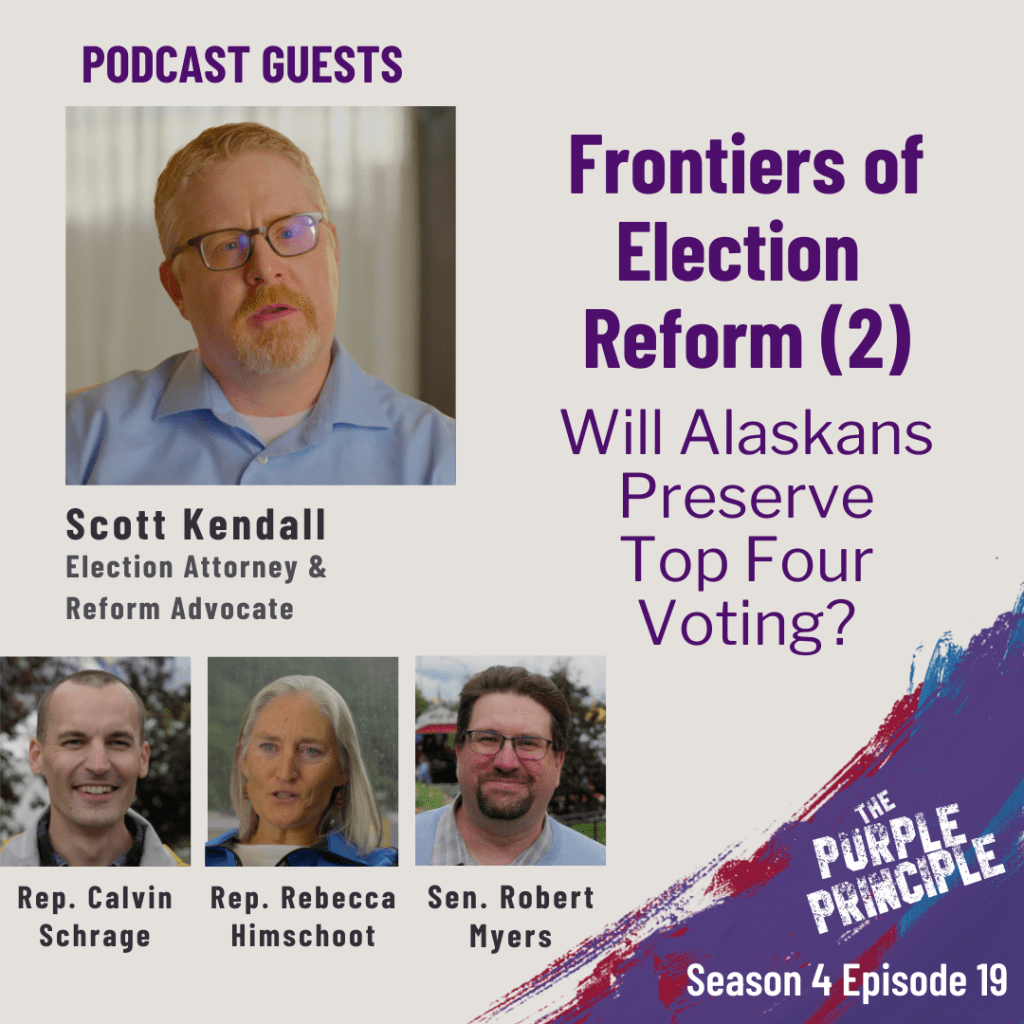
Robert Pease: But will these reforms be given sufficient time? A repeal of the Alaska election model is on the ballot in this year even as several other states attempt to emulate this model. In our next episode we’ll hear from Alaska State Senator Robert Myers on why he and elements of the Alaska GOP support that repeal
Senator Robert Myers: A lot of people were voting for the campaign finance changes, didn’t realize they were voting to put in a jungle primary and ranked choice voting general election. So that soured some people pretty early on.
Robert Pease: We’ll also speak with Scott Kendall, former chief of staff to independent Governor Bill Walker. Kendall then led the 2020 effort to pass election reform in Alaska and now works to save it from repeal.
Scott Kendall: I think kind of the North star for me is what is a better system where a few insiders control what happens and control who gets elected? Or is it a better system when every candidate feels like they have to campaign to every voter?
Robert Pease: We’ll also hear from two other independent legislators on what might be lost if this repeal is successful. House minority leader Calvin Schrage of Anchorage
Calvin Schrage: I think returning to the old system that we had just further empowers extreme partisan individuals to choose the candidates for us, and I think that would be a terrible choice for Alaska to go back to.
Robert Pease: And Representative Rebecca Himshoot of District 2 encompassing 500 miles of southeast Alaskan coastline. She’s part of that large freshman class of less dogmatic, more moderate house members that Rep. Alysse Galvin described.
Rebecca Himschoot: It’s a planetary test. If you can keep the Everglades, you can keep the planet. And I feel that way about RCV. If we can keep our open primaries and if we can keep rank choice voting, I think we have a chance at our state getting into a better place.
Robert Pease: We hope you’ll join us for that episode and subscribe to both our Youtube and TikTok pages for video highlights of interviews in Alaska, Nevada, Washington DC, Idaho, Colorado and other states seeking to make 2024 a potentially pivotal year for US election reform and governance.
Robert Pease: The Purple Principle is the product of a dedicated team of media reformers: Kevin A. Kline, Sr. Audio Engineer; Vienna Maglio, Bookings & Field Producer; Trevor Prophet Digital Ops & Strategy; Mary Claire Kogler, Associate Producer & Videographer; and Sarah Kim, fact checking & research.
Robert Pease: The Purple Principle is a Fluent Knowledge Production. Original Music by Ryan Adair Rooney.
Our Guests:
Join Us for Premium Content:
Apple: https://link.chtbl.com/PurpleApple
Patreon: patreon.com/purpleprinciplepodcast
Find us online:
Twitter: @purpleprincipl
Youtube: @thepurpleprinciple
TikTok: @thepurpleprinciple
Facebook: @thepurpleprinciplepodcast
Instagram: @thepurpleprinciplepodcast
Our website: https://fluentknowledge.com/shows/the-purple-principle/online-conspiracies
Subscribe to our newsletter: bit.ly/3wDbr4o
Additional Resources / Fact Checking:
Bryce E. Edgmon – Ballotpedia
House Speaker Bryce Edgmon stresses Alaska Native leadership in AFN 2020 keynote speech
Alaska Ballot Measure 2, Top-Four Ranked-Choice Voting and Campaign Finance Laws Initiative (2020) – Ballotpedia
Alaska’s first ranked-choice election will be a special vote to replace Rep. Don Young – Anchorage Daily News
Alaska Voting Registrations by party (last page for totals)
BREAKING NEWS – Bryce Edgmon wins coin toss
Bristol Bay, Alaska
Matanuska-Susitna Borough, AK population by year, race, & more | USAFacts
Alaska population steady for 2nd year; Kenai Peninsula sees growth | Homer News
How red is Alaska?
Economy, Alaska Kids’ Corner, State of Alaska
Alaska Permanent Fund – Wikipedia
The rest of the country should learn from Alaska’s successful ranked-choice voting experiment | The Seattle Times
Majority of Alaskans voted across party lines in ’22 primary, study says – Alaska Public Media
Alaska House of Representatives – Ballotpedia
Fresh in power, Alaska House’s new Republican-led coalition outlines its priorities
Alaska AFL-CIO & Alaska AFL-CIO Staff
May 2023 Board Proclamation Statewide
Alyse Galvin – Ballotpedia
May 2023 Board Proclamation Anchorage
Alaska House of Representatives elections, 2022 – Ballotpedia
Alaska needs a new approach to energy problems
Power-line problem triggered brief but broad outage across Southcentral Alaska
Alaska’s looming natural gas crisis draws growing attention from mayors, state regulators
‘Teachers leaving faster than they can be replaced,’ reports Alaska Dept. of Labor
Anchorage teachers say they’re concerned about a proposal to increase class sizes – Alaska Public Media
Alaska’s working-age population continues its long decline, a headwind for the economy – Anchorage Daily News