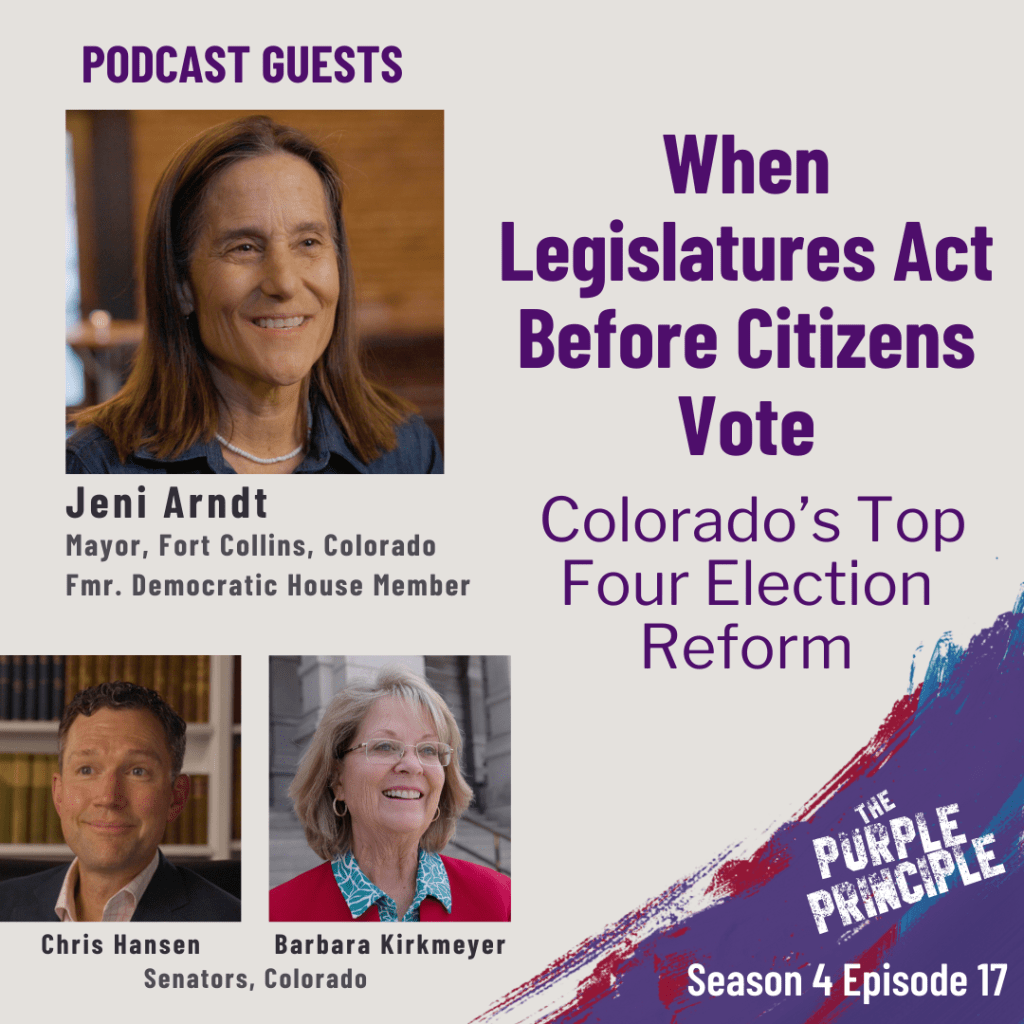
Election reform is officially on the ballot for voter approval in Colorado this year. This “Top Four” voting system is similar to the Alaska model of a unified open primary plus ranked choice general election. But there is a catch to this Colorado ballot measure, and it came via the state legislature in the final moments of the 2024 session.
“Well, the last couple of days of the legislative session are very hectic,” says Jeni Arndt, a three term Democratic House Member in Colorado before her election as non-partisan Mayor of Fort Collins. “And you don’t know every amendment that you’re voting on in the last few days. But this was clearly an orchestrated effort to put in a poison pill.”
The amendment in question requires at least 12 Colorado municipalities to pass and implement ranked choice voting elections before the state can do so. Thus it could delay citizen-will on this issue until at least 2028, even if voters overwhelmingly pass the initiative in November.
“When our legislature waits and passes a law with very little debate that no one basically really knew that that was in the bill,” says Republican State Senator Barbara Kirkmeyer, “that’s wrong.”
Senator Kirkmeyer has not yet taken a position on the Top Four voting in Colorado. Both nationally and in Colorado her party has come out against any form of ranked choice voting. By contrast, Democratic opposition or concern around election reform has been more nuanced.
“I think the folks who brought the amendment, I’ve worked closely with them on lots of different things,” says Democratic Senator Chris Hansen, a former House Member and former candidate for Mayor in Denver. “I think they were trying to make sure there was not an implementation issue with ranked choice if that moves forward in November.”
Executive Director of Denver-based Unite America, Nick Troiano, is not so sure. He sees similar motivations behind both GOP and Democratic tactics in preventing or delaying these increasingly popular reform measures.
“The fact that they went out of their way in a midnight effort to try and undermine the people’s will not only demonstrates the potential impact of this reform,” says Troiano, author of The Primary Solution. “But it also demonstrates the problem that we’re trying to solve, which is politicians are largely in it for their self-interest.”
Was this Colorado amendment a self-interested poison pill or an effort to make RCV elections go smoothly once implemented? Tune in for three viewpoints on this question and make up your own independent mind.
And stay tuned for more upcoming episodes on the various ways party and legislative leaders in multiple states begin pushing back on nonpartisan election reform momentum in 2024, a potentially historic year for depolarizing ballot initiatives. It’s all part of our season long series on state and district level reform from Washington DC to Alaska with a record number of states in between, including Idaho, Nevada, South Dakota, Arizona, Oregon and now Colorado.
The Purple Principle is a Fluent Knowledge production. Original music by Ryan Adair Rooney.
watch now: Episode Highlights
Watch a 2-minute “Best Of” with our three featured guests this episode for their reactions to the last-minute amendment.
We will be posting new content each week to The Purple Principle YouTube channel, such as shorts, highlights, and previews for our podcast episodes.
Opening
Female Anchor: “Well, Colorado Voters may decide in November whether to switch to a ranked choice voting system.”
Male Anchor: “Open primaries and ranked choice voting that’s a national movement with Colorado voters likely to consider it this November.”
Robert Pease (Host): Election reform is now officially on the ballot in Colorado this year. That was validated in September by the Secretary of State. That should mean Colorado voters have the chance to approve a Top Four election system similar to Alaska’s. But in the case of this Colorado ballot initiative, there is a catch.
Male Anchor: And a last minute amendment to a state elections bill this year would indefinitely delay ranked choice voting until certain criteria are met.
Female Anchor: Critics, including the League of Women Voters argue the amendment undermines voter initiatives
Male Anchor: That amendment was added by State House Democrat, Emily Sarda.
Rep. Emily Sarda: I really think this ballot measure is a solution in search of a problem.
Robert Pease: I’m Robert Pease and this is Purple Principle, a podcast on the perils of polarization. In this season-long series we’ve seen reform leaders in different states adopt different election models to put before voters this year. Now we’re seeing the different ways state party leaders and legislators are pushing back on these reforms . Several Republican legislatures around the country have passed laws prohibiting ranked choice voting while the Democratic controlled legislature in Colorado took a different tactic.
Robert Pease: But Nick Troiano, Executive Director of Denver based Unite America sees similar motivations in both parties:
Nick Troiano: The fact that they went out of their way in a midnight effort to try and undermine the people’s will not only demonstrates the potential impact of this reform, but also demonstrates the problem that we’re trying to solve, which is politicians that are largely all in it for their self-interest.
Robert Pease: We’ll speak to 3 current or former legislators about the energy behind election reform in Colorado but also this legislative maneuver to slow that momentum down.
Robert Pease: Democratic Senator Chris Hansen– he feels caution is warranted when it comes to election systems.
Chris Hansen (Guest): I think the folks who brought the amendment, I’ve worked closely with them on lots of different things and I think they were trying to make sure there was not an implementation issue with ranked choice and if that moves forward in November.
Robert Pease: Republican Senator Barbara Kirkmeyer has not taken a position on the Top Four election model for Colorado. But she is no fan of the last minute amendment employed by the House and Senate Democrats.
Barbara Kirkmyer (Guest): So when we have a legislature who waits till the people have gone through their process and they have a ballot title, when our legislature waits and pushes through and passes a law with very little debate that no one basically really knew that that was in the bill– that’s wrong.
Robert Pease: This Top Four ballot measure in Colorado is backed by former DaVita CEO & Unite America Co-Chair Kent Thiry. He previously led successful ballot measures to create semi-open primaries and independent redistricting. And there’s a lot of intrigue around the amendment to delay this Top Four voting measure in Colorado. Let’s start our discussion off with former House Rep and now nonpartisan Mayor of Fort Collins, Colorado, Jeni Arndt. She’s worked to pass and fund RCV for (Colorado) cities and towns as a mayor and formerly as an indie-minded Democratic state legislator for three terms.
Jeni Arndt: Interview Part One
Jeni Arndt (Guest): When I started running, everyone said, “oh, the district is a third D [Democrat], a third R [Republican], and a third independent.” And of course I’m a very careful person, so I thought, well, let me just check. And so I checked and what people hadn’t realized is no, the district had completely changed. So my first race was in 2014, and even then that house district was more than 50% independents.
Jeni Arndt: So I always say I’m a member, but I work for the people. And I’m very clear in my thinking about the role of what parties are in our politics and the role of people and the voter. And so I got quite a reputation for being an independent thinker and really listening to my constituents.
Robert Pease: So were there ever any positions or bills where you voted your district which was different from what the Democratic caucus wanted you to vote..
Jeni Arndt: Many times.
Robert Pease: And was there ever any sort of consequences for that?
Jeni Arndt: Yes, that was fine with me. I also ran the bill for the National Popular Vote, which was contentious and not a partisan vote by any means. And I ran a resolution every year to get dark money out of politics. And that was very upsetting to the parties, both of them, because the parties like money in politics but they don’t want to take a vote on it, on the record, to be against taking that out. So I was made aware that it would be a lot more in line with party politics to go ahead and not bring that resolution.
Jeni Arndt: I also was chair of a committee and then two years later I was not chair of that committee. As I said, sometimes I have a little trouble with the front office, but I always kept in mind that I didn’t become a representative for my district to be a committee chair or anything. I ran to represent my people. And no one can take that away from me except for the people. And I think that’s really special.
Robert Pease: Well, let me ask you to comment on a comment that we had recently from another former mayor, a man named Paul Johnson who is mayor of Phoenix, who’s pushing for open primaries in Arizona.
Paul Johnson: Everybody likes to think about these reforms that we’re talking about as being revolutionary. They’re not. City governments have been doing these reforms for about 50 to 60 years. If you look at today, cities in America, about 70% of all cities are open primaries with nonpartisan type of elections.
Jeni Arndt: Correct. People are really increasingly looking to the cities as places that get things done. And I think part of it is because for the most part, especially medium and smaller sized cities are nonpartisan elections. And the more people push to have these be partisan, we could get as jammed up as the other levels of government. And I really argue against that because it’s so important to just get down to the work and solve the problems of the people.
Jeni Arndt: So yes, I agree. Mayors, we all kind of club up together and it’s so refreshing to go to a conference where there’s other mayors because we never even consider, it’s not even on the table what party you are. We do talk about things that can be seen as partisan, right? So taxation policy, homelessness, some things that we do in Fort Collins where we backfill people who are less advantaged than others to make sure that everyone’s welcome in Fort Collins. But other mayors are also free to speak about things without feeling that they’re going to be tinged or painted as whatever color brush people want to paint us with in a partisan lens.
Robert Pease: That’s great. So when you were in the House, you and others tried to draw attention to ranked choice voting…
Jeni Arndt: Well, what we did was for the municipalities that had opted into our rank choice voting, we put more money into the Secretary of State’s budget to help implement that because a lot of the county clerks who run the elections are saying, this is very complicated. It’s more expensive. We said, okay, that’s a true argument, right? This is something different. So let’s put in more money so that the municipalities who have opted in could make it happen.
Robert Pease: So as you probably know at the last minute in the last legislative session there was what’s being called a poison pill amendment to delay implementation.
Jeni Arndt: Yes, I watched that with chagrin.
Robert Pease: Knowing the inner workings of the House, how much behind the scenes support was there for this last minute amendment…
Jeni Arndt: Well, the last couple of days of the legislative session are very hectic. And you don’t know every amendment that you’re voting on in the last few days. But this was clearly an orchestrated effort to put in a poison pill on this. However, I do think, and I listen carefully to the governor’s rationale for signing it and his statements when he did sign it. I think if it passes, I would say when it passes, I think it’s going to be popular in Colorado. There’s a real case that the legislature should not overturn the work of the people.
End Interview Part One – Jeni Arndt
Robert Pease: We’re speaking with Fort Collins Mayor Jeni Arndt who brings a unique perspective to the question of election reform in Colorado this year. As Mayor of Fort Collins she led the effort to bring RCV elections to her city. And while in the Colorado House Arndt advocated for additional resources for the county clerks to implement ranked choice voting. In many ways Arndt has been ahead of her party on election reform. And certainly that’s true compared to those Colorado Democrats who passed this qualifying amendment that could delay election reform until at least 2028, even if citizens pass the measure this fall.
Chris Hansen Interview
Chris Hansen: So my name is Chris Hansen. I’m a state senator for District 31. It’s the central and eastern parts of Denver.
Robert Pease: Senator Hansen was also a former member of the Colorado House for two terms and a candidate for Mayor of Denver in 2023.
Chris Hansen: I’ve always tried to campaign in a way that is going to appeal to a broad spectrum of voters and in my primary races I was running against opponents who were well to my left. So they were running really trying to activate the party base. I was trying to activate more of the progressive and centrist parts of the party to win those primary elections, and, you know, there weren’t a lot of independents who participated in those primaries.
Robert Pease: Has that changed at all since the primaries became less closed?
Chris Hansen: Yeah, I think it has changed, but I would say that most independents either lean left or lean right, very few of them are what you’d consider pure swing voters. And I love the fact that Colorado has opened up our primary systems so that independents can participate, they can choose which primary they want to be in and really reflect where they want their voice to be heard and can change that over time, can change which ballot they decide to participate in as an independent.
Robert Pease: So part of this proposed ballot initiative for November would be to take a step further and to have not just a semi-open primary but a unified open primary. We’re wondering your position on that part of the proposal.
Chris Hansen: Yeah, I mean that’s a major change and I think it’s one that we maybe don’t entirely understand what the implications would be. There’s a few places where versions of that have been implemented. We did adopt in Colorado ranked choice voting in municipal level, and there’s been some cities that have been using that. Boulder I think is probably the best example in the state of Colorado, but I think the way that those primaries are open is really important. I’ve watched very closely what’s happened in California and the “Jungle Primary” as it’s referred to, and I think that’s had some success. I think it’s opened up the political process, but it’s also led to some gaming by different candidates in different situations. So there are pluses and minuses here for sure.
Robert Pease: Can you remember when you first heard about ranked choice voting and in what context and what your initial reaction… we’re interested because you have obviously a very analytical background and ranked choice voting was created by mathematicians and was implemented a century ago in Australia and makes a lot of sense in many situations, such as when you have, you know, 10 candidates running for Mayor.
Chris Hansen: Well, or 17 as was the case in Denver recently in the election that I participated in last year. So yeah, I’m a mathematician myself, an engineer by training and there is some wonderful, I think analytics that come with this approach that have a lot of upside for making sure people’s voices get heard. I think we’ve seen some of the pluses and minuses in places that have already used it. New York City, of course implemented it in their mayor’s race recently. And so I think we have to really carefully analyze some of the downsides of some of our current systems. And so I think carefully experimenting and looking for ways to open up the political process and making sure there’s great franchise, there’s great ability for people to get their preferred candidate and have their voice be heard is super important. And we’ve seen really low turnout over the last several cycles. And so I think that voter engagement is a really important goal here.
Robert Pease: Well, we’re curious when you first learned that there was going to be an amendment delaying the potential implementation of the reform, if voters pass it we’re just reading in the press that it was last minute, and I believe Governor Polis’ statement was that it wasn’t fully discussed.
Chris Hansen: Yeah, so this bill was a Senate bill that you’re referring to, and it was first passed by the Senate without the amendment that you’re referencing that was added in the House at the end of the session that then came back to the Senate and was approved with really no additional discussion. So it was not something that got brought up for additional debate. And I have to say I wasn’t deeply familiar with what had been amended in the house. That’s a very normal part of our process. We really try to prioritize in the final days of the session, things that need further debate, need further discussion. This was not something that was raised as a controversial issue on the last day of the session. And so it moved through the process as many other non-controversial issues did. Obviously there was controversy after it was passed, the governor did sign the bill and was aware of the passage of that amendment.
Chris Hansen: You know, I think the folks who brought the amendment, I’ve worked closely with them on lots of different things and I think they were trying to make sure there was not an implementation issue with ranked choice and if that moves forward in November. And so I don’t think there was kind of ill will or nefarious types of motivations here. I think it was really just an election bill that we were trying to make sure we had what we needed in place to be able to implement any changes that the voters approved. And I think that’s our commitment. And I think the governor said the same thing, that if the voters decide they want to move forward with these proposed reforms, it’ll be incumbent on the legislature then to make sure that they’re implemented with high fidelity. And I certainly share that commitment.
Robert Pease: Well, what about, was there any concern about the optics of it? Because as we understand it, the person who proposed the amendment is from a very safe seat and it’s just very easy from the outside to feel like these are people who don’t want competitive elections.
Chris Hansen: Yeah. Well, I would strongly disagree with the premise of the question that the person who brought the amendment brought it because they’re from a safe seat, because I know her very well. It includes parts of my district that overlap with her house seat, and she has been in very competitive elections. Now they were primaries because Democrats have the majority of votes in Denver. And so the election is often decided in primaries. But that’s true on the Republican side too in many districts. So she is very used to competitive elections. But I do think there are real implementation issues that the legislature will have to grapple with. And I think the amendment sort of came from that spot.
End Interview with Chris Hansen
Robert Pease: Senator Chris Hansen providing some of the Democratic rationale for an amendment that delays a citizen ballot initiative in Colorado this November even before citizens have the chance to approve it. Of course not all Democratic legislators have the same viewpoint on RCV in Colorado. And neither do all Republicans. We spoke to one of the most pragmatic conservatives in the Colorado Senate who has not yet taken a position on Top Four voting.
Barbara Kirkmeyer: So, hi, I’m Barb Kirkmeyer. I’m a state senator here in Colorado, and I’m a state senator in District 23, which is the North I-25 corridor, along the northern front range of Colorado. I serve parts of Weld County and Larimer County from some very rural, I mean, I used to own a dairy farm to give me an idea, and to more suburban areas within the district.
Robert Pease: We asked Senator Kirkmeyer what it was like on the minority side of the aisle as the amendment to delay implementation of an upcoming ballot measure passed through the legislature.
Barbara Kirkmeyer Interview
Barbara Kirkmeyer: So typically, at least from my experience being here, but I’ve only been here four sessions, there is an elections bill that is passed every year. Our county clerks who run the elections always have some changes, rulemaking, things that need to take place, things they learn, things that change. So we have this bill every year, so everyone expects it. The bill had passed out of the Senate and was headed over to the house, and the house last minute was like, I think in the last two, three days of session, added an amendment in that was not debated in the Senate and they amended it on the floor. So it really wasn’t debated that much either on the house floor. People were told one thing, and keep in mind our house here that chamber is Republicans are in a super minority. They don’t really get the opportunity to filibuster or really to debate.
Barbara Kirkmeyer: And if you’re not paying really close attention, sometimes people slip in amendments. So the amendment got slipped in that essentially circumvents the ballot initiative that we know had been approved for a title and had gone through this very long process. So they essentially put in a process about how we have to do ranked choice voting in 12 municipalities before anything else, whether it’s passed or not passed, before anything else can occur. So when we have a legislature who waits till the people have gone through their process, and they have a ballot title, and our legislature waits and pushes through and passes a law with very little debate that no one basically really knew that that was in the bill.
Barbara Kirkmeyer: They don’t like ranked choice voting apparently, and they put this amendment in. I think that is just blatantly wrong for them to have done that.
Robert Pease: Well, it’s interesting and I think also very persuasive that you’re not even yet in favor of the ballot initiative. You’re just opposing this on process and philosophical ground. So tell us about your own thinking about the ballot initiative..
Barbara Kirkmeyer: So I’m still in the middle of doing my research and I’ve talked to a lot of people about it. I’m interested, but I haven’t taken a position yet. There are certain things that I do like that are in the bill, the ballot measure. I like it that it’s an open primary and that it allows everyone to pick who goes on to the general election.
Barbara Kirkmeyer: So the other portion in the bill that I still need to do more work on is the ranked choice voting. And I’ve been spending the last couple of weeks really researching it, finding out why people like it, why they don’t like it. I’m coming to some conclusions. Obviously party structures don’t like it because it takes power away from them. So I’m finding out that for them it’s more about the power versus what’s good for the people in our state.
Robert Pease: And did it occur to you as you started your research on ranked choice voting, that you would’ve had a better chance to win a seat in Congress under that system in the results that we saw in Ballotpedia for that race?
Barbara Kirkmeyer: Yes. So I ran for Congress two years ago. I lost by 0.7 less than one percentage point in a race and there were three candidates in the race– myself from the Republican side, now Congresswoman Caraveo who was from the Democrat side, and then there was a libertarian or a spoiler candidate essentially who took 4% of the votes. Now we can all make our guesses and our assumptions, but typically Libertarians, if they have to choose, they’re not going to vote for a Democrat. They would probably vote for a Republican. So in that race where I lost by less than 1500 votes, I probably would’ve won had we had ranked choice voting.
End Interview with Barbara Kirkmeyer
Robert Pease: That’s Republican state Senator Barbara Kirkmeyer providing her perspective on the Top Four voting ballot measure and the Democratic effort to delay or weaken that reform despite the large number of uncontested general elections in Colorado and very low turnout for both primary and general elections. Those are major reasons why Mayor Jeni Arndit promoted RCV in her time within the Colorado House and has helped institute RCV elections in Fort Collins. We asked her what the prospects are now for this Top 4 election reform ballot measure in Colorado and for the record number of similar efforts in play nationwide.
Jeni Arndt: Interview Part Two
Jeni Arndt: So I think there’ll still be very, a lot of discussion, and I will publicly have something to say about that, I believe. Right? This is a citizen initiative directly to the people, and they preemptively took a bill that would undo that work.
Robert Pease: This is a bumper crop of election reforms, at least five, six states that include ranked choice voting, another couple that include open primaries. I know you haven’t served in Washington, but do you think that we’re sort of inching towards the possibility of creating, you know, more functional government in Washington through these states, passing these reforms?
Jeni Arndt: I certainly hope so. Democracy isn’t supposed to sit still. Our constitution is a living and breathing document, and this is exactly what people are supposed to do, get together, govern themselves, and make reforms when necessary.
Jeni Arndt: I also sit on the rules committee for the Democratic National Committee. That’s what I was doing until five of three today, and albeit the convention, because I believe that our democracy was supposed to live and breathe and change along with us. So it’s exciting. It’s not anti-democratic to think about rules changes that engage more people.
Robert Pease: Well, obviously the Democratic Party has been less kind of uniformly against these reforms than the Republican Party. But there’s so many cases, you know, Washington DC here in Colorado and other states, Nevada, for example, where the state party is against the reform measure. So I’m curious, when you’re on these calls with the rules committee, do you sometimes bump up against these people who are just dead set against election reform?
Jeni Arndt: Well, we didn’t take up election reform on the rules committee for the convention, just to be clear. But yeah, I come up, but that’s also part of the discussion. None of it bothers me or surprises me, nor does it make me mad or frustrated. Everyone has their opinion, and that is how we come together to make decisions, right? So someone’s like, “oh no, I’m a dyed-in-the-wool hardcore party person. The parties are going to rule. We’re going to have a two party system.” Ok, that’s a very valid way to think, and that’s the way people have thought for a long time. But if you read your American history, that’s not the way it’s always been. And if you study electoral systems around the world, which I’m sure you have, there’s lots of different ways to do this. So I’ve always been interested in thinking about, especially given our division, the outright hatred people have of someone who doesn’t vote the same way they do, which is completely nonsensical, right? I feel like we need to do something different.
Robert Pease: Obviously creating a third party is a huge uphill battle. But do you think that if enough states enact, you know, ranked choice voting, general elections, it kind of opens the door to the possibility of a third party?
Jeni Arndt: Yeah. I mean, there’s always a possibility of a third party. It just has to be generated, right? I’m not certain that a third party’s the answer. I like ranked choice voting, because first of all, if you think of it, you can think of it in so many different ways, but one of ’em is just financially responsible. You have an instant runoff. Two, when people have more choice and their voice is going to be heard, if not their first choice, their second choice. It creates more engaged voters. It creates, I think, better candidates because, “hey, if I’m not your number one, maybe I’ll be your number two.” So it makes better candidates, more friendly discussions, more engaged candidates. It makes more engaged voters. And then when you have the instant runoff, people know that their voice has been heard, and then the candidate comes in with more than 50% of the vote, which makes them a more engaged public servant. People don’t like to win by 30%. It doesn’t feel good.
End Interview Part Two – Jeni Arndt
Closing
Robert Pease: Jeni Arndt sharing her perspective on the advantages of ranked choice voting elections. She’s been elected both through both party run elections to the Colorado House and in the nonpartisan mayoral election in Fort Collins.
Robert Pease: RCV general elections along with fully open unified primaries are on the ballot this year in Colorado, as in several other states we’ve visited. But the Democratic legislature has already moved to delay implementation of these reforms even before the voters have had their say.
Robert Pease: Will Colorado citizens approve the ballot measure this November despite this legislative amendment? Will Colorado’s Democratic Governor Jared Polis speed up implementation of the measure if passed, as suggested when he signed the election bill containing this amendment. Or will the legislature itself reverse course and remove these delays once back in session in 2025.
Robert Pease: We’ll be checking back on this Colorado Top Four election initiative later this year, so strikingly different from the passage of ranked choice voting led by former House Speaker Dan Rayfield in the Democrat controlled Oregon legislature. We covered that last episode. We hope you’ll take a listen to that and other shows in this season-long series on nonpartisan election reforms in a record number of states this year.
Robert Pease: Next up in this series, a visit to Alaska, the North Star of election reform since 2020 passage of Final or Top Four voting and a first-in-the-nation election under that system in 2022. But a repeal of that Top Four voting system is on the ballot in Alaska this year. We’ll speak to several independent Alaska legislators about what would be lost to Alaskans if this repeal is successful, including former House Speaker Bryce Edgmon of Kodiak:
Bryce Edgemon: I think it was 2019 when I first heard about it but the notion of getting rid of a closed primary system in Alaska appealed to me instantly and overrode right there almost on the spot any trepidation I might add about having to rank candidates or anything else that would eventually become part of the ballot measure that narrowly passed in Alaska.
Robert Pease: First-term Juneau Representative Rebecca Himschoot:
Rebecca Himschoot: It’s a planetary test. If you can keep the Everglades, you can keep the planet. And I feel that way about RCV. If we can keep our open primaries and if we can keep rank choice voting, I think we have a chance at our state getting into a better place.
Robert Pease: And House Minority leader Calvin Schrage of Anchorage:
Calvin Schrage: Well, I think the reform has been incredibly beneficial to politics here in Alaska. We’ve seen legislators who are now much more willing to engage in conversations across the aisle to find a bipartisan solution to some of the biggest problems we’ve been facing.
Robert Pease: We hope you’ll join us for that Alaska episode and the rest of our state level reform series leading up to the November election when we”ll learn how many states have taken steps to depolarize our politics and governance. Please also check us on out YouTube, TikTok and all other major social media platforms for video highlights of all interviews.
Robert Pease: The Purple Principle is created by a talented team of media reformers: Kevin A. Kline, Sr. Audio Engineer; Vienna Maglio, Bookings & Field Producer; Trevor Prophet Digital Ops & Strategy; Mary Claire Kogler, Video Production; and Sarah Kim, fact checking & research.
Robert Pease: The Purple Principle is a Fluent Knowledge Production. Original Music by Ryan Adair Rooney.
Our Guests:
- Jeni Arndt – Mayor of Fort Collins, Colorado
- Chris Hansen – Colorado State Senator
- Barbara Kirkmeyer – Colorado State Senator
Join Us for Premium Content:
Apple: https://link.chtbl.com/PurpleApple
Patreon: patreon.com/purpleprinciplepodcast
Subscribe to our newsletter: bit.ly/3wDbr4o
Find us online:
Twitter: @purpleprincipl
Youtube: @thepurpleprinciple
TikTok: @thepurpleprinciple
Facebook: @thepurpleprinciplepodcast
Instagram: @thepurpleprinciplepodcast
Our website: https://fluentknowledge.com/shows/the-purple-principle/online-conspiracies
Additional Resources / Fact Checking:
Ballotpedia: Colorado Proposition 131, Top-Four Ranked-Choice Voting Initiative (2024)
Colorado’s political parties come out against ranked-choice voting, open primary initiative
Boulder Ranked Choice Voting Guide
Ranked Choice Voting In Nonpartisan Elections
Welcome to Brash Tacks
National Popular Vote: Concerning adoption of an agreement among the states to elect the president of the United States by national popular vote
The multimillionaire who reshaped Colorado’s electoral system wants to make even bigger changes
Colorado voters could be blocked from implementing ranked-choice voting