In 2020, Alaskans passed a first-in-the-nation voting system which helped energize similar reform efforts around the country. In 2024, Alaska voters are now presented with a ballot measure to repeal this same Final or “Top Four” system that includes a unified open primary of all candidates plus a ranked choice general election. Meanwhile, voters in Nevada, Idaho, Colorado and other states consider measures to pass major elements of the “Alaska model.”
This Purple Principle episode features discussion with election law expert and reform advocate Scott Kendall, a major catalyst behind “Top Four” in the frontier state. He explains the impetus behind the initial reform in terms of the perverse motivations elections have traditionally provided to candidates and elected representatives.
“We have set up a system that gives all the wrong incentives and then we’re surprised when people act on those incentives,” says Kendall, a former chief of staff to independent Governor Bill Walker. “It’s as though a teacher graded their students’ success on how much they misbehaved in class. And we wanted to change that.”
By contrast, Republican state Senator Robert Myers stands in favor of the repeal effort, noting the longstanding Alaska tradition of forming bipartisan coalitions in the state legislature. “I think this a problem in search of a solution,” Myers told us at the 2024 Alaska State Fair. “The way it was passed… a lot of people voting for campaign finance changes didn’t realize they were voting to put in a jungle primary and ranked choice voting general election.”
New System, Same Tradition?
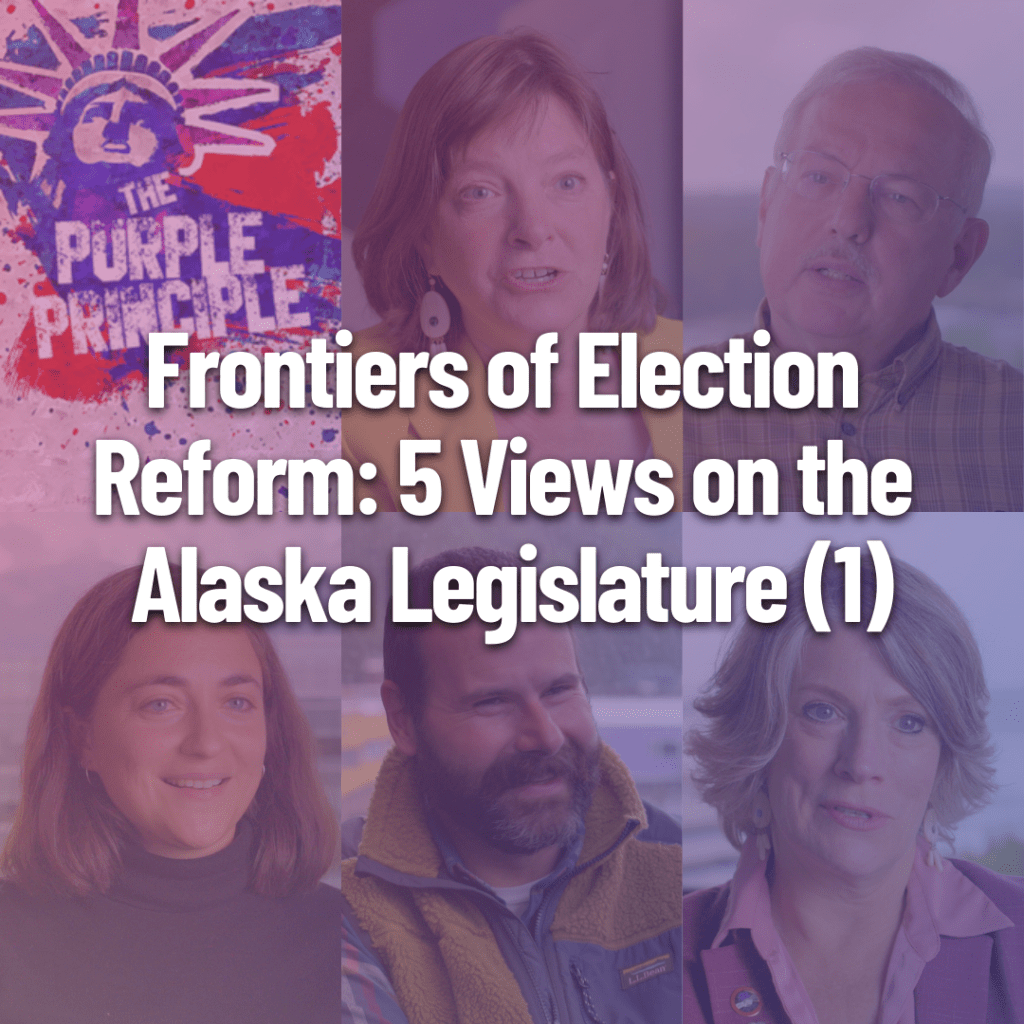
Independent Alaska House Representatives Calvin Schrage and Rebecca Himschoot see the Top Four or Ranked Choice Voting system differently. They think it will preserve and strengthen Alaska’s less partisan, more pragmatic political tradition.
“Going door to door on my campaign, I’m also talking to voters a lot about the initiative,” says Schrage, the House Minority Leader representing parts of Anchorage. “I think returning to the old system further empowers extreme partisan individuals to choose candidates for us.”
Prior to election, Rep. Himschoot was a career educator with a window on family and community challenges in her historically low-income southeast Alaska district. She doubts she would have entered politics without the Top Four system. “It’s a planetary test,” says Himschoot. “If we can keep open primaries and ranked choice voting, we have a chance at our state getting to a better place.”
Tune in for Part Two of this exploration of the frontiers of election reform. How did Alaska become the North Star for other reform efforts around the country? What seminal events laid the groundwork for Top Four passage in 2020 and a first full set of elections in 2022? And what are the issues surrounding potential repeal of Top Four or Ranked Choice Voting just four years after initial passage?
The Purple Principles is a Fluent Knowledge production. Original music by Ryan Adair Rooney.
Opening
[Alaska State Fair: crowd noise]
Rodeo Clown: Are we having a good time so far? We’re going to have so much fun today. We’re just getting started.
Rodeo Announcer: It’s going to be an awesome day at the Alaska State Fair. I can tell you that.
Robert Pease (Host): The Alaska State Fair. One of the world’s largest meeting points for RVs sends tens of thousands of Alaskans from near and far and also very far, yet still well within Alaska– they travel to the fairgrounds near Anchorage each year for this 2 week long event celebrating the frontier state.
[Alaska State Fair: crowd noise, commotion, roller coaster ride]
Robert Pease: There’s dozens of amusement rides, including the roller coaster. Also bands, dances, and hundreds of exhibits of all kinds, including rodeo, livestock, 4-H clubs and petting zoos.
[Alaska State Fair: Animals, kids getting excited by animals and pig squeal, cows mooing]
Robert Pease: There was also state politics on display at the 2024 Alaska State Fair with Governor Mike Dunleavy signing three bills on a small stage along with Republican, Democrat and Independent legislators.
Colony Stage Announcer: The Colony Stage proudly welcomes your Governor, Mike Dunleavy, please welcome to the stage.
Governor Mike Dunleavy: He’s having fun here at the fair? Everybody? So we got three exciting bills. Who here likes fireworks? Where are the four H kids? They’re all out back. Oh, they’re coming up. Awesome….
Robert Pease: Governor Dunleavy is a conservative Republican re-elected to a second term with over 50% support in the first round of Alaska’s 2022 election, the first in the nation to use a Final or Top Four voting system.
Governor Mike Dunleavy: But raise your hand if you’re in Four H. These are our future farmers. This is our future right here, these guys.
Robert Pease: But there is certainly one issue these legislators at the State Fair do not agree on– how they should be elected. As regular Purple Principle listeners will know, Alaska was the first state in the nation to pass Final or Top Four voting by ballot measure in 2020. And the first in the country to hold such an election in 2022 re-electing this conservative Governor, but also the moderate Republican Senator Lisa Murkowski and centrist Democrat US House Member, Mary Peltola. These events inspired election reformers in four other states and Washington DC to present ballot initiatives to their voters this November. But ironically, on that same election day Alaska voters will be presented with the option to repeal what they call Ranked Choice Voting or RCV.
Robert Pease: At the Fair, we spoke to House Minority leader Calvin Schrage, an independent legislator representing parts of Anchorage. He’s in favor of Top 4 or RCV for Alaska and therefore opposes this repeal initiative.
Calvin Schrage (Guest): Well, I think the reform has been incredibly beneficial to politics here in Alaska.
Robert Pease: We also spoke with Republican State Senator Robert Myers.. He supports the repeal of Alaska’s Top 4 or RCV election system, where all voters select from all candidates on a unified primary ballot, and the top 4 proceed to a ranked choice general election.
Robert Myers (Guest): So I first heard about the Ranked Choice and Jungle Primary initiative in late 2019 as the signatures were being gathered. I thought a lot of it was a solution in search of a problem…
Robert Pease: I’m Robert Pease and this is The Purple Principle, a podcast on the perils of polarization, focusing this season on state level efforts to depolarize our politics through non-partisan election reform. We’ll hear more from Senator Myers and Representative Schrage on this episode, and also from Representative Rebecca Himschoot who was initially elected to the state house in that first statewide top four election back in 2022.
Rebecca Himschoot (Guest): If we can keep our open primaries and if we can keep ranked choice voting, I think we have a chance at our state getting into a better place.
Robert Pease: But first we ask the question how did our 49th state become the north star of election reform for states as different as Nevada, Idaho, Montana and Colorado— all of whom have their own variations of Top Four or Top Five voting on the ballot this year. There is no one better informed on that question than the election law expert and reform advocate, Scott Kendall. He’s been a central part of nearly every norm shattering election event in Alaska over the last fifteen years.
Scott Kendall (Guest): And in 2010, I was counseled to Senator Murkowski when she ran her write-in campaign, which I think was just a real dramatic lesson in the dangers of closed primary elections.
[Prior Alaska episode: Lisa Murkowski: Tonight after 8 weeks i think we can say is our miracle is here (applause)]
Scott Kendall: Coming out of that, I actually went to work as Chief of Staff for Governor Walker and he was the only independent governor in the nation.
[Prior Alaska episode: Bill Walker: We talk about bipartisanship and a bipartisan administration. We’ll have a no partisan administration.
Robert Pease: Executive Producer Carol Wingard sat down with Scott Kendall in Anchorage the same week of the Alaska State Fair. That interview began with discussion of how a farm boy from the lower 48 ends up a prominent advocate for less partisan elections and for more pragmatic politics in the vast and sparsely populated state of Alaska.
Scott Kendall Interview, Part One
Scott Kendall: I grew up actually on a farm in Western Washington, in a farm town, right in the shadow of the Olympic Mountains on the Olympic peninsula. Lived in Seattle for law school and moved to Alaska quite honestly, because of the space, the nature, you know? Seattle was just too many people for me, I guess. I like the wide open space, the ocean, the mountains, the nature. One of the things I love about it is, Alaska is America’s biggest small town. Literally we don’t have seven degrees of separation. We have two degrees of separation. Everyone knows each other, Republican, Democrat, other, everyone is friends. Their kids play soccer or hockey together and it’s just a bit different that way.
Carol Wingard (Executive Producer): How would you describe the political culture here?
Scott Kendall: The political culture here is just, I think, different. We refer to the rest of the United States as the Outside with a capital O for a reason. We tend not to get drawn into national politics. 63% of Alaskans aren’t registered with either major party and, you know, even our elected officials from the major parties tend to buck the trends of sort of national partisanship and do I think very centrist and effective in their representation of Alaska.
Carol Wingard: So then turning now a little bit more to some of the work you’ve done in political reform. When did you first hear about Open Primaries and RCV?
Scott Kendall: Well, I mean I think I was peripherally aware of it, you know, for a long time. I’ve been an elections attorney since 2007 or eight. So I was peripherally aware of Washington and California systems of top two. I was a longtime Republican campaign attorney and in 2010 I was counseled to Senator Murkowski when she ran her write-in campaign. Senator Murkowski lost her primary to an extreme, extremely far right candidate extreme even by today’s standards. After she lost the primary, she actually ran a write-in against both the Democrat and the Republican and won and she won by a healthy margin.
Scott Kendall: What those results showed was that Republican candidate who would’ve won if Senator Murkowski hadn’t run, 65% of Alaskans didn’t want him. So it really showed how the partisan primary presents voters with a choice they may not want, and you know it’s that lesser of two evils problem.
Carol Wingard: So it is an incredibly unusual story that one could write in and win an election. Do you think that is a particularly Alaskan phenomenon? Is that something that could only happen here?
Scott Kendall: I mean, it wasn’t easy. I was there with the senator as she did it. I can say that, and Murkowski may not be the easiest name on earth to spell as well. And particularly so when you know that her base of support truly was from the Alaska native community and rural Alaska. And we had areas of the state where English is not even the first language. Ballots are presented in the local native languages. And you nonetheless had folks spelling Lisa Murkowski. And in fact, the margin in her election came out of rural Alaska. So I dunno if it could happen anywhere else, but it certainly, I think here we were particularly suited for it.
Carol Wingard: I understand that you were also very influential in bringing the top four system onto the ballot in 2020.
Scott Kendall: Well, I had worked on another ballot measure in order to protect Bristol Bay from the largest mine on earth. And Bristol Bay is where half the planet’s salmon come from, and some folks wanted to put the world’s largest mine smack in the middle of that watershed, which was something we did a ballot measure to sort of put some additional, I guess, barriers or restrictions on that process. And it was something that united Republicans, Democrats across the board, that ballot measure got nearly 70%, and that’s in a resource state.
Scott Kendall: And then I also took two years off from the practice of law and I helped run Senator Murkowski’s 2016 reelection campaign. Coming out of that successful campaign, which thank goodness was conventional, she won the Republican primary and then won reelection. Coming out of that, I actually went to work as Chief of staff for Governor Walker. He was a former Republican, turned independent. And the experience I had for a little over two years being his Chief of Staff was that elements of both parties constantly wanted him to fail.
Scott Kendall: There were good Democrats, good Republicans, who were absolutely willing to work for the good of the state, but there was a critical mass of partisans on both sides that wanted him to fail because he wasn’t on their team. And they would tell me quite candidly, we should do the thing you’re proposing. It’s good for the state, but we’re not going to do it because we want a Democrat to come in and run and knock him off. Or we want a Republican to come in and knock him off. So maybe that experience more than anything, the dysfunction in our state legislature really kind of honed me in that we have set up a system that gives all the wrong incentives and then we’re surprised when people act on those incentives. It’s as though a teacher graded their students’ success on how much they misbehaved in class.
Scott Kendall: That’s how people get reelected these days. And we wanted to change that. We actually wanted to create a system where folks were graded on how much work they got done. And so that more than anything, coming out of that experience at the end of 2018 into early 2019, led me to start looking at election systems around the country.
Carol Wingard: Got it. Now is it around this time when Catherine Gale was writing her book on Final Four, final Five, or was this before and were you even aware of what might’ve been going on elsewhere in the country?
Scott Kendall: You know, we knew RCV had happened in Maine. And we took a critical look at that and we found it just didn’t do the job because what you get is a Democrat going through a closed primary, Republican going through a closed primary. Each of them get 45 or 46% of the vote. And then the vote really boils down to fighting over that third party candidate’s support. And that third party candidate, that third or fourth choice is never viable. Whereas under this system, Mary Peltola finished in fourth place in her primary, in the general she finished in first. So really it gives a chance for candidate quality to shine. So we, after I had sort of settled on either top three or top four, I came across Katherine Gehl’s, Harvard Business School report, I think with Michael Porter. And that was very validating to see like, “hey, very smart people at Harvard of all things have actually looked at something like this.”
Carol Wingard: It is interesting that it seems around this time or after slightly after, it has sort of risen up sort of independently around the country in terms of a potential solution.
Scott Kendall: And I think we see a lot of people around the country, they see our congressional delegation who are always at the table in terms of making deals, who are always at the table in terms of important policy advancements. And other states are jealous, frankly, of the way our delegation can get so much for Alaska because when President Biden was putting together the infrastructure package, conservative Republican Don Young was in the Oval Office making sure that if he was going to support it, Alaska was going to make out as well. Senator Murkowski, Senator Sullivan. And ,you know, now I think Representative Peltola to some degree has continued that tradition. She secured approval of the Willow Oil Project on the North Slope, which is one of the largest approved oil projects in the nation in decades. I don’t think she gets that opportunity if she’s not able to go into the Oval Office as a resource friendly Democrat and make that deal.
Scott Kendall: So I think people around the country look and they say every time an issue goes up, I know how my delegation’s voting. They’re going to line up according to their party leadership, and that undermines our ability to get anything done. You can’t break the filibuster in the Senate, and so you don’t fix the border, you don’t do important climate change legislation. There are numerous things that are very bipartisan in nature that we simply don’t do because the party decides, you know, if it’s not a win for the party, we’re not going to do it. Which is, it’s a shame.
Carol Wingard: Yeah. So you’re working in the governor’s office, you’ve been thinking about top three, top four. What did you do then?
Scott Kendall: Well, from there I actually just, I began writing, I’m an attorney. I started writing a ballot measure, so I still have the original file on my computer. Started writing, consulted with an attorney who had formally spent 12 years working for the Alaska Division of Elections. She was even more of an elections expert than I was. And really worked on honing in the policy.
Scott Kendall: We had a lot of very bipartisan effort. We had a lot of Democrats, a lot of Republicans supporting us. We had the party leadership, the chair of both parties against us. We had the prior Democratic and Republican candidates for governor were both against us. And one of the more destructive things that happened was Planned Parenthood in Alaska came out against us late and really probably cost us seven or 8%.
Scott Kendall: I think partisan interests must have driven them to the decision. I’ve never really heard why, but it was incredibly damaging. As you can imagine when you have progressive women told that they’re going to lose their right to choose if they vote yes on this thing. We probably would’ve won it something like 57, 58%. But because of that kind of misinformation coming so late, we barely, we got 51%. We won by two points.
End Scott Kendall Interview Part one
Robert Pease: We’ve been speaking with election law expert Scott Kendall, he’s one of the primary catalysts for election reform in Alaska, which has become the North Star of similar efforts in several states in 2024. Yet it faces a repeal initiative this year. While attending the Alaska State Fair we spoke with legislators on both sides of that issue. Calvin Schrage, House Minority leader, he supports top four or RCV and is campaigning against the repeal effort while also campaigning for his own re-election.
Calvin Schrage: So going door to door on my campaign, I’m also talking to voters a lot about the initiative that’s before voters, and talking about the fact that we really need to preserve ranked choice voting and open primaries here in Alaska. I think returning to the old system that we had just further empowers extreme partisan individuals to choose the candidates for us, and I think that would be a terrible choice for Alaska to go back to.
Robert Pease: But State Senator Myers points out that another plank in the original 2020 ballot measure was a clause promoting greater campaign finance transparency. And that is no longer an issue in this 2024 repeal measure, which focuses squarely on open primaries and ranked choice voting.
Robert Myers: The way that it was passed with it being bundled with some campaign finance changes, a lot of people were voting for the campaign finance changes, didn’t realize they were voting to put in a jungle primary and ranked choice voting general election. So that soured some people pretty early on.
Robert Pease: Most of the opposition to Top Four or RCV in Alaska does seem to come from the populist right of the Republican Party who were incensed by the election of a centrist democrat, Mary Peltola, to the US House seat held by a Republican for the previous 50 years. Scott Kendall had a front row seat to that 2022 election that was preceded by an equally historic special election. Producer Carol Wingard asked Scott Kendall to recap his view of these important events.
Scott Kendall Interview, Part Two
Scott Kendall: Before the system went into place, we had to get through a lawsuit and then we had to go on appeal to the Alaska Supreme Court, which both confirmed that the system was constitutional. So the system was in place and unfortunately Congressman Young passed away and his untimely passing triggered a special election. He had served Alaska for 49 years, and of course that seat hadn’t come open for very long. So the system had early, very strong tests when we had 48 candidates run, but the system worked. The top four moved on, and Mary Peltola went from fourth place up to first place. And then of course we had the general election again in the fall. And what we found was we polled the voters and over 80% said the system was simple.
Carol Wingard: So Mary Peltola was number four when you had 48 candidates, right? And then when you ran the, was it a top four? She came up out on top. Did that make sense to the voters?
Scott Kendall: Yeah, I think it makes sense to most voters that Mary Peltola was able to win because of course she is a very moderate Democrat and she would be the first one to tell you she’s a Democrat who never would’ve won a Democratic primary. So she was of the type in that middle centrist sort of Alaska first lane, that it made sense that she could attract the same sort of base of support that I think Senator Murkowski does, which is probably an arms length relationship with their own parties, but at the same time appealing to the vast majority of that 60% of Alaskans that sit in the middle and don’t affiliate with either party.
Scott Kendall: So I think that’s just sort of the Alaska way is they first think of the person. There’s a reason here, Ted Stevens who served for 50 years, we called him Uncle Ted. Lisa Murkowski? Most people call her Lisa, and they see her, they say, “Hey, Lisa, and they hug her at the airport.” And we are kind of seeing that same phenomenon with Mary where people refer to her as Mary, and it’s not in a way that’s demeaning or because she’s a public official who happens to be a woman. It’s because there is a familiarity and approachability and a likability that I think transcends red or blue.
End Scott Kendall Interview Part Two (20:10)
Robert Pease: Scott Kendall has served as counsel to the official campaign to not repeal the Top Four RCV election system passed by ballot in 2020 and first utilized in that 2022 election of moderate republican Senator Murkowski, centrist democratic Rep. Peltola, conservative Governor Mike Dunleavy and an Alaskan senate that formed a bipartisan majority coalition. In short, a very Alaskan result.
Robert Pease: That election also brought in a wave of freshman house members, some running for office for the first time in part because of these election reforms.
Rebecca Himschoot: I’m Rebecca Himschoot. I am the representative right now for House District two, which is a vast district of coastal communities stretching from Yakutat in the north all the way down to Hydaburg in the south. It covers about 500 miles of Alaska coastline.
Robert Pease: Associate Producer Mary Claire Kogler spoke to Rep. Himschoot about Ranked Choice Voting, her first term in the Alaska House, and the district she represents, which is larger than many of the lower 48 states.
Rep. Rebecca Himschoot Interview
Rebecca Himschoot: There’s a lot you could say about the people I represent because they’re very, very diverse. And of my 21 communities, I can’t say that any one is like any other one. Their needs are different and the people are very different. So a few of my communities are what you would call tribal communities, and then other communities are very mixed, and every single community in my district is full of people who like to live hard, work hard, play hard. It’s kind of the Alaskan thing. But many of my communities live with a high percentage of poverty, and that is not a reflection of how hard the people work. It’s a reflection of our history.
Mary Claire Kogler: Right, and so, before you got into politics you were a teacher, is that right? How did you make that transition into government from teaching?
Rebecca Himschoot: I was a teacher until last November. I retired from basically a 30 year career. Some of that was classroom teaching and some of it was in a science center or for the National Park Service. So when you teach, you really are seeing the entire community in your classroom. The kids who come into a public school classroom represent every corner of the community. That’s every racial group, every ethnic group, every economic group. And so I had close to 20 years in Sitka’s classrooms and loved the job, loved the kids. But I also recognized that my classroom, I could do a lot of problem solving in there, and I could do a lot of good, I could really take kids where they were and move them forward, but it wasn’t making the impact that I wanted to in my community because the kids kept coming and they came with more needs, and they came in some ways less ready to learn.
Rebecca Himschoot: So when our legislator decided not to continue in office or to not seek election again, I had a few people ask if I would do it. And I went from a firm no, never. Not in a million years to, well, I guess I could do it, to finally embracing it and saying, okay, I’m going to change my life completely and take on the challenge.
Mary Claire Kogler: And when you did decide to take on that challenge Did you notice any change after ranked choice voting was implemented in 2022?
Rebecca Himschoot: I can try to explain that a little bit, but I wasn’t there before, so I can’t necessarily say how things changed a whole lot. I will say we had 19 out of 40 new legislators, 17 of those had never been in the House of Representatives before, so it was 17 new faces. We created a thing called the Freshmen Caucus, and I think there were 15 of us who joined into that group. And so it was an opportunity to learn and grow. And I don’t know if it would’ve happened without Open Primaries and Ranked Choice voting just because the group had to be moderate enough to be able to be in the same room.
Rebecca Himschoot: I had a legislative colleague who’s been in the legislature for quite a while. Last year we were at a social event. I saw her, she saw me just waved at her. And then I was walking up the hill back to my apartment, and she had also apparently left, and she was driving by and she rolled her window down and we had a conversation and she said, “yeah, I had to leave that event because people were starting to dance.” And I said, “oh, yeah, I don’t really like to dance either.” She said, “I love to dance. But I was taught early on don’t risk getting a picture taken with a Democrat.” She was a Republican. And that broke my heart a little bit because we’ve had good conversations. I enjoy her company. But she’s clearly unwilling to be seen in public with Democrats. And if we can’t even be seen together, how are we supposed to legislate together? How do we move our state forward?
Mary Claire Kogler: And now this November there’s a repeal top four or ranked choice voting that’s going to be on the ballot. Have you spent any time talking about the repeal, or have you heard other people talk about it?
Rebecca Himschoot: Mostly just with friends I don’t bring it up at the doors or with constituents. I think Alaskans are capable of making up their own minds. So I don’t try to sway people into thinking a certain way. That said, when it comes up, I ask people, “what do you not like about it?” And it’s often difficult for folks to articulate what they don’t like. And if it’s somebody that I can have a conversation with, we talk through, “What do you you not like?” And when I ask, “what do you dislike about RCV?” People will say, “well, it’s not fair.” And if you ask them to go a little deeper on that, “well, how is it not fair?” There isn’t usually a lot of meat to that answer.
Mary Claire Kogler: And…I don’t want to put you on the spot but, do you think that the repeal will pass this year?
Rebecca Himschoot: I don’t think the repeal will pass. And by having a second opportunity to use the system, I hope Alaskans are just more comfortable with it. So I don’t know. It barely passed in 2020. So it’s kind of like they say about the Everglades in Florida. It’s a test of whether you can keep it right. It’s a planetary test. If you can keep the Everglades, you can keep the planet. And I feel that way about RCV. If we can keep our open primaries and if we can keep ranked choice voting, I think we have a chance at our state getting into a better place.
End Rep. Rebecca Himschoot Interview
Robert Pease: Rebecca Himschoot one of 17 brand new House legislators elected through the Top Four election system in 2022 and now facing re-election through that same system even as Top Four voting faces a repeal. How did this repeal effort originate? What messaging will the repeal backers be circulating to Alaska voters? And what are the prospects for the success of this repeal? Our producer, Carol Wingard, put these questions to Scott Kendall, legal counsel to this year’s No On Repeal effort which is working to maintain this less polarizing election system in our nation’s least partisan & most indy-minded state.
Scott Kendall Interview, Part Three
Scott Kendall: There has been dissatisfaction or talk of repeal virtually since immediately after it passed. We actually had Kelly Tshibaka who ended up running against Senator Murkowski. She was a commissioner in state government and after it passed, she was making the argument that we shouldn’t count ballots that came in later by mail because they had flipped the election result, which anyone who understands elections knows election results don’t get flipped, they get completed. The problem she had was a lot of our ballots from rural Alaska take an awful long time to get back here for counting back here, meaning Anchorage or Juneau. We actually allow up to 15 days for them to get back by mail.
Scott Kendall: And as those ballots came in from rural Alaska, we were winning those areas by a two to one margin, which is why we overtook. So you had people even in state government almost immediately talking about there’s no way this passed. They actually hand counted the ballots to confirm that it passed. So they did a hand recount and what do you know? The margin only changed, I think by about 30 votes. And it just kind of added to both columns and it didn’t change the margin. And so folks have been talking about repealing it right from the get go. You know, people will complain but…They complain about voting machines, they complain about people being able to get absentee ballots. There’s always a complaint about election systems.
Carol Wingard: So I understand there have been a number of court challenges. The repeal is on the ballot. Now what?
Scott Kendall: Um, now there is an official no on two campaign to protect voter freedom. I think that’s their slogan. And they will of course give the voters good information about how ranked choice voting is legal and does work properly. And it’s really, it’s not a partisan reform, it’s a nonpartisan reform and also informing voters that this ballot measure will give the parties the power to close their primaries again, meaning 63% of Alaskans wouldn’t be allowed to vote in the primary elections where the elections would be decided.
Carol Wingard: And what do you think the strategy on the repeal side is?
Scott Kendall: If it’s similar to what they did in 2020, it will be misinformation. It will say this allows the person in last place to win, this perverts the will of voters. It’s too hard to do, even though we’ve proven it’s not too hard to do. We have heard them say some of the same old things. They will quote Governor Gavin Newsom, who’s against ranked choice voting and saying that it hurts voters of color even though we know it does not. Even though we know it helps actually candidates of color because it lets them kind of break through the party duopoly and actually get on the ballot.
Carol Wingard: Got it. How do you think it might turn out, you won by a very, or the ballot reform initiative won by a very small margin in 2020. What’s your prediction? Is this going to be close?
Scott Kendall: Yeah, I mean, I think it has been made to be partisan, so I think it’s going to be closer than it should be. And by which I mean partisan, I think you see, when Lisa Murkowski won, people who didn’t vote for her didn’t like it. When Mary Peltola won, even though she won fairly handily, those who voted against her… So those people who voted against those candidates, I think you’re probably no matter what, going to get a repeal support that’s in the forties just because it has become partisan.
Carol Wingard: So you say it, it’s sort of the partisans are lobbying for repeal. Does that mean it’s both Republican and Democratic parties are currently coming out against the current system?
Scott Kendall: Neither party has sort of officially endorsed either side. I think there’s probably more Democrats in support than Republicans generally. But again, Republicans are 23%. Democrats are about 13%. So really at the end of the day, it’s really going to come down to that group in the middle who do have partisan feelings. That 60%, it’s not as though they’re a blank slate. And it’s going to be about whether they can really kind of think about the policy versus have this bias of, “well, I voted this way and it didn’t go my way last time.” Where we had very diverse election results. We had a very conservative governor elected, we had a moderate Republican elected as senator, and we had a moderate Democrat elected as representative. Same voters voted for all those people, and all those people got over 50%.
Scott Kendall: One of the big reasons Democrats opposed ranked choice voting here is quite honestly, it was originally a Republican idea. In 2002, the Republican party officially supported a ballot measure to have ranked choice voting. In our general elections, they lost by 25 or 30 points, but they put the idea forward because in the nineties we had a two term Democratic governor because Republican candidates were fighting with one another.
Carol Wingard: One of the things that we’re obviously we’re focusing on is how Alaska has really energized so many other states around the country. How cognizant are you and others here in Alaska of the national or of the multi-state effect that you’re having?
Scott Kendall: Yeah, I think we’re very aware. I probably talked to people in half of the states, and I’ve certainly talked to folks in every state where it’s going to be on the ballot. I think we’ve built the prototype. It’s one thing to say, “I can make cold fusion work.” It’s another thing to actually do it and then have it work and have the election go smoothly, even in the context of a very, very rapid special election. So I think this sort of the proof point that we represent, that not only can a better system be passed by people, but it can actually work in practice as you use it and with relatively little disruption.
Carol Wingard: Do you think it is a reform that can be applied in states around the country?
Scott Kendall: I do. I don’t know if it’ll work absolutely everywhere. I got a lot of skepticism of it being everywhere, mostly because we don’t have citizens initiatives everywhere, and I do think if you’ve got a traditional legislative system in your state, you’re going to be hard pressed to tell a group of people who got there by the old system to change the rules of the game that they win every year. But where the citizens can pass something like this, I do think it’s very viable and it’s exciting. You can imagine a world in which 3, 4, 5 states have the system. Now you’re talking about 10 US senators, a fulcrum of the US Senate can say “the group of us will be over here ready to do good policy. Whichever party or both parties want to align with us, we’re ready to go because we don’t have to face closed primaries back home.” And I think you could see this real resurgence of something like a freedom caucus but from the middle out where a hardcore group of people who just want good policy could really chart the right direction for the country.
End Scott Kendall Interview Part Three
Closing
Robert Pease: We’ve been speaking with Scott Kendall, the election law expert in Alaska who has been instrumental in shaping the initial Top or Final Four Election reform that passed by ballot measure in 2020, energizing the numerous election reform efforts around the country, but which now faces a ballot measure repeal in the Frontier State.
Robert Pease: We’re nearing the end of our state by state election reform series here in 2024, a record year for these ballot measures. And the ultimate test is coming soon.
Robert Pease: On election day, will voters in Alaska decide to stick with the Top Four or RCV system, as it’s called by Alaskans? And, on the very same day, will citizens in 7 other states plus the District of Columbia, will they choose to advance their own customized versions of election reform, all of which have now passed signature requirements, fought off lawsuits and made it onto this year’s ballot. If all or most of these reforms pass, will that turn the tide against polarization in the US Congress and state houses across the country? Or will two party zero sum politics prevail again?
Robert Pease: Tune in next time as we examine the common principles behind these efforts, as summarized by Lisa Rice, Official proposer of the Yes on 83 initiative in Washington, D.C.
Lisa Rice: You know, when you get down to what we are trying to accomplish, access and accountability, it’s really simple.
Robert Pease: And, just a bit further west, Chuck Coughlin of the Arizona based effort, Make Elections Fair AZ.
Chuck Coughlin: So the very basis of our thinking is that if you’re going to use taxpayer money to run an election, you have to treat every voter the same. You have to treat every candidate the same…
Robert Pease: We hope you’ll tune in to both our pre and post election episodes on state level election reforms which will conclude this season of The Purple Principle. And please check out our video highlights of all episodes and interviews on Youtube, Tiktok, Facebook and Instagram.
Robert Pease: The Purple Principle is produced by a talented team of media reformers: Carol Wingard, Executive Producer; Kevin A. Kline, Senior Audio Engineer; Vienna Maglio, Booking & Field Producer; Mary Claire Kogler, Associate Producer; Trevor Prophet, Digital Strategy & Ops; Sarah Kim, Fact Checking & Research.
Robert Pease: The Purple Principle is a Fluent Knowledge production. Original music by Ryan Adair Rooney.
Our Guests:
- Scott Kendall – Election Attorney & Reform Advocate – @scooterkendall
- Rebecca Himschoot – Alaska State Representative [District 2]
- Calvin Schrage – Alaska State Representative [District 12], House Minority Leader – @CalvinSchrage
- Robert Myers – Alaska State Senator
Join Us for Premium Content:
Apple: https://link.chtbl.com/PurpleApple
Patreon: patreon.com/purpleprinciplepodcast
Find us online:
Twitter: @purpleprincipl
Youtube: @thepurpleprinciple
TikTok: @thepurpleprinciple
Facebook: @thepurpleprinciplepodcast
Instagram: @thepurpleprinciplepodcast
Our website: https://fluentknowledge.com/shows/the-purple-principle/online-conspiracies
Subscribe to our newsletter: bit.ly/3wDbr4o
Additional Resources / Fact Checking:
- 2023 Alaska State Fair, Iowa State Fair comparison
- Governor Signs Agricultural Bills at the Alaska State Fair
- Alaska gubernatorial and lieutenant gubernatorial election, 2022 – Ballotpedia
- Alaska Ballot Measure 2, Top-Four Ranked-Choice Voting and Campaign Finance Laws Initiative (2020) – Ballotpedia
- Alaska election results, 2022 – Ballotpedia
- Fight Over Senate Seat Reaches Alaska Supreme Court
- Scott Kendall – Ballotpedia
- Bill Walker (Alaska) – Ballotpedia
- State of Alaska – Division of Elections Voters Count By Party and Precinct – OCTOBER 2024
- Fight Over Senate Seat Reaches Alaska Supreme Court
- Lisa Murkowski – Ballotpedia
- Competition in the Politics Industry is Failing America: A Strategy for Reinvigorating our Democracy – Harvard Business School
- Bill Walker – Harvard Kennedy School Institute of Politics
- Pebble Mine – Bristol Bay Native Corporation
- Bristol Bay Salmon: A “Vitally Important Economic Engine” – NRDC
- This Alaska Mine Would Destroy the World’s Largest Salmon Fishery
- Peltola Hosts House Natural Resources Colleagues on North Slope
- Peltola, nearing one year in office, touts her support for Willow and other energy projects
- Alaska Native supporters of Willow Oil Project push for approval in D.C.
- Alaska Ballot Measure 2, Top-Four Ranked-Choice Voting and Campaign Finance Laws Initiative (2020) – Ballotpedia
- Palin among 48 candidates vying for Alaska House seat
- Peltola’s votes show she’s one of the least loyal Democrats in the U.S. House
- Alaska House District 2 Map
- State House District 2, AK Demographics
- Yakutat Tlingit Tribe
- Hydaburg, Alaska
- Hydaburg, AK – Data USA
- Alaska’s big class of freshman legislators gets ready to work
- ‘Freshmen 19’ bring unusual heft to Capitol
- Why Vote Counting in Alaska Takes a Long Time
- Alaska Ballot Measure 1, Ranked-Choice Voting Initiative (August 2002) – Ballotpedia