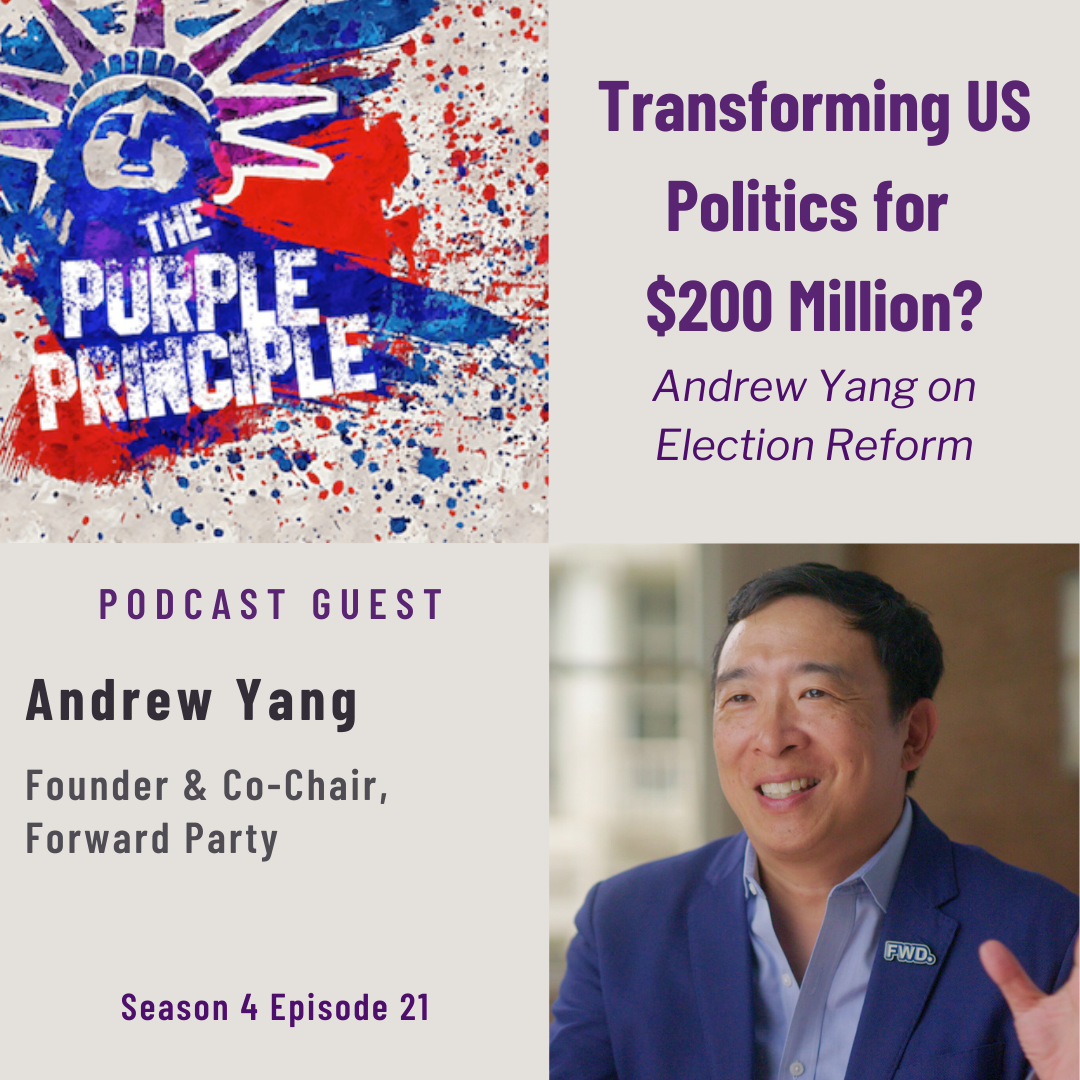
“You meet them and you’re like, ‘oh, wow, you’re a good person trying to do the right thing, and there’s nothing in it for you,’” says Andrew Yang, Founder and Co-Chair of the Forward Party. He’s referring to largely volunteer teams around the country that have raised the profile for election reform in 2024. “I mean, what could be more worthy of praise than that combination of attributes?”
Yang was a relative unknown upon entering the 2020 Democratic Presidential primaries. But that did not last long. He energized young voters with his informal approach to campaigning and practical position on innovative policies, such as universal basic income.
“The reason I do what I do is because I don’t have that positive an outlook as to what America’s future looks like if we don’t get our s%%# together,” says Yang, also an author and frequent commentator on major news networks. “Like it or not, the world’s future is determined very much by what happens here in the United States.”
Tune in to find out why Yang and the Forward Party support election reform in all its variations for 2024 and beyond. And why $200 million dollars spent on election reform, which is less than that spent on several Senate campaigns this year, could transform American politics for the better.
The Purple Principle is a Fluent Knowledge production. Original music by Ryan Adair Rooney.
Opening
Andrew Yang (Guest): It was 2020, I’d come off the election trail and I felt despondent about the future of the country, still.
Robert Pease (Host): Andrew Yang, founder of the Forward Party, was a surprisingly strong Democratic candidate for President in the 2020 primaries.
Andrew Yang: My campaign had in some respects achieved its main goal, which was to mainstream the fact that AI was going to come and change the labor market and we needed solutions like universal basic income.
Robert Pease: Yang entered that race as a relative unknown but generated a lot of excitement, especially among younger voters and qualified for most of the primary debates until suspending his campaign after the New Hampshire primary.
Andrew Yang: But I felt terrible. And so I started researching why I felt like the solutions were eluding us. And I read Why We’re Polarized by Ezra Klein, The Politics Industry by our friends Katherine Gehl and Michael Porter. And They Don’t Represent Us by Lawrence Lessig, these thinkers that I admire a great deal.
Robert Pease: Yang has since been a consistent advocate for election reform, such as in his own 2021 book, Forward: Notes on the Future of Democracy, and his position as Co-Chair of the Forward Party.
Andrew Yang: And I realized that these are the people that have identified the real core structural problems that are going to keep us continuously frustrated at the fact that solutions are not on offer. Because right now our political leaders are disincentivized to actually solve the problem.
Robert Pease: I’m Robert Pease and this is The Purple Principle, a podcast about the perils of polarization, with the privilege of speaking with Andrew Yang this episode, our last before the November election in which a record number of voters have the opportunity to pass election reforms in states in as politically different as Colorado and Montana, and geographically distant as Washington DC and Alaska. Will 2024 be a major tipping point for non partisan election reform? We asked Andrew Yang what’s he’s feeling as election day approaches.
Andrew Yang Interview, Part One
Andrew Yang: I am optimistic and yet anxious I’d say because I know people on the ground in each of these states that have been fighting to make these reforms happen, that have been fighting to make these reforms happen generally without getting compensated in some way, just taking their weekends and evenings and in some cases their entire lives. And I know that it would be highly unrealistic to have every effort be successful.
Andrew Yang: But what’s fascinating is that all of them are going to be close. Plus you don’t know what the opposition is going to do in the last two weeks. That’s always this giant unknown. So I’m optimistic, but concerned.
Robert Pease: Why do you think so many efforts have come into being in 2024? Why not 2020? Why not 2016? We’ve been experiencing these problems for decades. What is it about this moment?
Andrew Yang: I want to give credit to the people who’ve been banging this drum for years and years and years. Folks like Rob Richie who’ve been championing ranked choice voting since the eighties or nineties…when most of us, myself included, didn’t really figure it out until more recently.
Rob Richie (Prior Guest): I would say the case for changing how we vote to me has been compelling for decades. Right, so I helped start FairVote in 1992 because at that time the major parties seemed to be a duopoly, sort of just hip locked. And there was a feeling that we just needed an infusion of new energy.
Andrew Yang: But I think that now the average American, if you ask them, “Hey, how are things going?” They’ll be like, “you mean our political system? Not well at all.” And then if you ask them, “how do you feel about the two party system, the primaries, our democracy as it currently stands,” people will have a very negative attitude and they’re not wrong. So I think that these reforms are response to the tenor of the times.
Robert Pease: Well, you mentioned Rob Richie at FairVote. Who are some of the other people that you feel like have brought us to this moment where reformers in multiple states do have a chance? They won’t all pass, but many of them have a good chance this year?
Andrew Yang: No, certainly Nick Troiano at United America
Nick Troiano (Prior Guest): We’re leading with principles. And there are two very important principles, uh, to election reform that United America supports. The first is that every registered voter ought to have the right to vote in every taxpayer funded election for any candidate regardless of party. And the second principle is that whoever wins the election ought to have a majority of voters supporting them. You know, those are two principles supported by 70, 80 plus percent of Americans regardless of party affiliation.
Andrew Yang: and the folks at UA (Unite America), which includes folks like Kathryn Murdoch, John and Laura Arnold, Mark Merrill, Kent Thiry, folks who’ve put their money where their mouth is. You know what I mean? I can’t tell you how many well-resourced individuals I met with who’d express frustration about the current system. And I’d say, “well, there’s actually someplace you can put some of that money to work if you want to try and fund ballot initiatives.” And most people stop well short of taking that kind of action.
Robert Pease: Well, let’s talk a little bit more about Katherine Gehl’s book, The Politics Industry, which excited a lot of people…
Robert Pease: We’re wondering what were your reactions as you read it for the first time?
Andrew Yang: I remember reading The Politics Industry in 2020 and saying, “this is the most effective, accurate diagnosis of the problem in American politics.”
Katherine Gehl (Prior Guest): it’s the only industry I can think of where those people in the industry playing that game, their jobs and their revenue in the politics industry are the ones that make the rules that govern that industry.
Andrew Yang: And the most concrete solution I have seen.
Katherine Gehl (Prior Guest): We get rid of party primaries and implement a single ballot election where everybody runs on the same ballot and the top five finishers advance to the general election, regardless of party. And the second change is that in the general election, we eliminate plurality voting and we implement instant runoff voting, which uses a ranked choice ballot.
Andrew Yang: This is as close to the answer as I have read, and I need to contact Katherine Gehl and, see how I can help.
Robert Pease: And now Katherine describes her organization as a catalyst organization… How do you think she and the movement are doing at sort of broadening their base of support?
Andrew Yang: I think objectively the movement is growing all the time. The question is whether it’s going to be big enough, fast enough, because our institutions are degrading beneath our feet and we don’t have unlimited time. But I think Katherine should be very proud of everything she and her organization have accomplished. She’s a genuine leader.
End Andrew Yang Interview, Part One
Robert Pease: We’re speaking with Andrew Yang, former Presidential and New York mayoral candidate, Founder and Co-Chair of the Forward Party, author, and commentator on US political dysfunction and how to emerge from it. Back in his 2020 presidential run, Yang generated a lot of excitement based in part on personna:
Andrew Yang [2019 Democratic Debate Night 2, Yang’s Opening]: We need to the opposite of a lot of the things we’re doing now and the opposite of Donald Trump is an Asian man who’s good at math”
Robert Pease: But more importantly, and also exceptionally, Yang ran his campaign based on policy and on principle:
Andrew Yang [2018 Interview on UBI]: So, universal basic income is extraordinarily pro-capitalist because it is going to support the consumer economy at a time when that is exactly what it is going to need. Because capitalism does not function very well when people don’t have money to spend or when society is becoming increasingly dysfunctional.
Robert Pease: In addition to universal basic income, Andrew Yang and the Forward Party, they are strong supporters of election reform in all the various ways it is taking shape this year, in 2024 – open primaries, ranked choice voting and their combination in Top or Final Four or Five voting. Specifics do vary state by state. But the objectives of less polarizing elections and more pragmatic government – they are the same. We asked Andrew how the Forward Party might benefit if a good number of state level election reforms are passed this election and implemented in 2025.
Andrew Yang Interview, Part Two
Andrew Yang: Imagine a system where anyone could run for office and you could vote for multiple people, and you can have victors from different parties emerge who would wind up competing against the traditional Democrats and Republicans. I would put forward, that Forward Party would be backing a lot of the natural candidates that would emerge and that we would benefit enormously from these reforms. It’s something of a virtuous circle where we exist to help make these reforms happen. And then after the reforms do happen, then folks who the Forward Party runs as candidates or is supporting in some way would have a much better chance of success.
Robert Pease: And in your TED Talk and other appearances, you’ve said for as little as $200 million dollars, a drop in the bucket of the electoral bucket, we could reform the system. So tell us how you arrived at that number and is it going up a little bit with time, like so many other things in politics?
Andrew Yang: So of the states that you’re talking about in November, I think something like $75 to $90 million is going to be spent trying to make these reforms happen and not all of them are going to succeed. My $200 million figure was an estimate at trying to make it happen in 10 states and then figuring that five or six of them would succeed. We’re going to see whether that estimate was more or less accurate. But the thought was that if you had five or six states with nonpartisan primaries and Final Four voting, let’s say, then you might have 10 or 12 US senators that had the public’s interest top of mind as opposed to trying to stay on the good side of one wing or the other. And then you might have a completely different climate in Washington.
Robert Pease: Well let’s talk then about 2026. There are a number of states watching what happens in 2024, hoping to move ahead in ’26.
Andrew Yang: Yeah, let’s go.
Robert Pease: What do you think has to happen in November, 2024 for these states to move forward with confidence?
Andrew Yang: I’m a simple man. Check it out:
Andrew Yang: 2020, Alaska.
Andrew Yang: 2022, Nevada, stage one.
Andrew Yang: 2024 – You need at least two states to step forward, and then you can show growth so that you can be at, let’s call it three or four states total having adopted. And then you can point and say it’s real. It’s growing. You can go to any of these states and see what they made possible.
Andrew Yang: So I think you need two states to have it pass in November in order for the movement to say, this is growing and working.
Robert Pease: And how important is Alaska, which inspired so much of this energy? How big of a problem if it is repealed in Alaska? Does that set things back regardless of what happens in other states?
Andrew Yang: Alaska going backwards would be a setback no matter what, because it’s the clearest example of these reforms having their desired effect. And the fact that someone might be able to undo it is a negative no matter how you slice it. Now, I think most people can sense that what you have in Alaska is a reform that ended up empowering the majority to get what it wants. And then there was a very activist minority that said, “Ooh, I don’t like this situation, so let me do some dirty work and undo it.” So I don’t think that the reform movement will take the wrong lesson from Alaska, but you certainly want the original example to persist and show that these changes can be evergreen.
Robert Pease: Well, we’ve seen a number of high profile people express an interest in running for office and then express frustration that neither party speaks to them. And I’m thinking about a brief flirtation Matthew McConaughey had with running for governor and the No Labels movement unable to attract a candidate. If these reforms pass in four or five or six states over the next few years, does that change?
Andrew Yang: I’ve had conversations directly with people who would be, in my opinion, very, very formidable presidential candidates as an independent. And one of them even said something very concrete to me as a challenge. He said, “get me eight senators.” So if you wind up with folks who are genuine independents in DC and there’s a real cohort and movement, then it’s much more appealing for someone to throw their hat in the ring because no one wants to just be out there on an island.
Andrew Yang: And a lot of folks who are very, very rich or famous or whatnot, I mean, that’s a very unappealing proposition. Some of them were even smart.
Andrew Yang: They didn’t get to where they were by smashing their head into a brick wall. And so if you can say like, okay, you’ve got this battalion over here. You’ve got the battalion over here, and then you’ve got the squadron here. And the squadron is comprised of some awesome people every walk of life. And this squadron here, by the way, actually happens to represent the majority of the country. Then you’d get more takers as someone who has had conversations with some of the people you mentioned.
Robert Pease: What is it about people in the reform movement that they’re able to see this systemic problem and want to do something about it? What is it about their patriotism and how do you make that more attractive to more Americans?
Andrew Yang: This is the thing that’s wild about it, I think what sets us apart and oh, wait, right, check it out, check it out. I have been to gatherings of Republicans. I’ve been to enormous gatherings of Democrats, as you can imagine. I’ve been to gatherings of libertarians, I’ve been to gatherings of forwardists. And one of the things I become attuned to is like, okay, is there a certain sort of person that this group attracts? That this group grows to embody?
Andrew Yang: If I had to use attributes to describe them, they tend to be very lucid, very principled, and not very conformist, and not super concerned with status in a conventional way.
Andrew Yang: Yeah, I mean, there’s some of my favorite people now in particular, because you meet them and you’re like, “oh, wow, you’re a good person trying to do the right thing, and there’s nothing in it for you.” I mean, what could be more worthy of praise than that combination of attributes?
Andrew Yang: And then you have the government of the United States, which still, richest, most powerful nation in the world, still the most integral to solving any of our biggest challenges. Getting that government to respond to the will of its people, I’m going to suggest is the most important first order challenge. And it’s also the highest leverage. And I use 200 million as an examples, you can pick a number 2 billion, whatever, 20 billion would still be the most screaming value anyone can think of in terms of making meaningful progress on solving humanity’s greatest challenges. And the reverse is true too. If we do not do it, then our challenges are going to get more and more difficult and even insurmountable over time. I mean, the reason I do what I do is because I don’t have that positive an outlook as to what America’s future looks like if we don’t get our [beep] together or the world’s future. Because like it or not, the world’s future is determined very much by what happens here in the United States.
End Interview
Closing
Robert Pease: Andrew Yang on the global and really existential importance of the US government moving from dysfunction to a more rational functional place. This year’s historic crop of state level election reforms, they can’t fully transform Congress overnight. But, as Andrew and many of our guests in this series have emphasized: they could be an important step forward for both national and state level governance. And that would motivate reform leaders and supporters in other states to move ahead in 2026 and beyond on both ballot and legislative efforts to change our elections and more effectively incentivize those we do elect.
Robert Pease: First, though, these 2024 election reform ballot measures, they need to win voter support in an environment dominated by the Presidential race and battered by storm clouds of misinformation around election integrity. Here on the Purple Principle, we encourage all of you to vote for democracy up and down the ballot and tune in next time as we examine the results of the ballot measures in 8 states plus Washington DC that we’ve visited in this series.
Robert Pease: The Purple Principle is created by a talented team of media reformers: Kevin A. Kline, Sr. Audio Engineer; Vienna Maglio, Bookings & Field Producer; Trevor Prophet, Digital Ops & Strategy; Mary Claire Kogler, Video Production; and Sarah Kim, Fact Checking & Research.
Robert Pease: The Purple Principle is a Fluent Knowledge Production. Original Music by Ryan Adair Rooney.
Our Guests:
- Andrew Yang, Founder & Co-Chair, Forward Party
Additional voices from prior episodes:
- Rob Richie, Co-Founder, Senior Advisor of FairVote
- Nick Troiano, Executive Director, Unite America
- Katherine Gehl, Founder, The Institute for Political Innovation
Join Us for Premium Content:
Apple: https://link.chtbl.com/PurpleApple
Patreon: patreon.com/purpleprinciplepodcast
Find us online:
Twitter: @purpleprincipl
Youtube: @thepurpleprinciple
TikTok: @thepurpleprinciple
Facebook: @thepurpleprinciplepodcast
Instagram: @thepurpleprinciplepodcast
Our website: purpleprinciple.com
Subscribe to our newsletter: bit.ly/3wDbr4o
Additional Resources / Fact Checking:
- AndrewYang.com
- Andrew Yang – Wikipedia
- Forward Party
- Andrew Yang Universal Basic Income – “The Freedom Dividend”
- Radical Proposal: Universal Basic Income to Offset Job Losses Due to Automation
- Books | Andrew Yang
- Why We’re Polarized | Book by Ezra Klein | Simon & Schuster
- The Politics Industry | Book by Katherine Gehl
- They Don’t Represent Us: Reclaiming Our Democracy | Book by Lawrence Lessig
- FairVote
- Unite America
- The Primary Solution by Nick Troiano
- The Institute for Political Innovation
- Andrew Yang Ted Talk
- 2019 Democratic Debate, Night Two (Yang’s Opening Remarks)
- The Case for Universal Basic Income, with Andrew Yang | Carnegie Council for Ethics in International Affairs