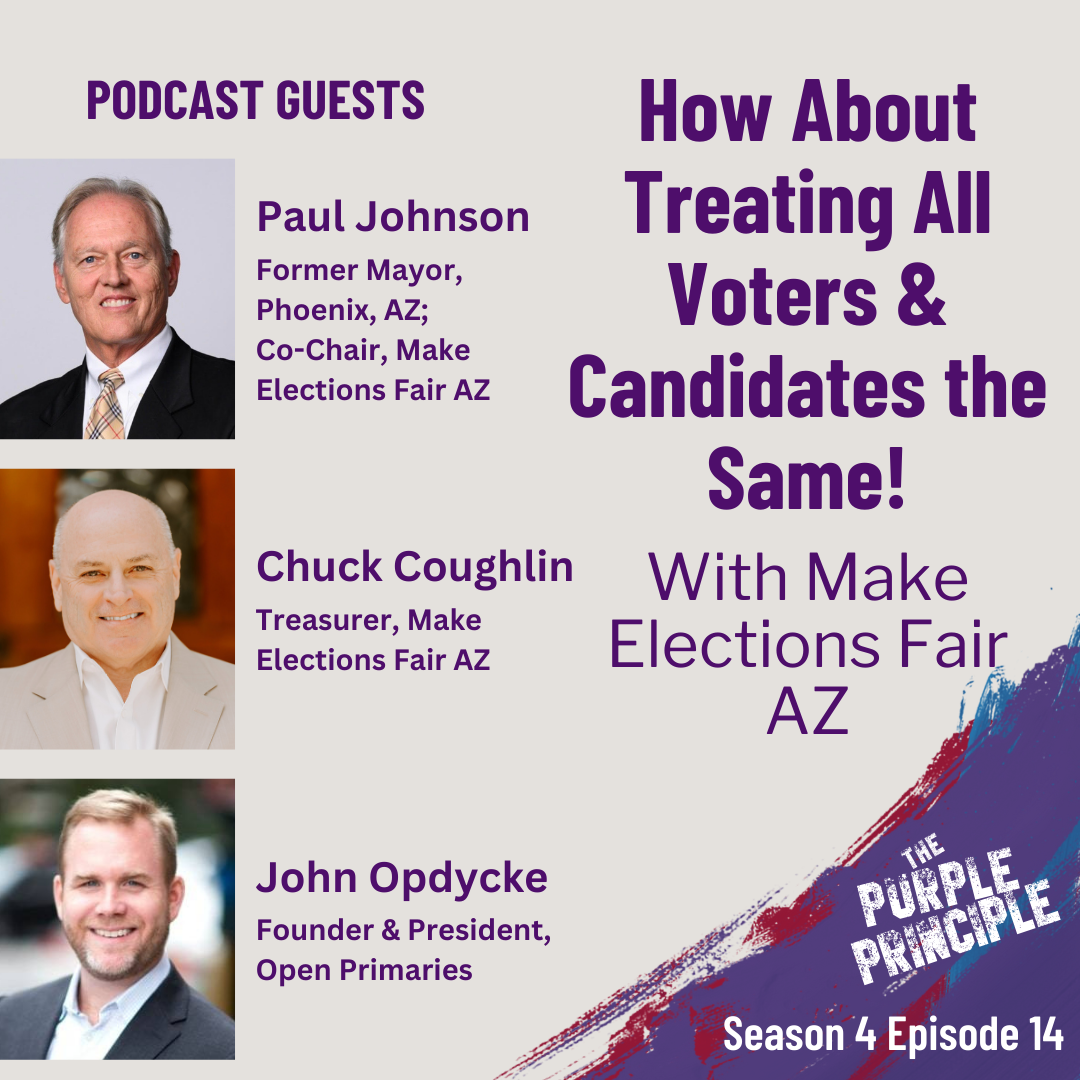
How About Treating All Voters & Candidates the Same!
Paul Johnson & Chuck Coughlin of Make Elections Fair AZ
“Everybody likes to think about these reforms as being revolutionary,” says Paul Johnson, former Mayor of Phoenix, now Co-Chair of Make Elections Fair AZ, on the record number of state level election reforms in play this year. “They’re not. City governments have been doing these reforms for about 50 to 60 years.”
Johnson, a former Democrat turned Independent, is leading a third attempt at opening primary elections in Arizona to independent and unaffiliated voters through a 2024 citizen ballot initiative that also amends the state constitution to allow ranked choice general elections. He’s joined in this effort by GOP strategist Chuck Coughlin, a veteran of hundreds of candidate and issue campaigns in the Grand Canyon state and now treasurer at Make Elections Fair AZ.
“The very basis of our thinking is that if you’re going to use taxpayer money to run an election,” says Coughlin, “you have to treat every voter the same. You have to treat every candidate the same. I mean, that is a principle part of our American jurisprudence and the way we govern ourselves.”
A Measured Approach
In this episode, we learn how Johnson and Coughlin initially hoped to pursue the Alaska election Final Five Voting model of a unified open primary plus ranked choice general election. Ultimately, they decided on a measured approach with higher probability of success.
“We did five statewide surveys trying to see if we could get that done, which would be a Final Five open primary, ” says Coughlin. “I concluded in June of last year that that was not possible…. Paul and his colleagues came back and said, ‘Hey, we just want to do an open primary.’”
Listen to the episode as Chuck and Paul share the data behind their incremental approach to election reform.
Past Rivals Work Together
We also hear how two political rivals (Paul & Chuck) joined forces in advocating for more sensible elections and pragmatic representation in the highly polarized state of Arizona.
“I always liked to tease Chuck that the only job that he had in the governor’s office was to destroy my career,” says Paul Johnson of two Gubernatorial campaign losses to candidates supported by Coughlin. “And he likes to tease me back, he did a pretty good job.”
Is this the year Arizona voters embrace the principle of treating all voters and candidates the same in their elections?
In fact, this Arizona amendment could precede further general election reform via the legislature or citizen ballot process. Opening party-run primaries could even happen in the near term.
This episode is part of our season-long non partisan election reform series. Previous episodes have visited Washington DC, Idaho and South Dakota. Upcoming episodes travel to Nevada, Colorado and Alaska.
The Purple Principle is a Fluent Knowledge production. Original music by Ryan Adair Rooney.
Watch Now: Episode Highlights With Make Elections Fair AZ
In this video highlight, hear Paul Johnson & Chuck Coughlin promote open primaries as a way to increase voter equality and bring people together.
We will be posting new content each week to The Purple Principle YouTube channel, such as shorts, highlights, and previews for our podcast episodes.
Opening
Paul Johnson (Guest): Everybody likes to think about these reforms that we’re talking about as being revolutionary. They’re not. City governments have been doing these reforms for about 50 to 60 years.
Robert Pease (Host): Paul Johnson was a city councilor at the tender age of 26 and the Mayor of Phoenix at age 30. He comes at the issue of non partisan election reform in Arizona today with the experience of running a major city.
Chuck Coughlin (Guest): So the very basis of our thinking is that if you’re going to use taxpayer money to run an election, you have to treat every voter the same. You have to treat every candidate the same. I mean, that is a principle part of our American jurisprudence and the way we govern ourselves here.
Robert Pease: Chuck Coughlin is a veteran Republican strategist in Arizona who helped defeat Paul Johnson in his two Democratic campaigns for Governor. Today he’s working with Paul and the group Make Elections Fair AZ, to open primaries in Arizona to independent voters and pave the way for less polarizing elections and governance.
Paul Johnson: So I always liked to tease him that his whole only job that he had in the governor’s office was to destroy my career, and he likes to tease me back. He did a pretty good job.
Robert Pease: Paul and Chuck were on opposite sides of the political fence for decades. But they’ve now teamed up on an innovative constitutional amendment that opens the door to ranked choice or instant runoff general elections not currently allowed under the state Constitution. And it also fully establishes a unified primary election of all candidates open to all voters.
Paul Johnson: What I would say are the biggest effects are people who are beginning to increasingly feel like they’re left out of the system. People who no longer want to register as a Democrat or as a Republican because they feel that the parties just simply don’t represent them. It’s been the largest voting block of people inside of our state. In general, independence and unaffiliated voters represent more people than both the Democratic party and the Republican party.
Chuck Coughlin: We’re getting worse and worse outputs and much more conflict oriented, much more deeply partisan. And on issues like water, which are critical to Arizona’s long-term success, we don’t have people that can see the wisdom of compromise.
Robert Pease: I’m Robert Pease, and this is the Purple Principle, a podcast on the perils of polarization. Arizona is one of the nation’s most polarized state governments, not just over past election results but over issues as fundamental to the state’s future as water policy. Could this open primaries amendment turn the tide on dysfunction and performative politics in the Grand Canyon State? We kicked off this discussion with some due diligence on Paul and Chuck’s political backgrounds, starting with Paul Johnson, former city councilor and Mayor of Phoenix, and how this experience of running a major city informs his election reform efforts today.
interview, Part 1
Paul Johnson: If you look at the polling of those different cities, what you’ll find is at the federal level, our congress is about 19 to 20%. From a popularity standpoint, our state governments run about 20 or 22%, but cities run between 50 and 60% popularity. Now, I’ll tell you the notable exception, that 30% of cities that are partisan cities, those cities fall back down into the single digits, or excuse me, the teens and 20 percentile. The point is that the public tends to like their government better when they have open primaries. Now, you might ask the question why, and I’ll give you an example. So when I was 25, I ran for city council and I had to go out and knock on doors when I would knock on doors. When you run in an open primary, you get a list of every single registered voter. I received 80,000 registered voters.
Paul Johnson: Now, I literally in about a year knocked on every one of those doors. I spoke to about 28,000 people. I know that because I wrote a handwritten postcard to every one of those 28,000 and then followed up with the GOTV effort to those individuals. But the point is this, I’d knock on democratic doors and I’d hear somebody on the Democratic side talk about their park or their school or the local issues that they thought were important. I’d knock on a Republican door and I’d hear somebody talk about their business or what regulations were doing to them or what the city closing down a street, the effect that that would happen.
Paul Johnson: Now, compare that if you would, to someone who runs for the legislature to begin with, you got to start with the numbers.
Paul Johnson (00:06:44): Out of every single registered voter today, about 70% are registered to vote of the 70% third or Democrat third or Republican or third are independent. So if you take that third times it by the 70%, you’re in the twenties, but turnouts in the primary drop all the way down to about 35%. Now you’re talking about eight or 9% of the public, and then what happens is in 70% of the 5,000 elected seats in America, they’re gerrymandered or stacked to the point where the person who wins the primary doesn’t have a general election. Now, think about that candidate. He goes out, he didn’t get a list of every voter. He just gets a list of the voters that are in his party, in his district, and for that matter, he only gets the high efficacy voters. So he goes and speaks to them. Now, here’s what I can tell you from seeing polling for years, both voters on the democratic side and on the republican side, when you get down to the small group of people who vote, they’re grievance driven.
Paul Johnson: They’re not driven aspirationally. They’re driven by their grievances and their hate of the other side, and then when they win, when they win, just talking to that list, 70% of the time, they never have to go speak to people on the other side. So the first question that we should ask ourselves is, are our candidates better when they have to talk to people other than just the people they agree with, should everyone have a chance for representation in our system? That to me is the key, and what it does is it begins to change this binary look at our politics.
Robert Pease: Well, I can hear how much of that informs the amendment that you filed. It’s such an interesting amendment. We’ll get to that in a minute. But Chuck, let me turn to you and ask about your background. You’re a veteran political strategist. Have you mainly worked on the GOP side in your career and how do you transition from that to working on something like this, which is nonpartisan?
Chuck Coughlin: So I came out here in 1985 to work for John McCain on his first Senate campaign in 85 and 86 when Barry Goldwater was retiring, worked for Chamber of Commerce after that; went to work for a firm similar to my own at that point, learned how to run statewide campaigns, mostly business republican oriented firm and almost exclusively Republican. And then started the firm 27 years ago in 1995, and then so we have been almost an exclusively Republican firm from then.
Chuck Coughlin: We’ve migrated over time because of the experience of the firm into senior consultants, to people who need problems solved League of Cities and towns. Lots of cities hire US counties. Maricopa County is a client, big businesses that need problems resolved,
Chuck Coughlin: You know, in 2022, I was given about $280,000 to run an independent expenditure campaign on behalf of a bunch of incumbent Republican office holders and incumbent democratic office holders that were problem solvers on the issue of water here in Arizona. All of them lost. I spent $280,000 and uniformly the Republicans lost to more progress, more populist Republicans. And then all the Democrats lost to more progressive candidates. I just sort of threw my hands up in the air. I’m like, this isn’t working anymore.
Chuck Coughlin: A group of people, including Paul, approached me because of my political experience. We’ve run hundreds of campaigns in Arizona, been successful at a number of ballot initiatives and ballot efforts and candidate campaigns and bond issues and all kinds of stuff. They came to me and they said, hey, we want to work on this. They sent me Katherine Gehl’s book, The Politics Industry. I read that in a weekend and I’m like, yep, this is the problem.
End Interview Part 1
Robert Pease: We’re speaking with Paul Johnson and Chuck Coughlin of Make Elections Fair AZ, the group proposing an innovative Open Primaries constitutional amendment in Arizona this year. Make Elections Fair came around to the idea of an open primaries initiative after first weighing the possibility of a Final Five voting amendment patterned on the Alaska 2020 voting reform, and currently being pursued in 4 other states this election cycle. Again, Final Five or Four Voting combines an open unified primary with a ranked choice general election. Katherine Gehl, the architect of Final Five voting, discussed Arizona’s decision to not pursue a Final Five in our interview earlier this season:
Katherine Gehl (Former Guest): So I actually thought that Arizona was going to be the next state likely to have a Final Five election ballot initiative in 24 because they had a super motivated group of leaders, and they contacted me very early and they were very politically sophisticated. So I was very bullish there. I spent lots of time there. And then, ultimately, it’s like I say, there’s a funnel and then you drop off when it becomes clear that it’s not a good investment. I mean, you need to make a rational decision. So they’re moving forward with a different type of reform right now, which I will certainly be rooting for.
Robert Pease: This Arizona open primaries reform may not be as far reaching as Final Five Voting but it is more ambitious and therefore potentially more impactful than simply opening up primary elections to independent voters. John Opdyke, Founder and President of Open Primaries, one of the nation’s foremost election reform groups, speaks to the unique nature of this Arizona amendment.
John Opdycke: So they’re combining open primaries for presidential with nonpartisan primaries for state and federal, and they’re not saying how many candidates go from the primary to the general election. They’re saying that’s up to the legislature. Could be top two, could be top three, could be top four, could be top five. It actually creates a really fluid, flexible environment where the question of what’s the best system for Arizona can constantly be engaged and re-engaged.
Robert Pease: Opdycke has been involved in dozens of state level open primary amendments since founding Open Primaries fifteen years ago.
John Opdycke: I think where they’ve landed is a very innovative policy that’s never been done in another state. And I think if it’s successful, a lot of people around the country are going to look to Arizona as a model they want to emulate in some form or fashion.
Robert Pease: With that perspective in mind, let’s learn more about this original approach to election reform in Arizona, starting with that decision to not pursue Final Five voting in 2024 but instead to open primaries and lay the groundwork for further reforms similar to the Final Five model that is being pursued this year in Nevada, Idaho, Colorado and Montana.
Interview Part 2: A Unique Approach to Opening Primaries
Chuck Coughlin: We did five statewide surveys trying to see if we could get that done, which would be a final open five primary. I concluded in June of last year that that was not possible. I told my client, I’m done. We can’t do this. It’s not going to be possible. I could only get an open final five to about 49%. I saw no wisdom in running a campaign where I couldn’t tell the donors that we could win. And so they came back, Paul and his colleagues came back and said, Hey, we just want to do an open primary.
Chuck Coughlin: And I said, well, open primaries have a lot of questions too. Let’s get into that. We had some lawyers draft up what we thought was a very effective open primary law, and we tested the open primary law with not a definitive conclusion on how the general election would work. We defer the question of the general election, but we focus on the very simple notion of treating every voter and every candidate identically, which our current system obviously does not do. And with those type of equity arguments, we are in a powerful position to win a reform campaign much as we have formulated today, which calls for an open primary, treat every candidate the same, treat every voter the same, and then run a general election according to a very simple principle. We will tell the legislature to either, they could move the top five forward as a maximum or a minimum of two so they could move the top two forward.
Chuck Coughlin: We’re not taking a position on that because we simply say anything’s better than the current system.
Robert Pease: Well, it’s interesting that you considered Final five voting. Do you think in a sense, you are creeping towards it because there is some language in the amendment that allows the legislature to implement a rank choice general election?
Chuck Coughlin: Right. So what we did was we legalize it. Currently rank choice voting is illegal in Arizona, it’s unconstitutional, since the state was founded. When the state was founded, it was a very progressive state, right? And they actually empowered voters to go pick their partisan candidates rather than a smoke-filled room. But what we’ve now gotten in the age of the internet and social media is we have an internet smoke-filled room of people who decide who the outcomes of those elections are.
Chuck Coughlin: So we want to bust that open. We want to break the stranglehold that those two parties have on the system. We want to eliminate their authority because what we do in our initiative, we specifically say it is illegal to spend taxpayer funds on a partisan election. And so what we do is we legalize rank choice voting, but we do not mandate it. We clearly say that is not up to us. That’s up to the legislature and the governor to define going forward, and that allows us to focus our narrative on this equality issue and our equality issue of treating every voter the same, and we believe we can win on that.
Chuck Coughlin: I think we would all agree that Final Five Voting is probably the most competitive model that there is. I have no qualm with Katherine’s conclusions. Having five choices is better than having two. But there’s significant parts of our electorate in Arizona, mostly Republican, mostly older voters, who do not see that as a wise choice.
Robert Pease: And Paul, let me ask you, in this period when you were contemplating and polling about final four or five voting for Arizona, were you hopeful that you could go for the most ambitious reform or were you skeptical that it was going to work in Arizona?
Paul Johnson: Oh, no. I started out very hopeful. And I would tell you to try to parse Katherine’s proposal apart. Because her proposal, if you read her book, it has the portion that deals with the primary, then the portion that deals with the general. What she talks about doing in the primary is exactly what we’re doing, the issue of what she proposes in the general we leave open.
Paul Johnson: So there’s a group in Arizona that’s called The Arizona That We Want, and they have been polling, it’s ASU, but they’ve been polling trying to figure out is there common ground on complex issues. They have found through polling an amazing array, you can go on their website and look, an amazing array of issues where literally 70% of the public agrees on what needs to happen. And it’s spread out. It’s spread out by supporters of Republicans, Democrats, and Independents. But they had to ask this question: if 70% of the public are supporting with an overwhelming amount of Democrats and Republicans, why can’t they get any of these issues through the legislature? Here’s the answer. They’re polling the wrong people. They’re polling the people who vote in a general election. You have to poll the people who vote in the primary. And I can tell you amongst that group, they’re not driven by aspirational causes, they’re driven by grievances. They’re driven by a fear and a hatred of people on the other side.
Paul Johnson: So the question becomes how do you create that type of change? And what we saw from the polling was clear. Chuck would tell you that they were opposed to it, and I think that’s true, but I think they were also confused. That’s becomes a lot to put on top of people. Here’s what we’re going to do different on the primary. Here’s how we’re going to run the general. Here’s how a top five works. Here’s how an open primary works. It was so much of a load, you just couldn’t get people to do it. But when you got them down to some simple basic things, they were very supportive. Here’s one, today a third of the voters are independent. In Arizona. If you want to run as an independent, if you run as a Democrat for statewide office, you need 6,000 signatures run. As a Republican, you need you, 6,000 signatures. To run as an independent you need 40k signatures.
Paul Johnson: Almost every voter says, that’s not fair. That’s not what we want. They want to make certain that every voter is treated equally. Well, if you’re going to do that, the open primary becomes an important component. Get that part fixed. I believe that’s 70 to 80% of the question. After that. If people want to go back and make it a top four or top five one, they now can do it legislatively. Two, they can do it through an initiative or a referendum if they would like, but get the part done that you can get the bite done that you can do. Because if you don’t, you’re going to end up with nothing. And we’re going to continue down the same path that we’ve been on where we’re incredibly divided, where a very, very small group of people are running the show.
Robert Pease: So let’s get into a couple of aspects of the amendment that I think are a little unique to Arizona. You’ve mentioned the fairness, and we do hear that argument or that messaging in other state initiatives, in South Dakota where we interviewed the other day. But it is interesting that you are referring this back to the legislature. Does that not depend on cooperation from the legislature?
Paul Johnson: Let me start with that, then I’ll let Chuck take the back end of that. First, we’re not referring it to the legislature. Today, the legislature has control over the primary and the general election. We’re taking the control away from them on making certain that all independents are treated fairly and that there’s an open primary. If the voters pass that, there’s nothing that the legislature can do or say on that. The only portion being referred back to them is how do you deal with the general election? My argument is we’re not just referring that back to them, we’re referring that back to them and the voters. At the end of the day, the voters want to change that piece of it, they can.
Chuck Coughlin: I understand that thinking that we’re empowering the legislature, but we are curtailing, as Paul just said, what the legislature can’t do by specifically stating in the state constitution that they shall do no more than five, no less than two, and if they do three or more, they got to rank it. That’s in our initiative. So we create a very specific menu for them to choose from. And as I said earlier, any of those systems are better than the current system we have today. We can be totally agnostic about it because any of those things, top two, top three, four or five is much superior to a system today where 80% of the people have no competition in the general election.
Robert Pease: Well, it’s a fascinating amendment. Another I think fairly unique aspect of it is at the presidential primary level. Could you explain that to our listeners and also your challenge to the parties that if they want to exclude independent voters then they have to pay for the primaries themselves.
Chuck Coughlin: So the very basis of our thinking is that if you’re going to use taxpayer money to run an election, you have to treat every voter the same. You have to treat every candidate the same. I mean, that is a principle part of our American jurisprudence and the way we govern ourselves here.
Chuck Coughlin: Washington warned against this in his farewell address, the American apocalypse, the three things that he feared the most. Adams talked about it, his most grievous nightmare being that you’d have the combination of two parties just opposed to one another. And Jefferson said, if I got to go to heaven as a partisan, I’d rather not go at all. And so we have American history on our side here.
End Interview Part 2
Robert Pease: Chuck Coughlin there and Paul Johnson before him, of Make Elections Fair AZ, key members of a coalition working to pass a constitutional amendment this year to open and unify primary elections in Arizona and require the state legislature to ensure that at least two or as many as five candidates move forward from those primaries to a more competitive general election.
Robert Pease: That is never an easy task. And this year it’s complicated by the fact that the Arizona legislature has referred a competing ballot to, in fact, close those very same primaries even before they are fully opened.
Robert Pease: But if you’ve been listening to any part of our state election reform series this year, you know that the appetite for rational elections is at historically high levels in 2024 and in a record number of states.
John Opdycke: It’s still the case that the horse race attracts most of the dollars in politics at the state and the federal level. However, there’s been a sea change, and let me illustrate that in the following.
Robert Pease: John Opdycke, President of the national group Open Primaries, he describes the very different fundraising environment for election reform in Arizona today versus a decade ago.
John Opdycke: This will be the third year that we have moved forward with an open primaries effort in Arizona. In 2012, Paul Johnson led the effort and he said that the response that he got from the business community was, “I don’t even know what you’re talking about.” And he had trouble raising any money, and that effort lost. In 2016, we tried to do it again. The response from the local business community was, “this sounds important, this sounds good, I’m with you, but I’m not writing a check.” In 2024, we’ve raised $7 million from the Arizona business community. They’re now saying to our local leadership, “I now get this. I now know why it’s so important. How do I make my check out too? How do I do it?”
Robert Pease: It does take funding to get these reforms off the ground and onto the November ballot. It also takes teamwork, sometimes from former rivals like Paul Johsnon and Chuck Coughlin. And it takes a coalition of supporting groups particularly in a state like Arizona, the nation’s sixth largest by area and 14th by population. So we asked about other coalition members behind this innovative open primaries reform.
Interview Part 3
Paul Johnson: There’s a broad group of people that are supporting the effort. Here’s what I would tell you. Certainly independents I think are at the table. Independents today have no voice. Unaffiliated voters have no voice, and so we’re helping provide a voice for them by making certain that they’re not discriminated against.
Paul Johnson: If you look at two of the larger funders, there are people who have been very philanthropic and they’ve done a lot for education. Education is where they put their foundations to work. They’re very concerned about trying to make certain that America’s, Arizona’s children are educated. So I asked them the question, well, okay, if your foundations are so focused on education, why are you doing this?
Paul Johnson: And their answer was, you cannot fix education if we don’t fix the political process. The political process today just simply doesn’t allow for it. Oftentimes what you see is that on the Democratic side, they want more money, but they’re not supportive of any type of reforms that will give you better outcomes. And on the Republican side, they’re oftentimes very supportive of reforms, but they want no new money. And the answer is those two things often times are tied together. But what happens is in the partisan system, you always get this binary answer.
Paul Johnson: So think about this, pick a party and then you could say, well, either you can be pro-business or you can be pro-education. You can either be pro-labor or you can be pro-business. You can either be pro God or you can be pro-human rights. Pick a side.
Paul Johnson: Well, here’s what I would say to you.How can you possibly be pro-labor without being pro-business? How do you do that? Those two things are connected. And how in God’s name can you be pro-business without being pro-education? Those two things are connected. And God doesn’t support human rights? The answer is there’s not just two ways. There are a variety of ways. You don’t have to have a binary solution. You can find an answer where you can pull people together.
Chuck Coughlin: Yeah. Let me add to the support list. So a broad cross section of business organizations, East Valley Partnership, Greater Phoenix Leadership, Westmark Regional Business Organizations here, Southern Arizona Leadership Committee, Chambers Of Commerce, veterans organizations. We have a lot of support from a number of veterans organizations because as we know, most veterans are registered independent and they want to have their voice heard. It’s crazy to them that they can’t vote in the presidential preference election, that they have to break their oath. So that’s a big part of it.
Chuck Coughlin: But underneath all that, you know, Robert, we’ve been enormously blessed. We’ve raised over seven million dollars from Arizona voters. I have been blown away by the amount of support that we receive from the business and philanthropic community that understand everything we are talking about– that this is a crisis, our democracy is in a crisis and we need to address it now.
Robert Pease: And I believe you’re close to your signature submission date and well above the threshold. Could you give us just quickly those numbers and what you expect for the validation process?
Chuck Coughlin: We will be filing roughly 570,000 signatures on July 3rd at noon with the Secretary of State’s office. We’re required to have 384,000 valid Arizona signatures. Our current validation rate on our internal process is above 75%, so we are confident we’re meeting that threshold since our internal validation is more difficult than what the state does. So we’re validating every signature and so we will be on the ballot, we’re going to be on the ballot, and we’re going to go raise a ton of money and we’re going to change the way Arizona votes, and that’s going to be a great experiment for the rest of the country.
Robert Pease: Well, that’s very impressive signature collection. I wonder is that in part to signal to the opposition that you really have no hope of holding back the broad support for this because they have filed, as you know, a competing ballot initiative to close the primary. So tell us about that effort and how has it in any way complicated your messaging or your signature process?
Chuck Coughlin: We start off our campaign with 40% of the Arizona electorate telling us to go to hell. I’m fine with that. It is what it is, but we have 60% of the electorate that is open to embracing our idea. That 40% of the electorate I just referred to is the electorate that is represented down at the Arizona legislature. The legislature referred a closed primary ballot before the voters. It will be a 100 series question as well, which is a constitutional amendment. It will be on the ballot, and I love it that it’s on the ballot because it is perfect. It is a perfect contrast to what we are. If you like the way it’s going now, vote for that. If you don’t like the way it’s going now, vote for us. If you want to have the institutionalized inequality, vote for that. If you want to make sure that every voter and every candidate gets treated the same, vote for us. It’s a perfect juxtaposition for us. We love it, and our polling data shows that they’ll get back to around that 40% of the electorate. They’ll be enthusiastic supporters of them and they will end up crying in their Cheerios on election night.
Robert Pease: Well, you’ve talked about the support amongst independent voters in Arizona, obviously for this initiative, which would re-enfranchise them, but let’s dig down a little bit deeper into that demographic. It’s a huge number of people. Obviously there’s a lot of variety, but what do you know from your polling and your conversations?
Chuck Coughlin: So it is the fastest growing part of the electorate. We’ve seen one of the top line issues which we’ve seen since 2016. Then Trump won them, those unaffiliated voters, a majority of them in 2016. A MAGA candidate has failed to win a majority of unaffiliated voters since then. Kirsten Sinema prevailed in 2018 in her senate campaign. In 2020, the president and Mark Kelly won majorities of unaffiliated voters, And in 2022, Mark Kelly again was on the ballot for the end of that term and the rest of the statewide democratic ticket from the governor, the Attorney General and the Secretary of State, all won pluralities of those unaffiliated voters. What that tells me is that MAGA message does not resonate with them, and they like, as Paul says, they like aspirational things. They’re tired of the narrative of, you’re bad, I’m bad. And there’s not an aspirational message there.
Chuck Coughlin: I think you can hear when we talk about our initiative, it’s an aspirational initiative and that is highly motivating to that portion of the electorate. Our data shows that well over 60% of unaffiliated voters will support our initiative in the fall. We will get the support of between 55 and 60% of Democrats. Democrats historically have embraced the notion of ballot access, you know, making sure that everybody has an equal access to the ballot. That is a Democratic gospel, and we are going to sell that loudly to that portion of the electorate. And then there’s the portion of the Republicans that are dissatisfied with the way the country is going as well. We see that in Nikki Haley voters. We see that in other types of Republican voters, and we anticipate getting 40 to 45% of Republican voters in support of our initiative this fall.
Paul Johnson: You know what I could give you about independents, I’ve done a lot of polling on them or scene polling across the country of independents. It’s an interesting group, and again, I include unaffiliated voters in with independents, but what makes them interesting is about a third of them end up being very, very conservative. Another third of them end up being very, very liberal, and then another third are truly independents. They cross over on issues. They’re more moderate on different items. So you have to ask the question, well, why did you then register as an unaffiliated voter and independent? Why didn’t you just register as a Republican if you’re conservative or register as a Democrat if you’re liberal? The first answer to that question is they don’t want to be identified as being part of a group. They really like the individual message. They believe in the individual message. And the second thing is the two parties today are not the same party they were just eight years ago. They both are going through dramatic transformations.
Robert Pease: Well, you’re obviously focused on getting this amendment over the finish line, focusing on Arizona. You’ve customized it to the population there, but I do wonder at the same time, there are all these efforts all over the country in DC, in Nevada, in Idaho, in Oregon, in Colorado. Do you take some hope, some inspiration, some interest in these other movements that it feels like even though we don’t know the results yet, that it is kind of a, that there is momentum at the national level.
Paul Johnson: I don’t think there’s any doubt that there’s huge momentum at the national level. There are a number of groups who are deeply engaged in funding these types of efforts. Again, we’ve raised all of our money locally, but there are a lot of groups around the country who are trying to help out those local efforts. There are grassroots efforts that are beginning to take place. There are organizations that are beginning to form around the independent movement.
Paul Johnson: Look, I believe this. I think that there is a large group of Americans who actually like who we are, and when I say that, I mean they like the United States of America. They believe that we’re a cause for good. They recognize that we’re the greatest superpower in the history of the planet, and they don’t want to throw out the baby with the bath water. They’re hearing from the extremes on both sides that that’s exactly what they want to do.
Paul Johnson: And so increasingly more people are leaving the parties because the parties are not giving them a valid answer.
Chuck Coughlin: Yeah, I would say this that I agree with everything Paul just said. I would say this though, back to another thing. Paul is famous for saying. America is based on individual liberty, and Americans embrace identity, their own identity. They don’t like to be told what their identity is, and we are embracing that freedom. We are embracing individual freedom, rejecting categorization, and we embrace the very best about what is America. And I think that is a giant selling point for us and for all of the other efforts that you’re talking about around the country.
Paul Johnson: And let me say one more thing about Chuck if I could. Oftentimes, you can gain a huge benefit from people who don’t think like you think, that as opposed to seeing them as the enemy, he and I have become brothers in a variety of things. We still have disagreements, I’m sure. But the best thing about Chuck Coughlin is, and he forced us to be data-driven, a recognition that if you want to win, you have to look at the data and you have to think clearly. My recommendation to other groups is, look, I am a big supporter of top five but make certain when you’re doing this that you’re looking at not what you want, but what it is that you can get your voters to support. Because if you spend a lot of money and a lot of time and a lot of effort and you come up short, it not only is a great disappointment, it begins to add to the weight that maybe we can’t fix these things.
Chuck Coughlin: After we succeed in November, there will be additional litigation. I’m confident of that. There’ll be a single subject challenge, probably. There will be a lack of specificity challenge on mostly the legislative stuff, like what can and can’t they do. Our answer to that is, well, we’ll know that when we see it, won’t we? And so this is not easy. This is really, really hard to do. It’s the hardest thing I’ve ever done in my life, by far, because you are opposed by the two principal political parties and they are not happy.
Chuck Coughlin: One of the things that was pointed out yesterday, which was really interesting to me by some of these guys is they say, and I think they’re right, that elections are going to be more expensive. Yes, they will, because there’s more candidates. We’re going to increase turnout. We’re we’re going to increase volume. We increase participation, we increase campaign spending, and that will happen as a result of this.
Robert Pease: That is probably the one legitimate oppositional viewpoint we’ve encountered so far. Most of them are just talking points. It’s too confusing. It’s not fair to seniors or whatever, but the county clerks, the concern of the county clerks that we’re having a hard time getting election results out quickly, and this will make it more difficult and we may not be getting additional funding.
Paul Johnson: I would tell you, we’ve spoken to many of the recorders. I don’t think any of them see what we’re doing as being a problem. Again, every city does it, and I’ve watched the city clerks deal with this. They know how to make these elections work. I don’t think that’s the issue. Probably the biggest complaint that you’ll hear is they try to confuse you because the more they can confuse you, the better a chance they have. The people will vote no, and the big confusion is, okay, well what are the unintended consequences of this? And here’s what I would tell you. Eight years ago, 10 years ago, we tried to get this on the ballot. We were unable to get it done.
Paul Johnson: I don’t think people even dreamed what the unintended consequences would be of not getting it on the ballot. It isn’t getting better. It’s getting worse. There is a huge challenge in our system. We should be really worried about the unintended consequences if we just leave this thing alone. It’s not working. The public doesn’t like it. It’s giving us bad results. It’s not giving us the results that pull us together. It is intentionally, by design, dividing us apart. We can’t live with the unintended consequences of doing the same thing for another eight years.
Closing
Robert Pease: Paul Johnson there, former Mayor of Phoenix, former Democratic candidate not once but twice for Governor of Arizona, defeated in part by his current election reform teammate, Chuck Coughlin, a veteran GOP strategist. We learned a lot from both Paul and Chuck about how states adapt election reform goals to conditions on the ground. In Arizona, as in our previous episode on South Dakota, that meant simplifying the request from ballot voters and focusing the message on the fairness of allowing all voters to vote in all taxpayer funded elections.
Robert Pease: We’ll be checking back with Paul and Chuck as the November vote nears on this Arizona constitutional amendment and as opposition from one or both parties heats up on this reform, which shifts political power toward the voter and creates more truly and broadly competitive elections.
Robert Pease: Next up, we’ll travel to Nevada where election reformers are working to pass a constitutional amendment to create final five voting for the 2nd time, as required by the Nevada Constitution– And despite strong opposition from both major parties.
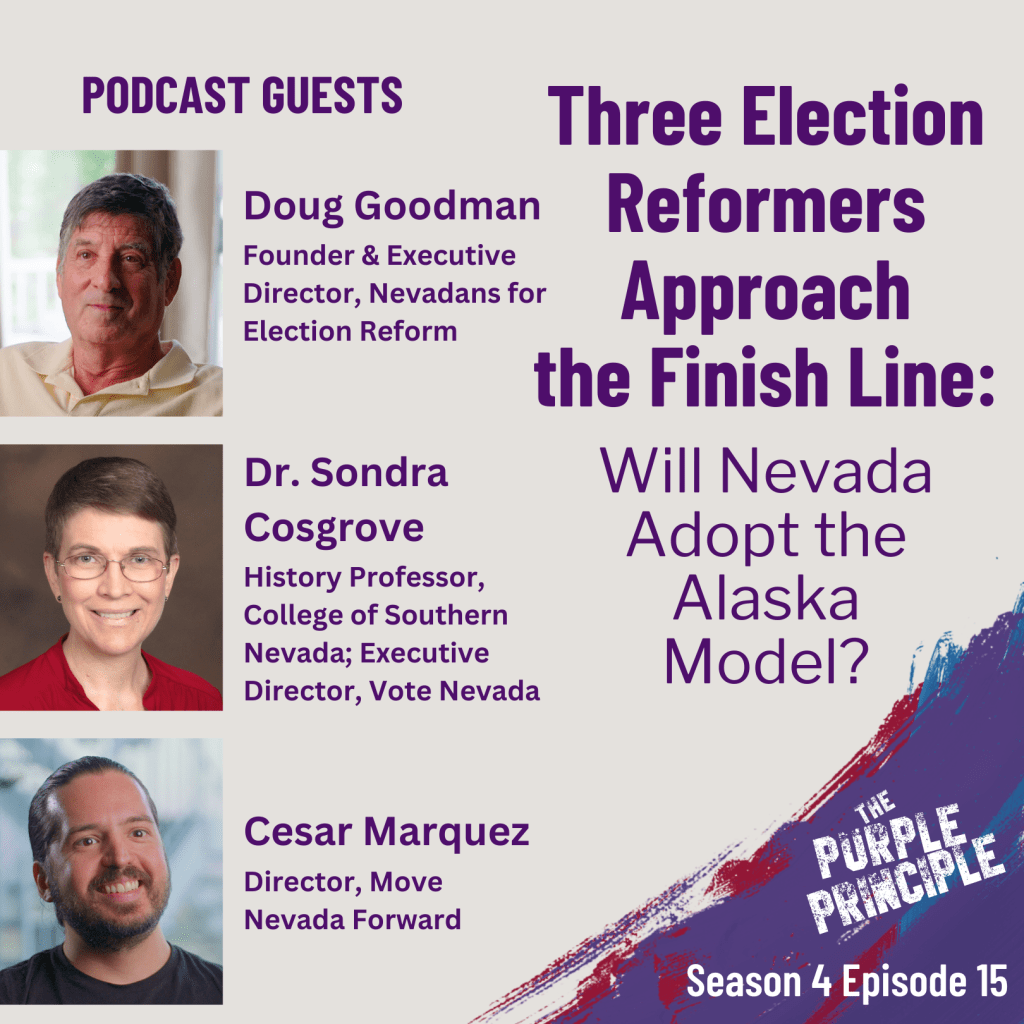
Doug Goodman: There have been constitutional amendment initiatives that have passed the first time, but not the second. So it can happen. We’re optimistic just from what we encounter out in the field. But there are no guarantees.
Robert Pease: Doug Goodman, a retired military vet based in Reno who has been working on election reform in the silver state for over a decade. He’s been joined in that effort by Dr. Sondra Cosgrove, a Las Vegas based history professor and Cesar Marquez, a former Tesla engineer who’s also state chair of the Forward Party.
Cesar Marquez: I think Nevada also has this sort of like independent libertarian sort of vibe. And so I think the fact that both parties of oppose this kind of helped us And you know we can always kind of clip that these two parties don’t agree on anything. Don’t you think it’s kind of weird that they agree on excluding independents and continuing the status quo, right?
Robert Pease: We hope you’ll tune into that episode, share us on social media and subscribe to our Youtube page for video highlights from all episodes in this nonpartisan state election reform series.
Robert Pease: The Purple Principle is created by a talented team of media reformers: Kevin A. Kline, Sr. Audio Engineer; Vienna Maglio, Bookings & Field Producer; Trevor Prophet Digital Ops & Strategy; Mary Claire Kogler, Video Production; and Jason Tomczak, Fact Checking & Research.
Robert Pease: The Purple Principle is a Fluent Knowledge Production. Original Music by Ryan Adair Rooney.
Our Guests:
- Paul Johnson
- Chuck Coughlin
Join Us for Premium Content:
Apple: https://link.chtbl.com/PurpleApple
Patreon: patreon.com/purpleprinciplepodcast
Find us online:
Twitter: @purpleprincipl
Youtube: @thepurpleprinciple
TikTok: @thepurpleprinciple (new account, please follow!)
Facebook: @thepurpleprinciplepodcast
Instagram: @thepurpleprinciplepodcast
Our website: https://fluentknowledge.com/shows/the-purple-principle/online-conspiracies
Make Elections Fair AZ:
Twitter: @MakeAZFair
TikTok: @MakeElectionsFairAZ
Facebook: @MakeElectionsFairAZ
Instagram: @MakeElectionsFairAZ
YouTube: @MakeElectionsFairAZ
Additional Resources / Fact Checking:
Ballotpedia – Chuck Coughlin
Optimistic American – Paul Johnson
How Political Reform Created Cooperation and Collaboration in Alaska, with Alaska Senator Cathy Giessel. The Optimistic American.
Chuck Coughlin’s firm, High Ground
Text of the proposed amendment
Make Elections Fair Arizona website
Ballotpedia – Arizona Proposition 140, Eliminate Partisan Primaries Amendment (2024)
Center for the Future of Arizona
Arizona Voter Registration Statistics
Subscribe to our newsletter: bit.ly/3wDbr4o