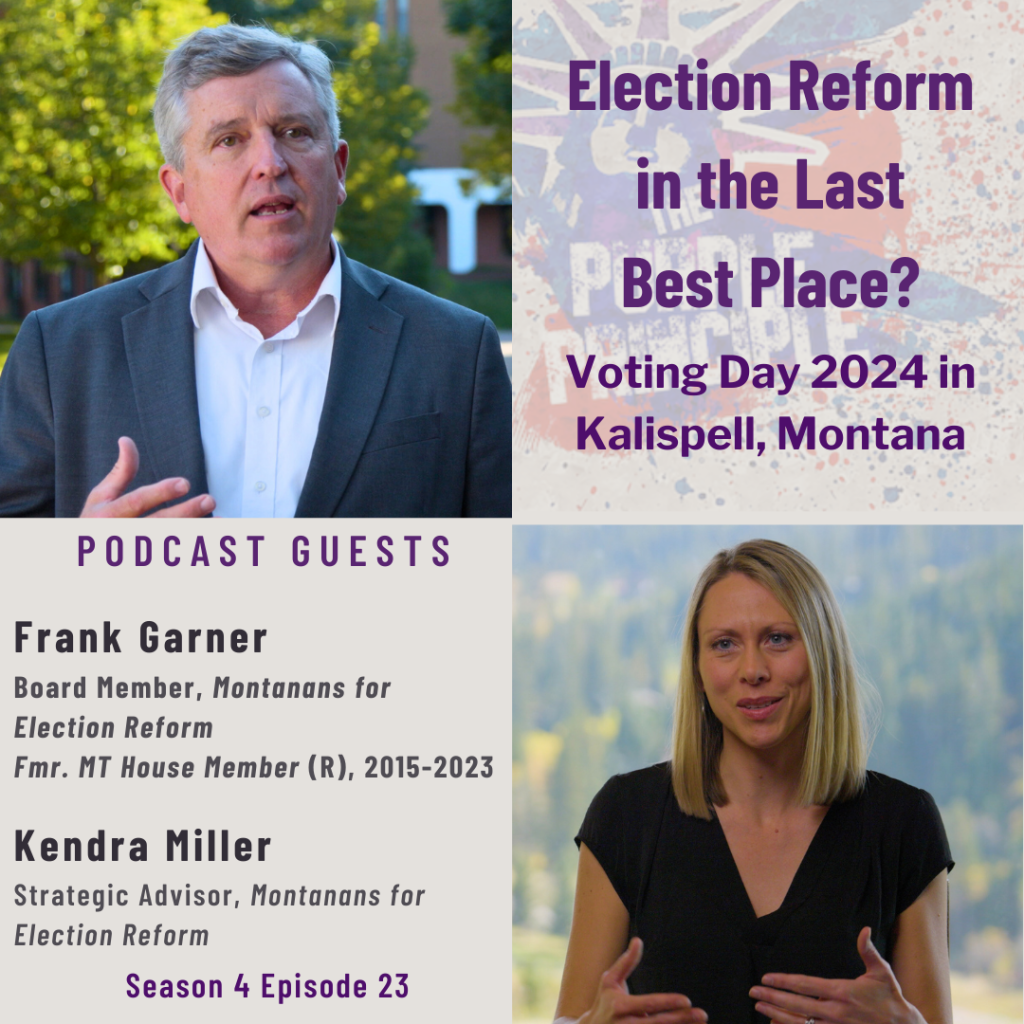
“You want to know why we’re polarized? You want to know why we have division?” Our featured guest Frank Garner posed this question to voters at the constitutional ballot initiative debate we attended in Helena, Montana and many similar events. “We have a system that allows for it and the pressure that is put on people… to vote a certain way.”
A Republican member of the Montana House from 2015 to 2023, Garner spent over a year as the primary spokesperson for Montanans for Election Reform, the group that gathered 200 thousand signatures and fought off four lawsuits to place two Constitutional Initiatives (CI) on the 2024 ballot.
CI 126 proposed replacing the current primary system where voters receive a ballot from each party (then choose one to complete) with a single, unified primary ballot of all candidates from which the top 4 advance to a general election. While CI 127 would require a majority winner from those 4 candidates.
In this episode we also hear from Kendra Miller, Strategic Advisor to Montanans for Election Reform, on the critical need for competitive elections in “the last best place.”
“I think one of the more shocking stats,” says Miller, a data analyst with extensive campaign experience, “is that in 2022…only 6% of Montana voters effectively elected 88% of the Montana House.”
We then visit with former legislator Frank Garner on election night and into the next day as the results slowly come on the initiatives he’s championed throughout this vast state.
Tune in for the final results and also reflections on the challenge of election reform messaging in a state saturated with ads from the most expensive US Senate race per capita in the country.
The Purple Principle is a Fluent Knowledge production; original music by Ryan Adair Rooney.
watch now: Frank Garner Reflects on Results
Hear Frank’s reflections on a narrow defeat for election reform in Montana.
We will be posting new content each week to The Purple Principle YouTube channel, such as shorts, highlights, and previews for our podcast episodes.
Opening:
Voter A: Well, so I’m a first time voter but this year, especially because I’m a first time voter, it was just really important to kind of educate myself on what I was going to be voting for.
Voter B: I just do as much research as I can and make up my decision before it gets to the last minute and just make sure I have a good idea of what I want to do.
Robert Pease (Host): We’re talking to voters on a chilly Election Day in Kalispell Montana, the largest city in the Northwest region of our 4th largest state. Turnout is unusually heavy with traffic backed up all around the county fairgrounds. That’ s in part due to the Presidential race but also the nation’s most expensive senate race per capita.
Robert Pease: Montanans are also voting today on how they would like to vote in the future with two constitutional initiatives, or CIs, on the ballot regarding election reform. Currently voters receive four primary ballots in the mail each spring, one from each party: then choose which ballot to fill out. So no cross party voting is possible. But voters today are looking over CI 126 that would create a single unified primary of all party candidates from which the top 4 advance to a more competitive general election.
Voter C: So 126 I actually signed a petition for, I felt like it was needed this last time when I got the primary ballot. I was like, why can’t I vote for a Republican here or a Democrat here, green or libertarian party, whatever. I shouldn’t be pigeonholed into picking just this party or just that party. I’m glad it got on the ballot. I voted yes for it.
Robert Pease: Also on the ballot is the related initiative, CI 127 which would require a majority winner from those 4 candidates in the general election but leave that voting method up to the state legislature. Meaning it could be a run off election, as occurs in Georgia; or it could be a ranked choice method, as in Maine or Alaska. But it seems CI 127 has been viewed with more skepticism by Montana voters.
Voter C: 127? So I figure okay, if somebody doesn’t get the plurality or over 50% majority, the majority, excuse me, I was like, what’s going to happen after that?
Voter D: So it’s a really hard even to get people to understand what’s going on just with parties. And so if you’re adding into the mix a bunch of different people, it’s, A: easier to manipulate. B: if you do the ranked choice voting, it’s so complicated if you try to figure it out.
Robert Pease: I’m Robert Pease and this is the Purple Principle, a podcast on the perils of polarization visiting Montana this episode, the final state in our series on the record number of state election reform ballot measures this year. The bipartisan group, Montanans for Election Reform, were able to field over 100 thousand signatures per ballot within a state with 800 thousand registered voters, as well as withstand 4 lawsuits to get Constitutional Initiatives 126 and 127 on the ballot. Board Member Frank Garner has been the group’s primary spokesperson in the effort to reach a broad spectrum of Montana voters with the need to reform elections. Which is no easy task. But Frank is no stranger to serious challenges.
Frank Garner (Guest): It was my pleasure to be able to serve as the chief of police in my town and to serve as a police trainer for a year in Afghanistan. I’ve also had the privilege of working in healthcare management and working in Montana’s legislature for four terms.
Robert Pease: Montana does have term limits for state legislators. So having served as a Republican representative from Kalispell for 8 years, Frank was term-limited out in 2023.
Frank Garner: and I had to ask myself here last year what I thought the most important use of my time and experience was. And without a doubt, for me it’s working on these two initiatives.
Robert Pease: That has meant criss crossing this vast state for town halls and debates. We attended one such debate in the state capital of Helena where Frank made his case for election reform based on his own legislative experience.
Frank Garner: You want to know why we’re polarized? You want to know why we have division? We have a system that allows for it, right? And the pressure that has put on people.
Frank Garner: I have been there, I have been that guy and there’s plenty of guys and gals that can tell you the same story, right? Not from my constituents but from the people in power that I have to vote a certain way, whether I think it’s good for my district or not..
Robert Pease: At this and other events. Frank also battled doubts raised around the integrity of these reforms put forth here by his debate opponent even as Frank himself was exempted from suspicion.
Debate Opponent: What I”m about to say does not apply to Frank.I’ve known Frank for over a decade. He is a principled man. I know his intentions about this initiative are sincere.
Debate Opponent: I don’t have the same confidence about the outstate folks that are financing this initiative…
Frank Garner: Let me be very clear what my opponent said on the money issue and why that we’re basically the shills for the corporate Republican party is absolutely a fantasy.
Frank Garner: This coalition is the one that put this together. Some of these people have been working on it for two years. It is my pleasure and privilege to work with them and I will not have their names associated with that kind of nonsense.
Robert Pease: Historically, Montana has long had a strong independent streak and was politically purple with more competitive elections up and down ballot for many decades. But in recent years “the last best place”has turned deeper red with an influx of conservative voters moving in from the West Coast solidifying GOP control of all major state offices and chambers.
Robert Pease: With that in mind we sat down to chat with Frank Garner on election eve as results came in quickly on the Trump White House victory but slowly on Montana races, including those two Constitutional Ballot Measures.
Frank Garner: We only have about 3% in right now. And so we’ve got a long way to go. And at nine o’clock usually we get on some of the early return, some of the counts on the, especially from the urban areas of the mail-in ballots, we start to see a little more significantly between nine and 10.
Robert Pease: The TV was on in the background with races being called on the east coast, then the midwest, but little Montana news. While waiting for results, we asked Frank about a recent drop in polling numbers for CI 126 which proposes that open, unified primary. Again, CI 126 had been polling well, as in above 50% until opposition media came out in force.
Interview with Frank Garner Part 1:
Frank Garner: Yeah, so I think for us, what we’ve seen from the numbers that we’ve looked at polling numbers is a kind of slow and steady progression, particularly on the open primary ballot initiative 126 until about three weeks ago where we saw a strong, well-funded opposition come into the state. And then we began to see a steady decline, which is to be expected when organized and funded opposition shows up.
Robert Pease: So when you say the opposition began to put out a lot more negative advertising, can you give some examples…
Frank Garner: Yeah, I think you went from seeing where the majority of what you saw was kind of organic social media and earned media from the opposition to organized and funded opposition, the kind of stuff that you can look at and know, there’s, call it tradecraft involved where they’ve, they’ve probably done focus groups or polling and tested their messages and coordinated those messages to see which words or phrase impact people the most. And initiatives are different than candidates where you basically have one versus the other with initiatives. I think for a lot of people, their inclination is to be a no if they don’t understand it or they don’t agree with it. And so the no or opposition on an initiative is easier to some degree because all they have to do is sow doubt in the mind of voters.
Robert Pease: Yeah. So was this something that your team saw on all the major social media platforms or was it targeted to more sort of leaning more far right platforms?
Frank Garner: I think it was a little of both, right? Because we’ve seen on the far left side and far right side of this issue, some opposition because the people in power in those areas don’t want to lose it, right? They want to try to maintain and defend having that political power in the hands of a few. But I’ve seen, certainly, some of it directed towards Democrats as well. I’ve seen arguments to the Democrats that it’ll help elect more Republicans, and I’ve seen arguments to the Republicans, it’ll help elect more Democrats. And when I am given a presentation or talking to a group of people, I say, it can’t be both.
Robert Pease: Any new results?
Frank Garner: Well, we’ve had a couple of the larger rural counties that have reported, and we’ve only got about 10% of the vote in still, although those two have changed, the almost doubled the total amount of vote that’s in. But one thing you get used to on election night, especially in our fine state, is hurrying up and waiting.
Robert Pease: Are you texting at all with anyone else on the board?
Frank Garner: I am. I’m trying to get there. Some of the other folks who are likely consumed with what other races are in their area or their attention to the national ones, because we’ve got 90% of our vote is still out. I’m just ah…
Frank Garner: I’m going to call one of the crew here real quick and just see if he’s…
Colleague: Hey buddy
Frank Garner: Sir.
Colleague on speaker phone: I hadn’t looked at our numbers at all until now. You know, if we’re running 45% in rural Montana
Frank Garner: I know what you’re going to say and it worries me that I’m going to think what you’re thinking.
Colleague: Yep. Where it’s 70-30, it means we’re getting 30% of the Republican vote.
Frank Garner: Right.
Colleague: That means we’re going to win…
Robert Pease: That produced a tentative hint of a smile from Frank who was still not seeing any updated results.
Frank Garner: Oh. And they still got people in lines.
Colleague: They got 7 hour lines at 8pm.
Frank Garner: Oh, and Great Falls., you were telling me. Right, right. Okay. That explains it.
Colleague: Well, there was just this monstrous game day vote.
Frank Garner: Yeah (laugh), that’s a lot of it. Ah, yeah, I’ve just never seen lines before.
Colleague: Our system is broken, if that’s what’s happening.
Frank Garner: Yeah, that it takes that long to process, right? But yeah, when I look at that number and I look at who it is that’s reporting, I’m not horrified by that at all. And if you look at the… you know, like the Senate race those numbers are interesting to me, ‘cause we’re outperforming…you know, the Senate race. .
Colleague:Yeah, I think we got a shot.
Frank Garner: Yeah, I think’s a chance. It’s a chance. Yeah. Alright, see ya bud. Bye.
Colleague: Take care. Bye.
Frank Garner: Yeah. This is when you’re involved in campaigns. This is the hurry up and wait. Hardest part of the whole deal. The work is pretty gratifying. The waiting is just waiting. Are you guys staying here tonight or back at your motel?
Crew: That’s a good question. I think I’m going back motel, but if I pass out,
Frank Garner: Yeah, I think what we’re going to see here is a big dump all at once from these as once those lines are gone. But to hear great falls was seven hours. Wow, that
Crew: Is amazing. Seven hours what?
Frank Garner: Seven hour wait in line.
Crew: Oh wow.
Frank Garner: And that’s, that’s Bozeman. That’s one. That’s a huge chunk. So we aren’t going to know anything until tomorrow.
Crew: That’s nuts.
Frank Garner: And I’m not getting a message back from Kendra and she may be at one of the polling places. Honestly, she’s in Bozeman, so this is a big hurry up and wait night.
End Interview Part One
Mid-roll: RCV results for S4Ep22 “Rank The Insight”
Montana Political Overview with Kendra Miller:
Robert Pease: We’ve been waiting and watching for election results with Frank Garner of Montanans for Election Reform, the bipartisan coalition advocating for two major reforms this year. News of those seven hour voting lines in Great Falls, Bozeman and elsewhere signaled the end of our election night watch session with Frank who had been reaching out to his colleague Kendra MIller in Bozeman for analysis of the first county results. A Senior Advisor to this effort, Kendra is a veteran of many Montana campaigns. We had reached out to her for an overview of Montana’s current electoral landscape just a few weeks prior to election day.
Kendra Miller: I think one of the more shocking stats that piques people’s interests when I’m talking about why this matters, is that in 2022, in the last election, only 6% of Montana voters effectively elected 88% of the Montana house.
Robert Pease: Kendra is also a Democratic member of the Montana Independent Redistricting Commission which creates the map of legislative districts.
Kendra Miller: And before the 2022 election, we had to come up with what a competitive district is. We had to define a competitive district, and we unanimously agreed, the Republican commissioners, the Democrats and the independent chair unanimously agreed on a criteria for what a competitive election is. And with that metric, we predicted 126 out of 127 legislative races in the state before the election.
Robert Pease: From that data set it was not much of a jump for Kendra to conclude, as did Frank from his own legislative experience, that Montana sorely needed more competitive elections.
Kendra Miller: So we don’t have party registration in Montana, but I know my background in politics is data. And I know that there’s a huge difference between who votes in primary elections and who votes in the general election. It’s both the type of people who are voting, but it’s also just the number, the number of people who vote in general elections is more than twice as many as primary elections. So the fact that primaries are so consequential and effectively deciding most of our elected officials is creating a totally different makeup of elected officials than if the entire electorate in November we’re deciding winners.
Robert Pease: Which brings us back to the two reform measures on the ballot in Montana this year and particularly to ballot measure 126 which polled consistently better throughout the campaign. Again CI 126 proposed to do away with the four party controlled primary ballots that voters need to choose from with a unified primary ballot of all candidates, four of whom then advance to the general election.
Kendra Miller: And I think part of what will happen under CI 126 if it passes is that we’ll see multiple candidates from the same party move on to the general election in November. And if you’re in a really lopsided district, a really safe red district or a really safe blue district, that’s a good thing for voters because it means they have a real race. They have competition in November, and so I can’t say ahead of time for sure who’s going to win in those situations. And it means that candidates are going to have to be working and talking to voters instead of they themselves knowing that they won their race in June and that they don’t really need to talk to voters for the last several months of an election.
Robert Pease: But could CI 126 get over the finish line in this hyperpartisan Presidential election year with a hugely expensive Montana Senate race saturating the airwaves, billboards, newspapers, and social threads? The day after the election we went back to meet with Frank Garner when those long voting lines had finally cleared. He’d obviously had very little sleep and something in his body language said, yup, those CI ballot results had finally come through.
Interview with Frank Garner Part 2: Day after Election
Frank Garner: Yeah. All night long we’ve been watching the returns and we’ve had a very close race on open primaries and it’s been razor thin all night and we’ve just learned that the AP has called it, we’re a little over 48% four and just over 51% against, but we just don’t have, I don’t think from looking at it and where the votes have to come from that we’re going to quite get there from here. Well, we got very close with CI 126 and the Open Primary policy initiative. It looks to me like we probably aren’t going to quite get over the finish line. But man, I’m just so proud of our team, still believe in this mission, and when you’re kind of finally faced with the fact that you didn’t quite get there, it’s always a little hard to finish processing.
Robert Pease: So have you had any communication with anyone on your team this morning?
Frank Garner: Yeah, probably only 40 or 50 phone calls during the course of the night. In the morning, right. I mean, it’s something they all really care about and that I do and something like this where it’s so close and we’ve had this delayed results in the state for a number of reasons. It’s really something that’s gone back and forth between a number of us, but we’ve spoken lately the core team and members of the board, and we can see now that we’re kind of facing just a lack of available ballots left for us to get there.
Robert Pease: Now, is it any consolation that you’ve done better than virtually any other state except possibly Alaska, which is very different.
Frank Garner: Well, I mean there is some consolation that we’ve done better than many of the other states that are working on this reform or similar reforms, but I’m always left with the feeling that there are no moral victories in things like this that are so impactful when you’ve worked so hard and that it means so much to the future of your state. It’s hard to accept a moral victory. It’s not in my DNA necessarily.
Robert Pease: When we interviewed Kendra and she talked about the early thinking on this, she said they just wanted to give it a try. They didn’t really feel like they had a great chance in the early stages, but at some point that changed. When did you think in the early signature gathering or town halls or whatever, when did you start to feel like open primaries at least has a chance?
Frank Garner: Yeah, I think for me it was during process of collecting signatures where you really had in volume a chance to hear from people, see the enthusiasm and say, man, this really does have a chance and it really does have legs. And when you look at the number of signatures we collected, and over the period of time we did it in a very short period of time, really, I think that’s when my enthusiasm for the campaign grew. And I think the results from yesterday and from the actual voting tells us again that over quarter of a million people in Montana agree with us. And that part is very gratifying to know that many people wanted this issue out in front of them on the ballot.
Closing:
Robert Pease: That’s Frank Garner, former police chief and four term Republican legislator in the Montana House, Frank and the team at Montanans for Election Reform, including board members, coalition partners, volunteers and strategic advisors like Kendra Miller– they came within 13,000 votes of passing a major primary election reform in Montana this year. CI 126 would have done away with the current system of four separate primary ballots in Montana, where voters choose one to complete, and replace that with a single unified primary with more emphasis on candidates and policies, not just party labels. That was not quite to be, though it also came closer than similar reforms in many other states this year. More on that in our season finale.
Robert Pease: But for now very special thanks to Frank Garner, Kendra Miller and the whole team at Montanans for Election Reform, as well as the League of Women Voters in Helena for allowing us to record their debate.
Robert Pease: That’s a holiday wrap for the Purple Principle for the year 2024. But we will be back with a season and election reform series wrap-up in January of 2025. For now best holiday wishes from the whole team at The Purple Principle: Kevin A. Kline, Sr. Audio Engineer: Mary Claire Kogler, Video Production; Trevor Prophet, Digital Ops & Strategy; Sarah Kim, Research & Fact Checking.
Robert Pease: The Purple Principle is a Fluent Knowledge Production. Original music by Ryan Adair Rooney.
Our Guests:
- Frank Garner, Board Member, Montanans for Election Reform
- Kendra Miller, Strategic Advisor, Montanans for Election Reform
Join Us for Premium Content:
Apple: https://link.chtbl.com/PurpleApple
Patreon: patreon.com/purpleprinciplepodcast
Find Us Online:
- Twitter: @purpleprincipl
- Youtube: @thepurpleprinciple
- TikTok: @thepurpleprinciple
- Facebook: @thepurpleprinciplepodcast
- Instagram: @thepurpleprinciplepodcast
- Our website: purpleprinciple.com
- Subscribe to our newsletter: bit.ly/3wDbr4o
Find Montanans For Election Reform on social media:
- Instagram: @montanansforelectionreform
Find us online:
Twitter: @purpleprincipl
Youtube: @thepurpleprinciple
TikTok: @thepurpleprinciple
Facebook: @thepurpleprinciplepodcast
Instagram: @thepurpleprinciplepodcast
Our website: purpleprinciple.com
Subscribe to our newsletter: bit.ly/3wDbr4o
Additional Resources / Fact Checking:
- Frank Garner – Ballotpedia
- Kendra Miller – MT Districting and Apportionment
- USDA – Kalispell, MT
- Montana’s competitive – and expensive – 2024 Senate race – Open Secret
- Daily Montanan – Constitutional Initiative 126
- Montana CI-126, Top-Four Primary Initiative (2024) – Ballotpedia
- Montana CI-127, Majority Vote Required to Win Elections Initiative (2024) – Ballotpedia
- Montanans for Election Reform’s constitutional initiatives will be on November ballot – Daily Montanan
- Montana Election Results
- Three constitutional initiatives’ long legal road to the ballot – Montana Free Press
- How Montana Took a Hard Right Turn Toward Christian Nationalism – NYT
- Party control of Montana state government – Ballotpedia
- Long lines of voters stretch outside MetraPark in Billings – KTVQ
- Same-day registration in Gallatin County reached 8-hour wait times; last vote cast 4 AM Wednesday – KBZK
- Montana Democrats reexamine voter efforts after tough election cycles – KTVH
- Voter turnout in Montana was around 56%, down from 72% in 2018 – Montana Public Radio
- Montana Voter Turnout
- Open primaries initiative CI-126 narrowly fails according to AP – Fox
- Montana Constitutional Amendment 126 Election Results: Support a Top-Four Primary – NYT