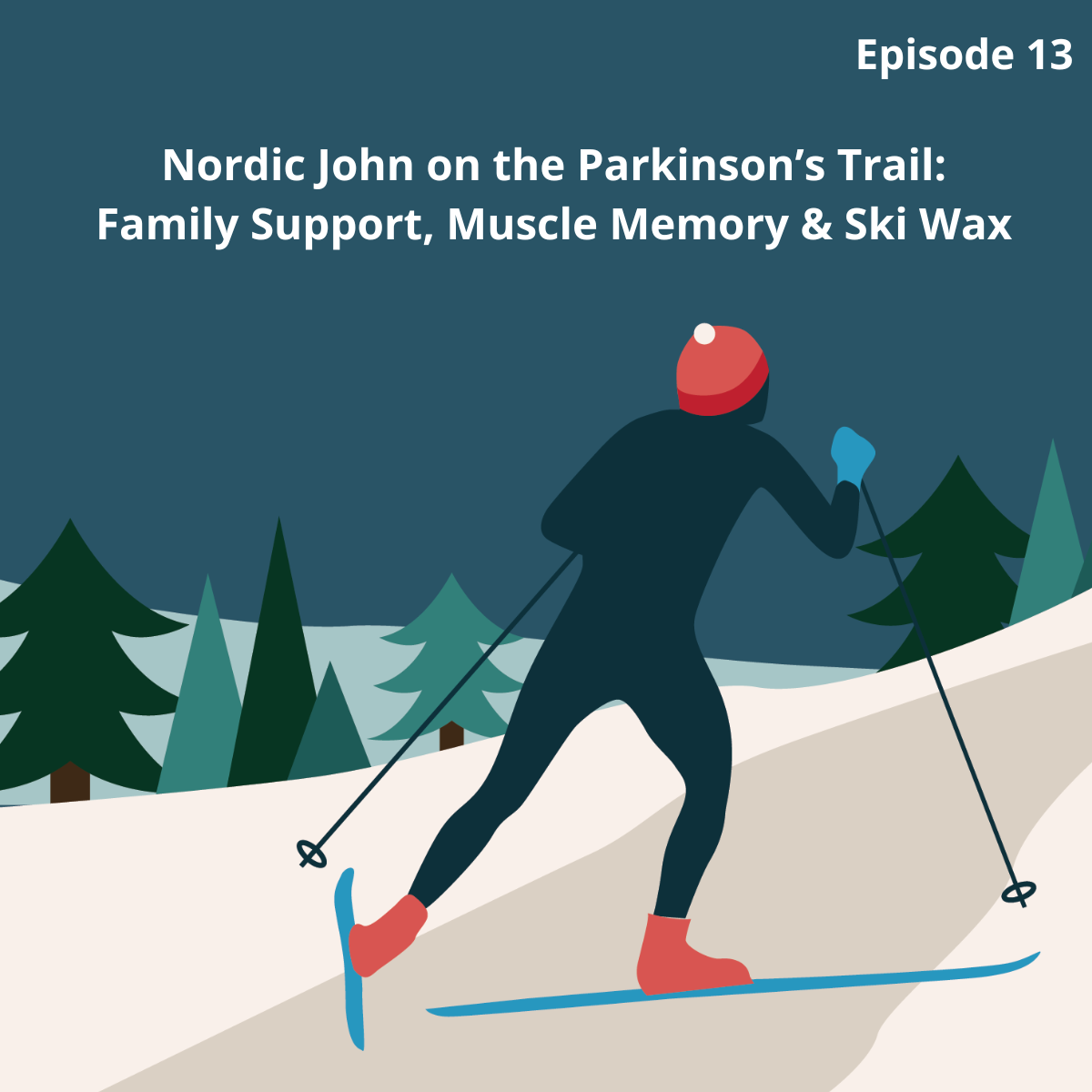
“I haven’t had any medical people tell me that I shouldn’t go all out,” says our protagonist in this episode, Nordic John. He’s 80 years young but still competing internationally in cross-country skiing despite, or possibly because of, the onset of Parkinson’s disease a decade ago. “That is really effective when you push yourself to the limit.”
Our expert guest this episode, Dr. Jerry Vitek, Head of Neurology at the University of Minnesota Medical School, confirms John’s experience. “Exercise is one of the best things we can do and recommend to our patients,” says Dr. Vitek, who describes some of the research behind this recommendation. “It does really need to be vigorous, though.”
Nordic John’s wife Gina, also a competitive skier, can attest that John is no stranger to the vigorous challenge of cross country skiing. In addition to his own training, John directed the Nordic Skiing Program at the Craftsbury Outdoor Center in Vermont for decades. And both attended the 2023 Master’s World Cup of Skiing in Austria.
Nordic Skiing and Parkinson’s
“I just need to get him to the start line, because then when the gun goes off he just knows what to do,” she explains. “He’ll worry about his balance but then he’ll ski down some steep slope carving tele turns on his cross country skis without missing a beat.”
That means Nordic John’s muscle memory for skiing remains intact, despite the onset of other symptoms, such as tremors in his arms and legs and loss of balance when off his skis.
“There’s no question that when you start to become proficient at something, you’ve clearly changed those connections and strengthened them,” confirms Dr. Vitek. “When skiing, those connections are well-established and it takes very little for him to kick that in place.”
In this episode we’ll also hear from Coach Ollie, who has taken over John’s former position at the Craftsbury Outdoor Center and now directs John at his Master’s practices. And we’ll learn about the important role played by the actor Michael J. Fox and his foundation in raising $1billion for Parkinson’s research over the past two decades.
How do John and Gina fare in the disappointing snow conditions at the Master’s World Cup? How are they coping with the climate change threatening the sport they’ve loved for decades? What important research is on the horizon for the many millions of Parkinson’s patients like John worldwide?
Tune in to learn more on this final My Body Odyssey episode of Season Two, Nordic John on the Parkinson’s Trail.
My Body Odyssey is a Fluent Knowledge production. Original music by Ryan Adair Rooney.
Brittany Thomas (co-host)
On a winter day that could give you a sunburn, the Masters ski team at the Craftsbury Outdoor Center groups up on the field with their coach, Ollie. Some skiers glide by in shorts.
Brittany Thomas (co-host)
John, do you have a favorite type of workout?
John
I think the short ones. The last workout we had with Ollie was right here in the stadium. There’s two hills and we tried to get up these hills in 30 seconds, and 30 seconds is about my limit of going full out.
Brittany Thomas (co-host)
John Brodhead knows the bumps and contours of the Craftsbury trails maybe better than anyone. He was the one who mapped and planned and negotiated in the late 70’s to groom the way for this intricate system of trails. There’s now 105 km of trails, and they welcome John almost daily.
Brittany Thomas (co-host)
Nordic John’s getting ready for his next big feat: The Masters’ World Cup in Austria. His wife, Gina, will race there with him.
Gina
I just need to get him to the start line. ‘Cause then when the gun goes off, he just knows what to do because he’s been doing it for so long. Um, you know, he’ll worry about his balance, but then he’ll ski down some steep slope carving tele-turns on his cross country skis without missing a beat.
Brittany Thomas (co-host)
And that is no small feat, because ten years ago, John was diagnosed with Parkinson’s Disease.
John
I think the first thing was, my handwriting got unreadable and smaller. Which is a key, um-
Gina
Symptom.
John
Symptom of, uh, Parkinson’s. Now, as you can see, I have a lot of extraneous movement in my legs and my arms. Um, and that’s very symptomatic.
Brittany Thomas (co-host)
But despite those tremors, when he clips into his two-inch wide nordic skis and sets out down the trail, John is smooth and graceful; a veteran skier in his element.
Robert Pease (co-host)
This is My Body Odyssey. A podcast about the rewards and challenges of cross country skiing this episode. I’m Rob Pease.
Brittany Thomas (co-host)
And I’m Brittany Thomas. Today we’re sharing a story of perseverance, family, and muscle memory.
Robert Pease (co-host)
We first met our protagonist, Nordic John, at the Craftsbury Marathon last winter, when he had just completed an 18 kilometer classic cross country ski race…and in classic John style.
John
Yeah, when I, we came to the first hill, I pushed it a little hard and I went up as fast as I could, but I paid for it. When I got to the top, I had to stop.
Brittany Thomas (co-host)
John does not hold back. He has a racer’s intensity even after a long day, and a love for this winter, this landscape, and these movements that have shaped his life for decades.
John
For 40 years I skied to work and skied home. Very nice lifestyle.
Robert Pease (co-host)
John has skied through lots of life transitions. Through his Parkinson’s diagnosis and transition to retirement, he still seeks out moments to get his heart pumping – sometimes up to 180 beats per minute.
Brittany Thomas (co-host)
Strenuous aerobic exercise is one of doctors’ top recommendations for subduing the symptoms of Parkinson’s Disease.
Dr. Jerrold Vitek
You know, exercise is one of the best things we can do and recommend to our patients, frankly.
Robert Pease (co-host)
Dr. Jerry Vitek is Head of the Neurology department at the University of Minnesota.
Dr. Jerrold Vitek
It does really need to be vigorous, though. It does have to be intense.
John
I haven’t had any medical people tell me that I shouldn’t go as hard as possible.
Robert Pease (co-host)
That powerful combination of aerobic capacity and balance and determination, that propels John forward.
Brittany Thomas (co-host)
All the way to the World Champs race Austria. John’s age group – 75 to 79 – is expected to be among the largest and most competitive.
Ollie
John was super fast back in the day.
Brittany Thomas (co-host)
Ollie Burress coaches the Master’s Team that John trains with. Ollie knows there are several chapters of John’s ski career that he’s only heard stories of. John first inherited a love for skiing from his parents.
John
Interestingly, my parents were, when I was eight years old, they left me with some friends and went to Europe to ski. And that, I have to believe, was inspirational to me.
Brittany Thomas (co-host)
That was in the 1950s and John followed in their tracks. He told me about one of his favorite skis to date.
John
From Russia to Sweden.
Brittany Thomas
That sounds far. That sounds really far.
John
We fortunately had people telling us where to go and setting a track as we went along.
Gina
It’s an annual event in Sweden.
Brittany Thomas (co-host)
Did you do that together?
Gina
No, I wasn’t able to go but, he’s got the hat on from the race, from the event. It’s not a race. Each community gets very involved with hosting the skiers each night.
Robert Pease (co-host)
While Gina didn’t make that ski trip, it’s almost as if she was there because she’s an avid skier herself. She gets it. She’s been at this sport since the 1960s.
Gina
I just wanna say something about women my age in skiing. Because when I was in high school, I was an alpine skier and the ski coach told me that women couldn’t do cross country skiing ’cause it was too exhausting.
Brittany Thomas (co-host)
Gina wears a spandex cap and sunglasses to help with the glare. She watches John as he speaks and skis, and in her conversations around the lodge, John comes up often. She’s kept her sights set on how they can manage Parkinson’s together.
Gina
There was some evidence that, um, not just as the doctor said, going out for a walk, but finding a hill and going up it 10 times as hard as you can would, would bear some benefit. And we thought, well, that’s okay ‘cause that’s what John’s been doing for, for decades.
Brittany Thomas (co-host)
Gina notices when he’s stuck on a word. Her compliments and jokes lift his spirits.
John
I’ll be lucky if I actually finish the races.
Gina
You’re so modest. What have you been doing for training?
John
Oh, nothing specific.
Robert Pease (co-host)
John and Gina raised three kids together, who also love winter. They’ve seen their kids grow up and the sport of Nordic Skiing change for the better, mostly.
John
Nordic combined skiing is actually one of the most traditional skiing events. And there’s no reason that women can’t do it.
Robert Pease (co-host)
John and Gina have spent a lifetime looking out for each other, suiting up to ski, sometimes like stunt doubles. During the Craftsbury Marathon, they mistakenly swapped numbers.
Gina
Something like that. We mixed up each other’s bibs. I put his on and he put mine on. Oh, for, for the race today. Yeah. The race organizer said, John, you did so well. And then I, you lost.
Brittany Thomas (co-host)
John’s Parkinson’s diagnosis added a new variable to their routines, but both John and Gina are well-trained in a sport that is perhaps one of the best therapies for the disease.
John
Well, I’ve tried to not let it affect my lifestyle. I still ski and my cognition is a little bit affected.
Brittany Thomas (co-host)
Gina explained to me that the medications prescribed to treat Parkinson’s address the symptoms, but they don’t stop the disease from progressing.
Robert Pease (co-host)
The cause of Parkinson’s is impaired or dead nerve cells in the base of the brain, which lessen the amount of dopamine and norepinephrine that serve as important messengers in the body’s nervous system.
Dr. Jerrold Vitek
Dopamine is important in a part of the brain called the basal ganglia.
Brittany Thomas (co-host)
Again, Dr. Jerry Vitek, a renowned expert on Parkinson’s from the University of Minnesota.
Dr. Jerrold Vitek
And you have two sets of basal ganglia deep in the brain, one on each side. But when you lose dopamine, the information processing that occurs in the basal ganglia that allows you to make normal movements, is disrupted.
Robert Pease (co-host)
Day-to-day, Parkinson’s can cause disruption to even the most common movements like walking, writing and eating.
John
Swallowing is another. I have to be careful what I eat and how I eat it.
Brittany Thomas (co-host)
One symptom that John doesn’t talk about is what doctors call “postural instability”. Or in other words, poor balance. On the contrary, John’s balance is remarkable. You could say he is more than a technically-proficient skier. This means that when he’s clipped into his skis, he spends most of his time on one foot – fully transferring his weight to glide on one ski, while the other leg kicks back.
Gina
The doctors will tell you that Parkinson’s is a suite of symptoms and it’s never the same for two people. It’s always different. And some people are less affected by balance issues, others are.
Brittany Thomas (co-host)
The interesting thing is, John says sometimes maintaining his balance is tricky- when he doesn’t have his skis on.
John
Well, when doing exercises with a group that isn’t Masters athletes, I can’t do any of the balance exercises. Like, I can’t even stand on one foot and balance.
Brittany Thomas (co-host)
But skiing seems to be a different story.
Gina
With skiing, maybe because he has so much muscle memory, he’s less affected than someone else with Parkinson’s might be.
Dr. Jerrold Vitek
There is muscle memory. There’s no question that when you start to become proficient at something, you’ve clearly changed those connections and strengthened them, right, that are involved in that motor act. So, when he’s doing the skiing, and he’s done it so much, it’s a repetitive movement that he’s just gotten so ingrained into his neural network, so to speak, that those connections are well established and it takes very little for him to kick that in place. It almost becomes automatic to some degree for him.
Brittany Thomas (co-host)
Scientists don’t yet know what causes the nerve cells in the basal ganglia to die. And they are still working on understanding why exercise seems to slow down the progression of the disease.
Robert Pease (co-host)
It’s hard to say with certainty what exercise does for the sick and injured cells of the basal ganglia. But there have been some illuminating results from animal studies.
Dr. Jerrold Vitek
Animal models, uh, basically show that rodents that were exercised, compared to those who were not exercised, when both were exposed to a, a neurotoxin that destroys these dopamine cells, the rodents that exercised were protected to a degree. The ones that were not exercised took the full brunt of that toxin.
Robert Pease (co-host)
Dr. Vitek says that the mechanisms our body has to provide protection are called “neurotrophic factors”. That’s a family of proteins that help the brain repair itself.
Dr. Jerrold Vitek
There is a factor that we all have in our brains and our bodies called growth factors. There’s different kind of growth factors, but they promote cell health and growth and allow them to repair themselves. And we see that in those rodents that were exercised compared to the ones that were not, there was a 300% increase in those growth factors.
Brittany Thomas (co-host)
Why is exercise protecting these animals’ brains? And what type of exercise is most helpful? Dr. Vitek says that’s the million dollar question, and scientists are working hard to uncover answers.
Robert Pease (co-host)
One of these studies is being led by Dr. Daniel Corcos, a professor of Human Movement Sciences at Northwestern University. And this will be the first randomized control trial designed to investigate the effects of moderate and high-intensity aerobic exercise on Parkinson’s. Dr. Vitek and others in the field are really looking forward to those results.
Dr. Jerrold Vitek
I had a baseball coach that used to take me to games when I was a little kid. Uh, he developed Multiple Sclerosis. And he would tell me, uh, he would say, “I always like to go to my neurologist, even though the neurologist has told me there’s nothing I can do for you”. This was many, many years ago when they didn’t have therapies for MS. He said, “But I just feel better going to see him. I have hope.” And I was probably 11 years old when he told me that. I am now 72. But that has stuck with me. And so, I tell every patient that I see that there are new therapies coming out all the time, multiple studies being done all the time, and that you need to maintain a strong hope, because there are a lot of good things around the corner.
Robert Pease (co-host)
Some of the momentum behind this emerging science comes from the Michael J Fox Foundation – founded in 2000 by Michael J Fox, the actor, who made his first big splash as Alex P. Keaton in the tv series Family Ties.
Robert Pease (co-host)
The foundation funded the Parkinson’s Progression Markers Initiative. That’s a data-set that allows scientists to better understand how the disease starts and how it progresses.
Brittany Thomas (co-host)
Michael J Fox says Parkinson’s has been the gift that keeps on taking – a story he recounts in his 2023 documentary, “Stil”l.
Brittany Thomas (co-host)
Fox is working hard to maintain the stability to walk with his personal trainers. It’s a spirit of persistence on screen that is also powering what the Michael J Fox Foundation calls a “renaissance” in Parkinson’s therapeutic development.
Robert Pease (co-host)
Outside the lodge, the Masters team gathers on the snow. Ollie is there in his racing shades, and he jokes with each skier as they pull up. They ask him what’s in store for the day, but there’s really no strict hierarchy around here.
Ollie
They’re really fun because they, I could be most of their children, which is, or they could be my parents for most of ’em.
Brittany Thomas (co-host)
Today they may do some hill repeats. It’s the countdown to the Master’s World Cup, and John and Gina are only 3 days away from flying to Austria.
John
Master’s skiing is very popular in this country and in Europe. Socially, it’s a great thing.
Gina
For the older people, 75 and over for men and 70 and over for women, they have a much, um, less elevationally-challenging course. So the courses are flatter.
John
The World Masters is popular for people over 80 and 90. We’ve had skiers that were in their high nineties, who participated. And that just gives me a lot of, gives me a lot of, uh…
Gina
Hope?
John
I wouldn’t say hope, but,
Gina
Okay. I don’t know what you wanna say, so I shouldn’t say anything.
John
Inspiration, that’s the word.
Gina
That’s the word. Oh, okay. Yeah.
Brittany Thomas (co-host0
Totally
Robert Pease (co-host)
Nordic John is also an inspiration to many younger skiers at Craftsbury and at The Masters’ World Cup, which is a meeting place for skiers from all over the world. And Ollie hopes John just can enjoy the experience.
Ollie
That’s the privilege of a Master’s athlete is you don’t have to worry about making sacrifices to optimize for performance. You can just, performance is whatever you want it to be.
Robert Pease (co-host)
Ollie himself is no stranger to the racing circuit. He traveled in Europe with his nordic ski team, before stepping into some very big ski boots at the Craftsbury Outdoor Center. He’s now the Nordic Race Director, which John’s former position.
Ollie
One thing that is also just really, really cool and unique about John is that when he let it go, he did let it go and he let me take it over and learn on the job.
Brittany Thomas (co-host)
And Ollie has earned John’s approval.
John
Well, I think Ollie has done a great job of taking on some of the events. I initially did, uh, for example, the ski marathon. He’s got that going.
Brittany Thomas (co-host)
So while Ollie’s technically John’s coach, he’s also John’s student. And he knows to expect a lot from him.
Ollie
Man, I, I think the happiest place that JB has is when he is out skiing. And he really sort of expresses himself through his skiing and he just goes out there and, and does it.
Robert Pease (co-host)
Ollie’s learned the ins and outs of the trail system from John: which landowners are cooperative, which ones not so much, and which surrounding towns have a right of way that could be groomed as a trail. Now he’s carrying the torch to make sure that Craftsbury stays a destination for ski racing.
Ollie
I don’t take that responsibility lightly at all. And, and so in a way, coaching him and seeing him all the time kind of holds me accountable, reminding me that what he built here is really special and we need to protect it and try and nurture it forward.
Brittany Thomas (co-host)
During his time as director of the Nordic Program, John started a ski training program for youngsters. It was modeled on the multi-generational ski programs from the Scandinavian countries where John’s parents used to go when he was a kid.
Robert Pease (co-host)
Every Thanksgiving, they’d take a trip to Silver Star- a ski resort in British Columbia with the junior team.
Gina
We would bring our kids, the juniors from the outdoor center, would go out there for a training camp Thanksgiving week. We’d bring 20 kids and a couple of coaches and rent a whole bunch of condos and cook food and ski, ski with all the, you know, they were all high school aged kids, our kids. And now we just go ourselves, which is a lot, a lot different trip than what we did back in the nineties and the early two thousands.
Brittany Thomas (co-host)
After his retirement, John was inducted into the Vermont Ski Hall of Fame in 2019. A point of great pride for the Craftsbury Outdoor Center. Their storyline read: “As the Craftsbury community knows, for 38 years, Nordic at Craftsbury was synonymous with John.”
Brittany Thomas (co-host)
The 2023 Master’s World Cup of Cross-Country Skiing took place in a haven for skiing – a small village called Seefeld. John and Gina had high expectations for the trip and the races.
John
We flew to Austria. And, uh, took ground transportation to Seefeld. And our hopes were to have some good skiing.
Gina
It’s the, was the Olympic cross country venue when the Olympics were Innsbruck. So SeeFeld sits in the mountains above, above, Innsbruck. And there’s downhill, you know, there’s downhill areas all around..
Robert Pease (co-host)
When they arrived, the scene was different from what they had imagined. Different from the Austria John’s parents had shared travel stories about.
Gina
There was no, no snow on the hills. You could get to snow if you took tramways up, you know, another 5,000 feet. Um, but it was, uh, it was, there was no snow on the ground in the village except for this, this ribbon of dirty wet snow for the cross country races.
Brittany Thomas (co-host)
John was entered in three races: a ten kilometer, five kilometer, and fifteen kilometer classic race, scheduled over three days.
John
The piles of slush on treacherous downhills was very difficult because you couldn’t slow, you couldn’t slow yourself down because there was deep ruts.
Gina
And the snow was the consistency of a, of a uh, a melting, melting ice cream. It was very wet. Um, it was a very discouraging scene. It was right out of, you know, your worst climate change nightmare.
Robert Pease (co-host)
Gina wished they’d brought shorts to ski in. The temperature was consistently in the 60’s.
Gina
It was very sad. We brought a lot of long johns and other useless items.
Brittany Thomas (co-host)
With warm temperatures and higher water content in the snow, classic skis can be notoriously sticky. Sometimes, so bad they become kind of like six foot long platform shoes, with gobs of uneven snow stuck to the bottom surface of the ski.
Robert Pease (co-host)
Gina and John worked with a waxing coach to help their skis glide through the slush.
Gina
We paid them dearly, but it was something that, it was like sending your skis to a spa. You gave them to them and then they’d be all nice and ready, ready to go.
Robert Pease (co-host)
There’s only so much that waxing techniques could do to change the natural order of things. And there just wasn’t enough snow for John’s typical race routine.
Gina
And in venues like in Seefeld this year, there was very little snow to spare, so we couldn’t do a lot of warm-up or testing, ’cause there just wasn’t enough snow. Um, you like, you really like to warm up, right?
John
Yeah.
Gina
It’s really important for you.
Robert Pease (co-host)
Even when you’ve raced for decades, the warm-up is important for managing pre-race nerves and coaxing your muscles into readiness. Dr. Vitek explained how this can be even more important for athletes with Parkinson’s.
Dr. Jerrold Vitek
When you get stressed, your symptoms get worse. This is true of every movement disorder. So if a patient gets really nervous or anxious, the motor signs, the slowness, the stiffness, the tremor, the gait, the walking, uh, postural stability, all those things get worse with anxiety. And so it’s kind of a self fulfilling prophecy, right? “I think I have a problem. I am getting anxious. I do have a problem. I knew I’d have a problem, and now I’m more anxious.”
Brittany Thomas (co-host)
John finished his 10km and 5km races. Almost half the field didn’t race. But by the time the day of his third race arrived, John decided not to join the other skiers at the start line.
John
By the time we got to the third race, the, uh, ruts were practically knee deep. And, uh, I was afraid I’d fall and hurt myself.
Gina
But you survived.
John
I did survive. And I think it was, I survived because I was, that was good intentions. The elephant in the room hasn’t really been told, but this lack of snow is probably due to global warming. Europe, Central and southern Europe have been losing their snow pack every year. The glaciers that were there are gone, or almost gone.
Robert Pease (co-host)
John and Gina are not planning to attend the World Cup again this year. Instead, they’ll be taking the Amtrak west to return to Silver Star – but this time, it’s not with the Juniors from Craftsbury, but with their own family: their son, who’s also an avid skier, and their grandkids.
Gina
I’m very proud of their love of winter, and they, and their love of skiing. And their families. And so I feel like I’m passing it on to the next generation. But it also gives me concern, because I want my grandchildren to be able to ski too. And, uh, they aren’t going to be able to, um, if climate change occurs the way scientists say it’s going to. So that’s very sad to me.
Brittany Thomas (co-host)
I asked Gina and John if their grandkids were already skiing. Gina says, not quite yet.
Gina
My rule of thumb with kids is they have to be able to get up off the ground by themselves to be ready to start skiing. And they’re not there yet. They get like turtles on their backs.
Robert Pease (co-host)
Maybe in a year or two, those turtles will be clipping into some mini-skis. They’re only 2 and 3 and a half now. In the meantime, John’s thinking ahead to Silver Star, which is renowned for its long season of skiing.
Brittany Thomas (co-host)
Anything that I missed that you want to add to your story of Craftsbury or skiing?
John
Well, there’s a lot to say, but I want to get skiing.
Robert Pease (co-host)
And that wraps our second season of My Body Odyssey on the rewards and challenges of active lifestyle. If you’ve enjoyed this season’s episodes, gotten some benefit from them, please give us a review on apple podcasts and spread the word to others. Our sincere thanks to John and Gina for sharing their odyssey of Nordic skiing and of course Parkinsons. And thanks to Dr. Vitek for his insights on this very difficult condition.
Robert Pease (co-host)
Special thanks also to Ollie and the Craftsbury Outdoor Center. There’s a link in our show notes to Craftsbury and other nordic ski resorts offering lessons, rentals and groomed trails for those who may want to try cross country this winter. Get out there soon; the season’s are getting so much shorter. We’ll be back, hopefully, for season 3 in the summer of 2024 if we can line up a sponsor or two. Till then, best wishes from the whole team here for a happy, healthy and active new year. My Body Odyssey is a Fluent Knowledge production. Original music by Ryan Adair Rooney.
Experts:
Relevant Studies:
Deep Brain Stimulation for Parkinson Disease: An Expert Consensus and Review of Key Issues
Forced, Not Voluntary, Exercise Improves Motor Function in Parkinson’s Disease Patients
Resources:
- Ski For Parkinson’s Fundraiser
- What is Parkinson’s?
- Parkinson’s disease: overview and symptoms
- Stanford Medicine: The Benefits of Exercise for PD
- Parkinson’s Foundation: Exercise
- NIH: Role of Physical Activity in Parkinson’s Disease
- American Parkinson Disease Association: Which types of exercise are best for Parkinson’s?
- American Parkinson Disease Association: Approved Medications for Parkinson’s
- American Association of Neurological Surgeons: Causes of Parkinson’s
- Parkinson’s Foundation: Postural Instability
- Stanford Medicine: The science behind muscle memory
- Preserved motor memory in Parkinson’s disease
- Benefits of physical exercise on Parkinson’s disease disorders induced in animal models
- Neurotrophic Factors
- Growth Factors
- The Relationship Between Stress, Anxiety, and Parkinson’s Disease
- How Stress and Stress Management Impact Parkinson’s
- Can Exercise Slow Parkinson’s Disease Progression? with Daniel Corcos, PhD
- The Michael J. Fox Foundation For Parkinson’s Research
- John Broadhead: VT Ski Hall of Fame, 2019
- Climate change makes the future of Nordic skiing uncertain
- Craftsbury Outdoor Center
- Ski For Parkinson’s
- University of Michigan Udall Center of Excellence for Parkinson’s Disease Research
- Jaxon XC
- Bethel Outing Club
- NENSA
- Nonstop Nordic
- Silver Star