In 2024, Nevada voters will see a ballot Question 3 strikingly similar to the question on Final Five voting that passed by 6 points back in 2022. That’s because a constitutional amendment must be passed by voters twice in succession, according to Nevada law.
And should voters approve Question 3 again this year, Nevada will become the second state (after Alaska) to implement this ambitious electoral voting reform system including a unified open primary and ranked choice general election.
“After we won,” recalls Cesar Marquez of Nevada’s first passage of Final Five Voting in 2022, “Sondra, Doug, and I and so many others, we felt, okay, we now have two years to talk about ranked choice voting.”
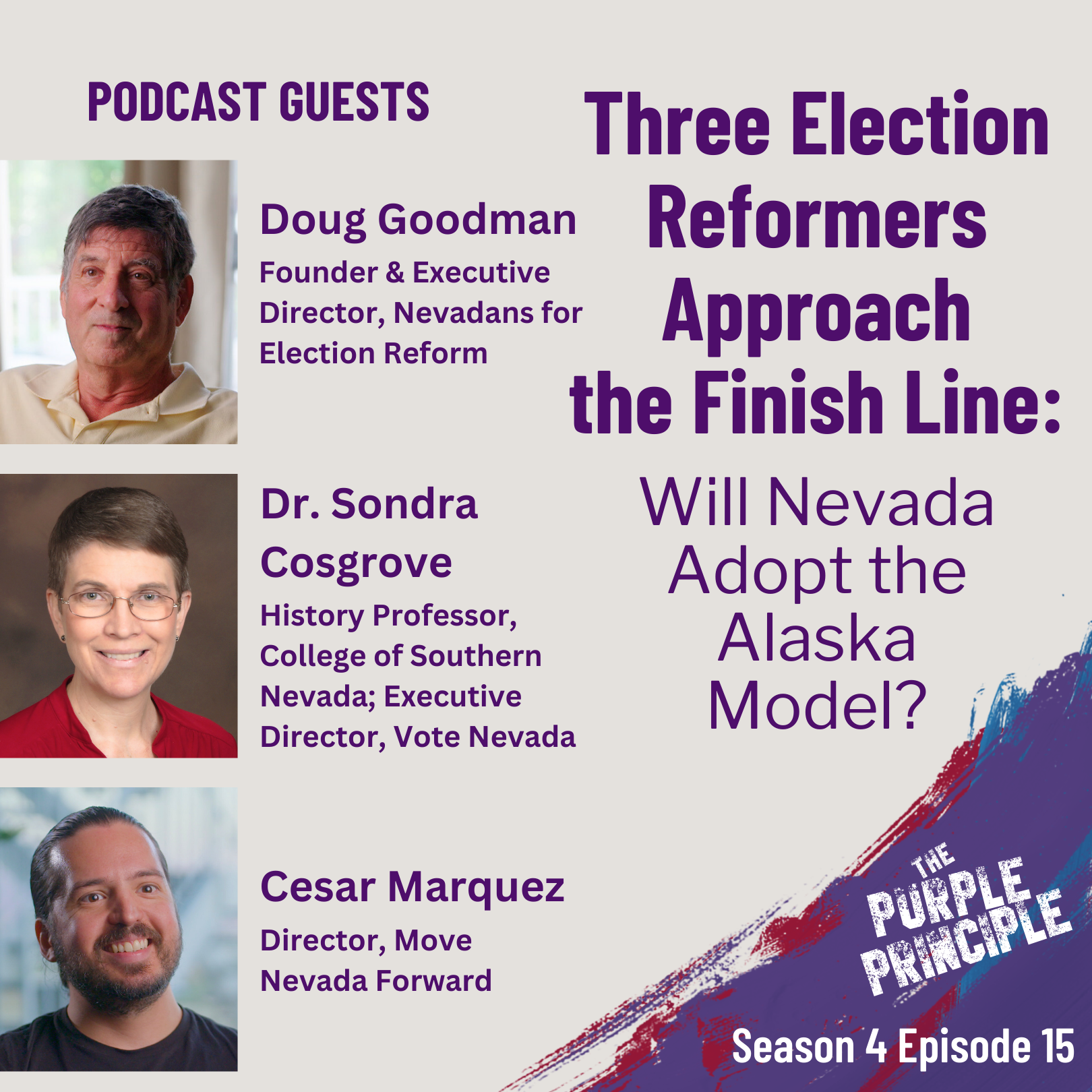
A former Tesla Engineer, Marquez is referring to his colleagues Doug Goodman of Nevadans for Election Reform and Dr. Sondra Cosgrove of Vote Nevada.
In This Episode
We learn how Goodman, a retired military veteran, began working on election reform in the Silver State a decade ago. Initially, Goodman lobbied extensively for legislative action before pivoting to the ballot initiative process. He recalls:
“One of the questions I was posing to business leaders at the time was, if you had a more open electoral system, could that be a tiebreaker if a company was considering moving to Nevada?”
Sonda Cosgrove, a history professor at Southern Nevada College, soon joined Goodman in that effort. She had noticed an alarming and counterintuitive trend in her efforts at Vote Nevada. Yes, more voters were registering to vote. But they were not voting in larger numbers.
“And so we started realizing that they were being turned off right at the get-go in the primary,” says Cosgrove.” That’s when.. .they were just kind of opting out.”
Marquez joined forces with Goodman and Cosgrove to place Final Five Voting on that 2022 ballot. But he came at political reform from a very different direction.
“The first thing I’ll say is that I never liked politics, I still don’t like politics,” admits Marquez. “ My background is in engineering, and I’ve worked in manufacturing for my whole career.”
What do a military veteran, academic historian and engineer turned reformer have in common?
Is ranked choice voting best demonstrated by a “rank the drink” event in English or “rank the taco” evening in Spanish?
The Purple Principles discusses these and other election reform questions in this latest episode of our season-long state election reform series. We began in Idaho then traveled to Washington DC, Alaska, South Dakota and Arizona, before landing here in Nevada.
The Purple Principle is a Fluent Knowledge production. Original music by Ryan Adair Rooney.
Watch Now: Episode Highlights of Nevada Election Reform
In this video highlight, hear our three featured guests talk about election reform and see Cesar and Doug in action as they facilitate ranked choice voting education events.
We will be posting new content each week to The Purple Principle YouTube channel, such as shorts, highlights, and previews for our podcast episodes.
Opening
Cesar Marquez (Guest): Red wine. White wine. Pink lemonade. Lemon seltzer. Modelo.
Cesar Marquez: Perfect. Ok. If everybody has their phones, we’ll scan the QR code and then you guys will drink and rank your drink.
Robert Pease (Host): Cesar Marquez demonstrating ranked choice voting at a rank the drink house party in Reno Nevada this summer.
Cesar Marquez: So in the first round, it looks like Modelo got five votes. Pink lemonade got two. Lemon seltzer got two. Oh, red wine got three. And then white wine was our extreme candidate who got zero votes. Right? That’s hysterical
Robert Pease: Marquez is one of a core group of grassroots leaders in Nevada hoping to push Final Five Voting over the finish line this November. Final Five Voting includes an open unified primary of all candidates with the top five advancing to a ranked choice general election. And Marquez is holding events like rank the drink or rank the the taco in both English and Spanish.
[Cesar Marquez explaining ranked choice voting in Spanish]
Cesar Marquez: Aquí se se eliminaba el taco de carnitas y la persona que ah, puso un taco de carnitas número uno, puso al birria número dos, verdad? Pero como todavía no ha, no ha ganado nadie con la mayoría se comienzo otra vez el el proceso.
Robert Pease: Among other grassroot leaders supporting this amendment is Doug Goodman a retired military veteran who got the ball rolling on ranked choice voting in Nevada over a decade ago.
Doug Goodman (Guest): Nevada was growing, it was changing from being a gaming centric economy.
Doug Goodman: And one of the questions I was posing to business leaders at the time was, if you had a more open electoral system, could that be a tiebreaker if a company was considering moving to Nevada?
Robert Pease: Doug is the Founder and Director of Nevadans for Election Reform and has worked on both legislative and ballot focused efforts.
Doug Goodman: We had started the conversation going and it just grew and grew to where it is now that we’re one vote away from implementation.
Robert Pease: Working closely with Marquez and Goodman is Dr. Sondra Cosgrove, a Las Vegas based history professor, who’s the founder and director of the non profit group Nevada Vote.
Sondra Cosgrove (Guest): We were registering people and then they weren’t voting. And so then if you’re an academic, you’re like, okay, there must be another problem. You know, how do we solve for X?
Robert Pease: Sondra has increasingly focused her efforts on the Final Five constitutional ballot amendment as a means of re-engaging voters and increasing turnout.
Sondra Cosgrove: And so we started realizing that they were being turned off right at the get go in the primary. That’s when they were getting turned off and were just kind of opting out.
Robert Pease: We’ll meet these three reform minded Nevadans on this episode of The Purple Principle, a podcast on the perils of polarization. I’m Robert Pease, and this season we’re chronicling state level efforts to depolarize our country through election reforms. Sondra, Doug and Cesar and others have pushed this effort close to the finish line despite opposition from both major parties. And that kind of effort takes many years of networking, lobbying and, of course, house parties.
Cesar Marquez: Yeah, well, how did you guys feel about the process, right? I don’t know. Was Modelo your second or third choice? Maybe you want to talk about, okay, my first choice didn’t win, but how did you feel that maybe your second or third choice won?
Speaker 5: Modelo was my second choice. I said red wine first. And I think I’m just excited that I don’t have to drink white wine cause that was the one I didn’t want.
Robert Pease: Let’s raise a glass to less polarized elections and learn about the origins of this effort with Doug Goodman. Soon after retiring from the Army and moving to Nevada he had an epiphany that might allow him to maintain his longstanding commitment to country over party but yet also vote in primary elections. That epiphany occurred well before the passage of RCV (Ranked Choice Voting) in Maine or Final Four Voting in Alaska but also involved opening primaries and creating ranked choice general elections.
Part 1 – Interview with Doug Goodman
Doug Goodman: Back in 2010, I’d been a registered Republican for over 30 years. At that time, I was maintaining my registration so I could vote in primaries. I was a registered voter in California at the time. And of course there, this was before they had the open primary, so still had to be. And then up to that point, then when we moved to Nevada in 2004, Nevada had closed primaries finally in 2010. I couldn’t do it anymore. Neither the party was not representing me, not even close. And being a military veteran, having served 20 years in the US Army, I made, to me what was probably one of the most difficult decisions I’ve ever made in my life. And that was to register nonpartisan, which in Nevada is what we call basically independence. Because I knew that what I was voluntarily giving up, I was giving up my right to participate in part of the election process. And so then in, I just got, there had to be something that could be done.
Doug Goodman: And that point I got with a friend of mine who was very well connected in the political community. He said, tell me a legislator who will listen to any idea, regardless how crazy it sounds, and give me honest feedback. He told me to go to this person who was actually my state assemblyman at the time, one of our most conservative legislators. And I broached the idea of a top three nonpartisan, open primary and ranked choice voting. And based on that conversation I said, “I’m going full bore.”
Robert Pease: So had they heard of this before? Were they familiar with ranked choice voting?
Doug Goodman: No, they had not heard of this before.
Robert Pease: And what was,
Doug Goodman: Given his history and everything, he was very much interested. But this was something that had potential. And so then I started contacting legislators, business leaders, and my first trip to Las Vegas in March of 2014, I had 19 meetings in four and a half days. Key legislators, business leaders. And so the result of all this effort was we actually had a bill filed by two Republican legislators to actually bring top three open primary and ranked choice voting to Nevada.
Robert Pease: So it seems like very early on you made a connection that not everyone makes…
Doug Goodman: There is a connection between open primaries and ranked choice voting. And let me also preface that non-partisan open primaries and ranked choice voting because there’s a difference. The traditional open primary is, you have to declare a party. You get to say, “I’m an independent, but I want to vote in the Republican primary. I want to vote in the Democratic primary.” You have to pick one ballot. In a nonpartisan, open primary, that’s where all candidates, regardless of party are listed on the ballot. So I think that’s a very important distinction to make, but there’s definitely a connection between open primary and ranked choice voting.
Robert Pease: Why do you think you were able to make the connection? Did it have something to do with the fact that you’d already been a member of both parties and you felt politically homeless?
Doug Goodman: I think that could have been part of it. However, I really think what was making the connection was the change in the political climate, that we started to see this change to a more hyper-partisan in environment where the potential for collaboration was diminishing, that it was more difficult for elected officials to work across the aisle on a common solution. And so I think elected officials knew that, they knew, or know that that partisan divide is preventing them from actually getting things done. But they’re under this conflict that if they want to be elected, they want to keep their elected position, they want the support of the party, they have to go along with the game, so to speak.
Robert Pease: So your efforts to through the legislature pass a bill with an open primary, a top three instant runoff was not successful, but shortly after that Maine passes ranked choice voting. Was that something that you followed?
Doug Goodman: What was even more of a confidence builder wasn’t so much Maine because Maine too, the thing with Maine, their state constitution was such that they really had to limit what they could do. And in fact, so what was more important was the number of cities, the number of local governments that were adopting this. This was even more important.
Robert Pease: Then when do you decide, well, perhaps more energy needs to be directed towards a ballot initiative. Is it after Alaska passes or is it even before Alaska passes?
Doug Goodman: Oh, this was before Alaska passes that we made the decision that there had to be initiative.
Robert Pease: I see. And you said we, is that a reference to, for example, Sondra Cosgrove or you were working with other team members at that time? Well,
Doug Goodman: That primarily would be Nevadans for Election Reform, which is me and Vote Nevada, which is Sondra Cosgrove.
Doug Goodman: She was one of my first meetings that I had when I went to Las Vegas. So she has been on board. We have been working and cooperating, collaborating with each other for 10 years at this point. So there was no moment that, oh, all of a sudden in 2018, let’s do this. This was just a developing effort. And the mechanics of it didn’t really materialize until 2021 when the idea of actually doing an initiative was picked up by Katherine Gehl and her Final Five group, and that’s where she was the one that actually started the process of the initiative, which is Question Three. They realized that Nevada was a player, that what was happening in Nevada was worth investing in. And so that’s where Question Three came about. But this was all, I think, a result of all the work that we had been doing that my self Sondra Cosgrove, other people who have been working with us have been doing up to this point, that’s why it was on Katherine Gehl’s radar.
End Doug Goodman Interview
Robert Pease: Doug Goodman there on the origins of this Nevada ballot measure, often called Yes on Question Three. We had Doug on the show back in 2022 before for the initial passage of this amendment, which needs to pass in 2 successive elections according to the Nevada Constitution. Doug has been tracking the strong growth of independent or unaffiliated voters in libertarian minded Nevada for a decade as has his reform colleague Sondra Cosgrove, Professor of History at the College of Southern Nevada. Her efforts to increase voter participation were being derailed by polarized politics, highly negative campaigns, and Nevada’s closed primary election system.
Part 2 – Interview with Dr. Sondra Cosgrove
Sondra Cosgrove: And then after every election, whether it was a midterm or a presidential election, after every election, the number of nonpartisan registrants spiked again and went up. So when we saw that kind of independent voter group getting larger, knowing that this is a closed primary state, we said we have to talk to these people and ask them, because you are opting out of the primary by doing this. Are you just not aware of that? And they said no. Most of them said, “we’re aware that we’re opting out, but the amount of negative campaigning is just too much. I just can’t take it. The political parties don’t seem to want to solve problems. They’re just fighting with each other.”
Sondra Cosgrove: So this means from about 2016 onward, we started looking at how do we diversify the number of voters turning out as far as ideology and age and everything you could think of. And both of the parties really pushed back. Both parties really said, no, we want to keep the primaries, you know, solidly closed. And so that kind of then set us up to say, especially to the Democrats, “why is this one reform that seems like it would be very good for people, not something you want to engage in?” And that’s how I became really involved in what is now ballot Question Three, which is open primaries and ranked choice voting.
Robert Pease: Yeah. So that’s a great summary of many years where the rise of independent voters and the rise of social media and polarization in general turned a lot of people off. So when did you first hear of ranked choice voting and do you remember your initial reaction?
Sondra Cosgrove: I actually heard about ranked choice voting in 2013. So Doug Goodman, who’s a gentleman who lives in Sparks, Nevada, had also seen that spike in 2012 of those non-partisans. And so he, like me, we didn’t know each other, but we were looking to try and figure out why. He had then gone to a conference in New York and had heard about ranked choice voting and its ability to help more moderate people run for office to kind of cool off the rhetoric. At that point, I was the president of the League of Women and Voters of Southern Nevada, and so Doug flew down to Las Vegas and we met, and that was the first time I had ever heard about it, and I was intrigued. I thought it sounded, you know, it had potential, but it just seemed like such a heavy lift. I didn’t know how we would be able to do it.
Robert Pease: And what was your first meeting with Doug like ? Was it really kind of a meeting of Kindred election reform spirits or did it take a while?
Sondra Cosgrove: Oh, no, no. I mean, I immediately went to my board and the League of Women Voters of Southern Nevada endorsed ranked choice voting at that point because Doug was wanting to do a ballot initiative then, or possibly see if he could get a legislator to sponsor it in the next legislative session. But I have to say, and he will tell you I did this, I kind of patted his hand and said, bless your heart. I mean I am there with you, but oh my gosh, the parties are going to fight back on this, which they did. But as it got worse and worse, more and more voters kind of opting out of the primaries, the primaries becoming more extreme, the more he and I engaged and the more we said, “no matter what the lift is, we have to do this.”
Robert Pease: And so you have all of that in mind. You’re watching the Alaska result. It’s pretty close, the fact that it barely passed there. Did it give you any pause, any concern about a full fledged effort in Nevada?
Sondra Cosgrove: No, because the ferocity of the opposition meant it was getting to what we needed to get to. If the opposition doesn’t care what you’re doing, then you’re probably not threatening them. And so when they pushed back so hard, that meant the thing that they were trying to protect the most, which is their power to control everything in the primary, was actually being threatened. And so I knew it was going to be a knockdown drag out fight. And oftentimes, historically, that’s the way big change happens. It wins just a little bit the first time and then it gains momentum after that.
Robert Pease: Well, tell us about that first successful 2022 campaign. Obviously it’s a constitutional amendment, Nevada, you require passage to successive election cycles. Tell us, was it difficult initially to get supporting organizations, to get funding, to get student interest?
Sondra Cosgrove: Yes and no. So all I had to do is first of all reach out to everybody that I work with who are also frustrated with the way our primaries run. They’re confusing, they block out too many people. We’ve all been talking about reforming the primary process. So that was easy to go concentric circle wise from our small circle to one, a bigger circle. But as soon as we filed the language, immediately we got ferocious pushback, especially from the Democrats. The Republicans were kind of within their own little worlds with some other stuff, but the Democrats came out and the first thing they said is that we were being racist because ranked choice voting is too confusing for people of color. And they did a press conference and I hadn’t seen the press conference. I knew it was happening though when I got a text message from a reporter that said, “did you just hear what they said?”
Sondra Cosgrove: And I said, “no. What did they say?” When I read the text message I said, “yeah, that’s racist.” He goes, “that’s what I thought too. Do you want to come over to the station and talk about that?” I said, “oh, absolutely.” I said, “if you’re going to go after any part of it, fine, but don’t say it’s too confusing for people of color.” That made me really mad playing the race card… And so we came out punching pretty quickly, especially me who is a community college professor because I spend all day every day explaining complicated things to people. And so when they said, well, people just can’t understand this, I’m like, well, if you explain it, maybe they can’t, but they can if I do.
Robert Pease: Well, how about Sondra, some of your personal conversations in this period, because I’m going to make an assumption here that many of your academic colleagues, perhaps majority of students, will tend to be left-leaning and the Democratic Party is against this. So what are those conversations like where you say, well, I’m afraid your party is getting in the way of an important reform here?
Sondra Cosgrove: A lot of my colleagues who are math professors use ranked choice voting in their classes to talk about how democracies run around the world and how math plays a part in that. My political science colleagues obviously aware of it. My students very excited about it because many of them are registered nonpartisan because the parties are kind of turning them off right now, but they want to be active and engaged. So being shut out of the primary is very offensive to them. When they saw that the Democrats were really strongly against this, I had students asking me, “why I don’t understand?” And then they’re like, oh, they just don’t want to give up power. And so then they would say to me, see, this is why we don’t trust the parties because you say one thing and then your behavior is something different. I kept trying to tell my democratic friends, you’re really hurting your brand by doing this.
Robert Pease: And Both parties are actually opposed at the national level, there’s very strong Republican opposition to ranked choice voting.
Sondra Cosgrove: But not here.
Robert Pease: So in your experience, the Nevada Party has a bit of independence from the national position.
Sondra Cosgrove: So on the Republican side, our Governor Joe Lombardo, he’s a very moderate Republican and I worked with him on redistricting reform. I’ve worked with him on mental health initiatives. I’m pretty good friends with him. And he basically said to me, “I also think it’s kind of confusing, but I think the voters should decide. And so I think myself and our party, we’re just going to say the voters should decide.”
Robert Pease: Well, that’s great. So how did you feel as election night approached in 2022? Were you pretty confident? Were you seeing polls that indicated it was going to pass or were you apprehensive?
Sondra Cosgrove: We were sure we were going to pass. We just didn’t know by how much because we also had in 2022 ballot question one was an equal rights amendment put into our state constitution, Ballot Question two was raising in the minimum wage, and we were ballot question three. So I had been in a lot of spaces with women especially that were saying, vote yes on all three. And so we knew that a lot of women were going to turn out and vote yes on one. And if they turned out to vote yes on one, they were going to vote yes on all three.
Robert Pease: So it then passes and you can’t fully celebrate. I suppose if you know there’s another hurdle in the very near future, but what are the particular challenges for passing in two election cycles consecutively?
Sondra Cosgrove: To be truthful, we were glad we got another bite at the apple. We tried to make sure we went to every club, caucus, small group meeting that we possibly could because we knew with the ballot question that was complicated, we needed to have personal conversations with folks so they could ask questions and then we could clarify for them.
Sondra Cosgrove: These are our friends, these are the people we live with. We owe them an honest response. So we’ve spent the last two years talking about nothing but ranked choice voting. So right now, we feel very comfortable that everybody that said, you lied the last time or said, I don’t understand it. At least even if they say I don’t like it and I’m voting no, they can at least explain why they at least understand ranked choice voting.
Robert Pease: Well, let’s talk about some of the other elements of opposition from both parties. Perhaps Democrats have more resources or more to lose. What are you seeing about messaging against question three in 2024?
Sondra Cosgrove: Nothing. And here’s why. So they started out by saying, oh, the ballot initiative is just from people outside of the state. And then I list all the ballot initiatives that they just worked on, like the abortion protection ballot initiative that was just paid for by the governor of Illinois. And I said, you guys do the same thing. So that comes off the table. They said, it’s a bunch of outsiders. Notice that when I first introduced myself, I moved here in 1986, I teach Nevada history. I’m from here, I’m in Nevadan, so is Doug. They can’t do that. So every argument they had against us, we pulled off the table.
Sondra Cosgrove: So we were at this kind of stalemate where no one was really saying anything, and then Kamala Harris became the presumptive nominee on the Democratic side. And if she’s going to win in Nevada, she’s going to need independent voters to vote for her. She can’t do that if she comes in and basically calls them dumb and tells ’em they can’t understand ranked choice voting. So we don’t think there’s going to be any opposition from the Democrats from this point going forward.
Robert Pease: And how about from Republicans?
Sondra Cosgrove: They’ve said not one word at all. Okay. There’s a little bubble of opposition on the MAGA side, and it’s coming from the Heritage Foundation. The Heritage Foundation just sponsored an event in Reno and they just sponsored an event here.
Robert Pease: Well, you mentioned your first meeting with Doug Goodman. Can you tell us about your first meeting with Cesar Marquez and did you immediately feel like this is somebody who could help put question three forward.
Sondra Cosgrove: When Doug and I were having conversations with the folks from Alaska, with Katherine Gehl’s group, with United America, we were obviously thinking we’re going to have to build out a grassroots team. We weren’t sure who in the progressive community that we had worked with before would want to be in the firing line. And so that’s when we started looking on Twitter and on Instagram to see who was kind of in the general space. And that’s when we noticed Cesar because he had been with a Yang gang, and so he was a big supporter of Andrew Yang. And so Doug and I were aware of who he was before we even talked about ballot question three. So we reached out. He was up in Sparks with Doug, so Doug reached out and said, “Hey, can I take you to lunch?”
Sondra Cosgrove: Maybe you would be interested in being on the team soon as we explained it to Cesar. He’s like, oh, absolutely. And so it’s been kind of a give a take. And so there’s a lot of reciprocity because he’s obviously Latino, he speaks Spanish, he’s younger, but doesn’t have any experience in how to navigate the waters of a ballot initiative Doug and I do.
End Dr. Sondra Cosgrove Interview
Robert Pease: Dr. Sondra Cosgrove there of the College of Southern Nevada and the organization Vote Nevada with some insights into potentially reduced opposition to Ballot Question 3 in Nevada in 2024, as it nears final passage. Again according to the Nevada law, constitution reforms like Ballot Measure 3 need to pass in two successive elections. That’s a lot of effort.
Robert Pease: Over many years of working on this issue Doug Goodman and Sondra Cosgrove have helped attract other younger reformers to the effort, including Cesar Marquez, a former Tesla engineer . And like so many involved in these non partisan reform efforts, the motivation for Cesar’s entry into politics was his distaste for politics.
Part 3 – Interview with Cesar Marquez
Cesar Marquez: The first thing I’ll say that I never liked politics. I still don’t like politics. I don’t like bureaucracy. My background is in engineering, and I’ve worked in manufacturing for my whole career.
Cesar Marquez: So in 2019, I found Andrew Yang through Joe Rogan’s podcast, and his message really resonated with me because he started talking about the rise of automation and why we needed this universal basic income. And because I worked at Tesla at the time, that’s the reason why I moved to Nevada, that I saw firsthand how these robots were just getting better and more efficient and just automating jobs.
Cesar Marquez: So I was part of the “Yang Gang”, that’s kind how I started politically 2019, 2020. And then when Andrew Yang dropped out, I felt, well, just because he dropped out does not mean that the problems he ran on are going to go away, right? And so I just sort of narrowed my scope a little bit where getting somebody elected as President, that’s pretty hard, but maybe I can just focus in Nevada. Nevada’s a relatively small state compared to the other ones that I lived, and I felt like I could make an impact. So after the presidential or after the election, me and some of the local Yang Gang from Vegas, we created this nonprofit, Move Nevada Forward, and at the time, our biggest, we were more focused on universal basic income, but we really liked ranked choice voting because that was one of the policies that Andrew supported, actually, that is how I learned about ranked choice voting through just looking at his policy page.
Robert Pease: Well, tell us about your first thoughts when you hear about Ranked Choice Voting, because a lot of people, when they hear about it for the first time, the fireworks don’t go off. It’s like what is this? So what was your first reaciong?
Cesar Marquez: I mean, to me, it just made sense, right?
Cesar Marquez: It made a lot of sense to me because like I said, I’m an engineer, I’ve worked in manufacturing, and so I always started to think of things, terms of systems, and when I saw ranked choice voting, I was like, oh, this is actually addressing the problem at the root cause. It’s the incentive structure that is messed up. So once I understood that, so somebody has to win with the majority, then that’s going to change the way that politicians are going to campaign the way that they’re going to talk to people.
Robert Pease: So in that campaign, and Andrew Yang did excite people for a period of time, and that fizzled as it always does. Was that part of the reason why you were looking for a more open, less major party constrained situation because you thought this guy has value and it’s just kind of going to waste?
Cesar Marquez: Well, I think because I was pretty involved starting in 2019, and at the time he was relatively unknown. I think the Joe Rogan interview was one of this, give him a huge bump, but the mainstream media did not give him any air. They would mess up his name. At the debates you saw that he had two minutes. And so I got to kind of witness all of that, and that really turned me sour on the Democratic Party because it was not a fair competition. They were tilting the election to help whoever they approved of. And so at that point, that’s kind of when I realized the whole system is pretty messed up and we have to change it.
Robert Pease: So 2020, the Alaska ballot measure passes. Were you aware of that at the time in 2020?
Cesar Marquez: So I became aware that Alaska passed Final Four voting by watching Andrew Yang’s podcast. He had Katherine Gehl. And that’s when they brought up that, hey, there was a state already that passed it. And that kind of got me excited because somebody actually did it. So one of my volunteers actually had been in contact with somebody from the Institute for Political Innovation, which is Katherine Gehl’s organization, and he connected me with one of their staffers, and we set up a meeting.
Cesar Marquez: At that point in my life, I was doing pretty good. I was working as a production supervisor at Tesla. My parents are from Mexico. I had bought a house, and so I had achieved my version of the American Dream, but then when I looked around, and this was in the middle of the pandemic, my people were some of the ones who were suffering the most. And so it just didn’t feel right to be like, “Hey, I’m doing great,” and then everybody else is literally dying and suffering. So to me, it was like, well, I have to do something. I have to at least try. And that’s when I decided, well, I think this thing is doable. If Alaska hadn’t done it, maybe there’s a chance that I would’ve been like, you know what? It hasn’t been done before. But to me, I just need to know that it can be done once. And to me, well, that can be replicated. So yeah, that’s where I felt confident that it could be done. I knew it wasn’t going to be easy. I mean, we still haven’t finished it, but yeah, I mean, I grew a little bit more confident by the day.
Robert Pease: Okay. So let’s talk about some significant, memorable, interesting conversations you had during that first 2022 campaign here in Nevada.
Cesar Marquez: Sure. Okay. So I mean, I remember the first two years it was very difficult to get people on board because I understood the concept, but explaining it to somebody else in a way that they’re going to understand it, that was difficult, especially for me because I’m a very technical person. I think of those kind of terms of the tabulation process and all this engineer or more just technical stuff, but a lot of people don’t want to hear that. They want to hear maybe the benefits or they want to hear how it’s going to help their party or whatever. And so kind of selling the idea to people in a way that they want it. I kind of struggled because I didn’t have the language.
Cesar Marquez: I think one of the things that help were having visuals, if I just say it with words, that’s the thing. If I just explain it through words, most people get completely lost. But we’ve been able to find some websites that actually walked through the tabulation process. And so I think once some of those tools started coming in, people started having the aha moment when they saw, for example, when the candidate gets eliminated and then they see the votes being spread out to the rest. That’s a very powerful visual that I’ve seen has worked on people. .
Robert Pease: How confident were you as Election Day approached in 2022?
Cesar Marquez: I was cautiously optimistic, but I did know that 2022 I think was the harder one compared to 2024 because it was midterm elections. So the polling that we were getting at the time had us in winning, but it was very, very tight. We would hear from 52-48, sometimes it was like 51-49. And so we weren’t resting on our laurels at all during that time.
Robert Pease: And how did that feel once you knew it had passed?
Cesar Marquez: I felt great. I mean, spending two years and then seeing that you knocked out probably the hardest obstacle.
Cesar Marquez: But now after we won me, Sondra, Doug and I, and so many others wanted to talk about ranked choice voting, and we felt, okay, now we have two years to do voter education and talk to people about ranked choice voting. And so the presentation that we did today, we wanted to do that times a thousand. And I felt like there was a really good opportunity to get resources to volunteers and empower them to be able to host their own events. The idea was like, Hey, you can sit down with your family and have a ranked choice voting poll about what Netflix show you’re going to watch. And so we wanted to mainstream it in the sense that we wanted to make it part of our culture. Like, Hey guys, we already use ranked choice voting when we decide what restaurant to eat at.
Robert Pease: So tell us about outreach here in Nevada to the Hispanic community and this idea that for many Hispanics, particularly recent immigrants, neither party really fits them very well. And so maybe they’re more open to alternatives.
Cesar Marquez: Sure. Okay. Yeah. So because I’m Mexican American, I lived in Mexico for seven years, I’m fluent in Spanish. And a big reason why I started doing this whole thing in the first place was to uplift my community. So I felt confident that Latinos would support it [Ranked Choice Voting] if we explained it to them and understood it, in part because we’re not really loyal to the parties. We’re also used to having more than two parties. When we talk about the two party system, to us it’s like, wait, why is that even a thing? And I actually use that, “Hey, if we pass open primaries and ranked choice voting, it’s actually going to give third parties a fair chance to participate.” And so they really understand that concept because they’re used to a multi-party system.
Cesar Marquez: I think just looking at the numbers, Latinos, young people, young Latinos are some of the most independent because we’re not loyal to the parties. I kind of grew up being a Democrat, but ideologically, I’m more of a libertarian, and I’m conservative in some ways. I lived in Mexico, I grew up Catholic, and so I hold those values dear to me. But then I also have a ton of liberal values as well. And so we’re used to, as Latinos, we’re used to just living with your conservative dad and your conservative mom and your uncle, but you still love family. And so just seeing how the American culture, people, families get split because one person supported the other, a different candidate. So from my Latino cultural values, to me, that kind of stuff doesn’t make sense. And yeah, I think because we’re not loyal to the parties, we want to vote for whoever’s going to deliver results.
Cesar Marquez: That has been sort of my approach to present open primaries and ranked choice voting as one of the real solutions that can help us solve some of the other problems. So one of the arguments that I use, “Hey, Latinos, you care about immigration? Well, the current system is not going to allow for collaboration between Democrats and Republicans. Why? Because with the current close primary system, a Republican candidate is likely to get primaried out if they support some sort of immigration or even just seen collaborating with the other person.” And so a lot of Latinos ask themselves, why is this so dysfunctional? Why is it so extreme? My hope is that they’re going to be excited when they hear that there is a solution.
End Cesar Marquez Interview
Closing
Robert Pease: Cesar Marquez there, one of the grassroots leaders behind the Nevada Final Five voting reform facing a final ballot hurdle this year. Having passed by 6 points back in 2022 there is some confidence among this group that Ballot Question 3 will pass again in 2024. But there is also concern about misinformation spread around the ranked choice voting aspect of the measure– thus the interest in educating as many groups and voters as they can on rcv before voters go to the polls.
Robert Pease: We’ll check back with this group just before and just after the November vote. But next time on the Purple Principle we’ll travel to Oregon, the very first legislature in the country to pass ranked choice voting for state elections, though by referral to a ballot initiative. That means Oregon voters do have the final decision this November. But we’ll hear from former house speaker Dan Rayfield how Oregon arrived at this historic and norm breaking point where a dominant party, Rayfield’s Oregon Democrats, voted in favor of more competitive elections:
Dan Rayfield: So when I got into the legislature, I had a title and I thought, well, hey, let’s start exploring doing some local reforms in my own personal county and actually passed it in 2016, which then was implemented in 2020. And then in 22 when I was Speaker, we really continued to build the institutional knowledge to then get it passed in the legislature. But I will say I’ve made it sound so much easier than it really was. It’s been a long journey and I think there are many times on the road that we didn’t really appreciate how challenging it would be and whether or not we could actually get it passed in the legislature.
Robert Pease: We hope you’ll tune into that episode, share us on social media and subscribe to our Youtube page for video highlights from all episodes in this nonpartisan state election reform series.
Robert Pease: The Purple Principle is created by a talented team of media reformers: Kevin A. Kline, Sr. Audio Engineer; Vienna Maglio, Bookings & Field Producer; Trevor Prophet Digital Ops & Strategy; Mary Claire Kogler, Video Production; and Sarah Kim, fact checking & research.
Robert Pease: The Purple Principle is a Fluent Knowledge Production. Original Music by Ryan Adair Rooney.
Our Guests:
Doug Goodman, Founder & Executive Director Nevadans for Election Reform
Dr. Sondra Cosgrove – History Professor, College of Southern Nevada; Executive Director, Vote Nevada
Cesar Marquez – Director, Move Nevada Forward
Join Us for Premium Content:
Apple: https://link.chtbl.com/PurpleApple
Patreon: patreon.com/purpleprinciplepodcast
Find us online:
Twitter: @purpleprincipl
Youtube: @thepurpleprinciple
Facebook: @thepurpleprinciplepodcast
Instagram: @thepurpleprinciplepodcast
Our website: https://fluentknowledge.com/shows/the-purple-principle/online-conspiracies
Subscribe to our newsletter: bit.ly/3wDbr4o
Social Media from Guest Organizations this Episode:
Twitter: Nevadans For Election Reform
Twitter: Vote Nevada
Twitter: Move Nevada Forward
Additional Resources / Fact Checking:
Nevadans for Election Reform
Vote Nevada
The Nevada Forward Party
How does California’s “Open Primary” work?
Primary elections in Nevada – Ballotpedia
Ranked Choice Voting in Maine
Sondra Cosgrove’s ACLU Biography
Nevada’s Voter Registration Statistics
Sondra Cosgrove’s Vote Nevada Biography
Nevada Election Results 2022 – Ballotpedia
Both parties oppose November’s ranked-choice ballot initiative – Las Vegas Review Journal
Nevada open primaries, ranked choice voting comes under fire as civic groups speak out – News 3 Las Vegas
GOP National Resolution to Oppose Ranked-Choice Voting
Is Automation Threatening American Jobs? Democrats Debate – NY Times
Andrew Yang had less than 3 minutes of debating. Here’s what he’d say if he had more – Miami Herald
Joe Rogan’s Interview with Andrew Yang
New, Younger Latino Voters are Driving Shifts in Latino Voter Sentiment – Unidos US